Get Full Government Meeting Transcripts, Videos, & Alerts Forever!
Get email alerts on the Special Education topic
No spam. Unsubscribe anytime.
Katy ISD outlines special-education programs, notes steady enrollment growth and new behavioral supports
Summary
Assistant Superintendent Dr. Gwen Coffey presented an overview of Katy ISD special-education services Feb. 24, describing program types, related services, and classroom counts while trustees asked questions about program capacity and staffing.
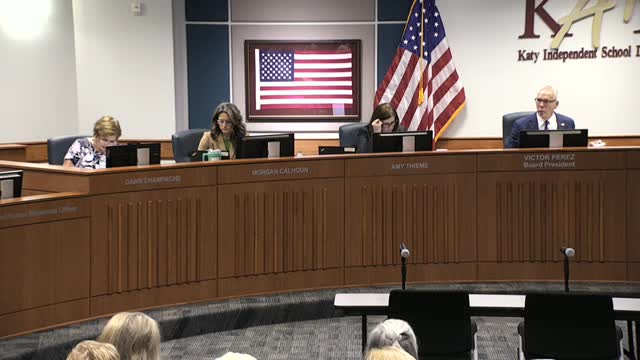
Dr. Gwen Coffey, assistant superintendent for special education, presented an overview of Katy ISD’s special-education continuum and related services at the board’s Feb. 24 meeting, outlining the district’s program types, placement approach and recent growth in special-education enrollment.
Coffey described special education as an individualized set of supports and instruction governed by federal and state law, including the Individuals with Disabilities Education Act (IDEA), which guarantees a free appropriate public education in the least restrictive environment. “There is no one size fits all in special ed,” Coffey told trustees, and she walked the board through the district’s identification, evaluation and IEP/ARD processes.
The presentation included program and classroom counts. Katy ISD reported 55 monolingual and 13 bilingual ECSE (early childhood special education) classrooms. The district has 46 elementary life-skills classrooms and 47 at the secondary level. Coffey described structured programs that apply principles of applied behavior analysis (ABA) in instructional settings; she said Katy ISD does not provide ABA therapy as a medical service but uses ABA principles in education. The district operates multiple specialized program models (Coffey used program names and acronyms in her presentation), and she gave these examples: 8 ECAP (early childhood programs), approximately 40 YCAP elementary programs, 20 elementary ASIP classrooms and 12 secondary ASIP classrooms, 41 RISE classrooms at the secondary level, and 10 adaptive-behavior (AB) classrooms at the elementary level with a secondary equivalent (BTP).
Coffey said related services — a label under IDEA that includes speech, occupational therapy, counseling and other supports — are determined by the ARD committee and delivered as required by a student’s IEP. She highlighted that Katy ISD hosts the Regional Day School Program for the Deaf (RDSPD) and also Project Hike, an early-intervention program for infants and toddlers; she said Katy ISD is one of two districts in Texas that host Project Hike.
Trustees asked questions about capacity and staffing. One board member noted the district is nearing 20% of enrollment identified for special education; Coffey and her team said that rise is attributable to a number of factors, including district growth and state policy changes such as expanded dyslexia identification. Coffey estimated the Behavioral Learning Center (BLC) could serve roughly 200–300 students in a year once fully operating and described the district’s placement continuum from general-education supports to more specialized settings.
Board members thanked Coffey and her staff for the work. Trustees asked about teacher shortages and whether the district could add special-education tracks to its existing “grow-your-own” teacher pipeline; district staff said the program aims to expand and that special education was being considered for addition in a future cohort.