Get Full Government Meeting Transcripts, Videos, & Alerts Forever!
Get email alerts on the Church Security Immunity topic
No spam. Unsubscribe anytime.
Committee rejects bill to codify immunity for volunteer church security teams
Summary
The House Judiciary Committee debated House Bill 1306, which would have codified civil immunity for volunteer church security teams conditioned on training. After witness testimony and committee questions, a motion to pass failed on a roll call and the bill did not advance.
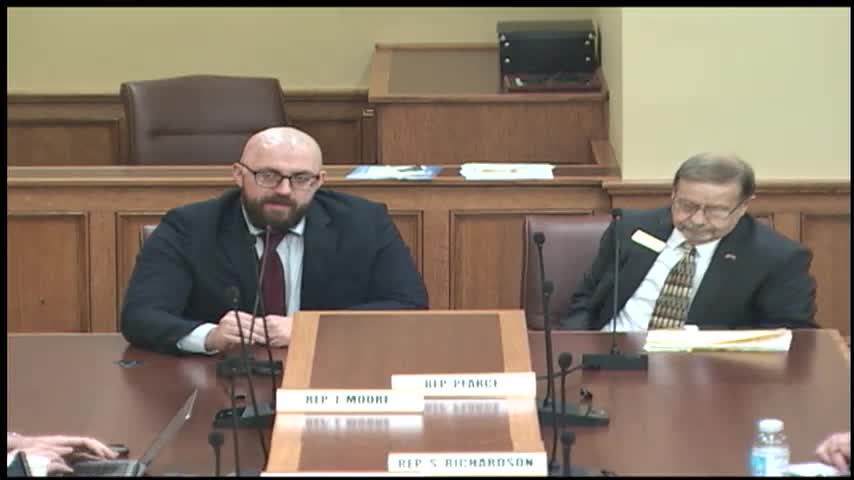
Representative Tony Furman, R.-District 82, introduced House Bill 1306, a measure that would codify and tighten civil-immunity protections for volunteer church security teams provided the volunteers complete training the congregation requires. The Judiciary Committee discussed the bill at its October hearing, with testimony from faith leaders, a retired FBI agent and an active police officer, and questions from multiple committee members. The committee ultimately voted not to pass the bill.
The bill’s sponsor, Representative Tony Furman, said the measure was intended to address a chilling effect he’d heard from church leaders worried that volunteers would be sued if they acted to protect congregants. “A lot of pastors and leaders and church staff have reached out to me and said that they're afraid to even use the security they have if they need it because they're afraid of being sued,” Furman said during his presentation. The bill would require some form of training before immunity applies, but it left the content and provider of that training to the congregation.
Supporters testified the bill filled a gap for congregations that rely on unpaid volunteers rather than paid security or on-site law-enforcement officers. Michael Thompson, a retired FBI special agent who volunteers as a church safety-team leader, told the committee that some states — he cited Texas and Idaho — had enacted similar protections and that volunteers face “a huge civil liability gap.” Michael Peyton, an active police officer and longtime church security volunteer, told the committee volunteers needed protection beyond existing immunity around deadly force.
Committee members pressed the sponsor on several points tied to the training requirement and the bill’s interaction with existing law. Representative Ernesto O’Cline questioned whether the bill’s training language—“requires training”—would give a trier of fact any standard to judge adequacy, noting the draft did not use an adjective such as “adequate.” Representative Furman answered that his intent was for training to be meaningful and for courts to resolve inadequacy claims as fact issues, but acknowledged the bill text did not explicitly include the word “adequate.” Representative Tash asked whether the 2015 civil-liability protections tied to self-defense law would be affected; Furman said he had sought an attorney-general comparison and believed there was no conflict because HB 1306 was narrowly tailored to volunteer church teams.
Representative Dolby opposed the bill on principle, saying charitable-immunity doctrine already covers churches and warning that carve-outs for specific groups could prompt additional special provisions. After discussion, Representative Tosh moved to “do pass.” Committee chairs first took a voice vote, which the chair said favored the noes; the committee then conducted a roll call. The chair announced the bill had failed.
The measure drew testimony from law-enforcement and security practitioners who said volunteers often arrive on scene before deputies and that fear of civil suits discourages volunteers from stepping forward. The sponsor and witnesses said the bill would not create new rights but would codify protections that exist under common-law charitable immunity and the 1987 Volunteer Immunity Act while adding a training condition. At least one committee member pressed for precise statutory language about when criminal prosecution would affect civil immunity claims; the sponsor said the bill did not specify prosecutorial procedures and anticipated courts would sort those issues when cases arose.
Votes at the committee showed a roll-call following voice vote opposition; the chair announced the bill failed on the roll call and the bill did not advance from committee. The committee record contains a roll-call transcript in which members recorded affirmative and negative votes; the chair announced, “Representative Furman, your bill has failed.”
The hearing record shows advocates urging the panel to adopt statutory clarity for volunteers who provide security at houses of worship, and opponents cautioning against statutory carve-outs when common-law protections already exist.
The bill received extensive questioning about training standards, possible interaction with criminal prosecutions, and whether codifying the protection would have unintended consequences for other volunteer groups.
Representative Furman closed reiterating the bill’s limited scope and asked members for a favorable vote; the committee instead declined to advance the bill.