Get Full Government Meeting Transcripts, Videos, & Alerts Forever!
Get email alerts on the Capital And Infrastructure topic
No spam. Unsubscribe anytime.
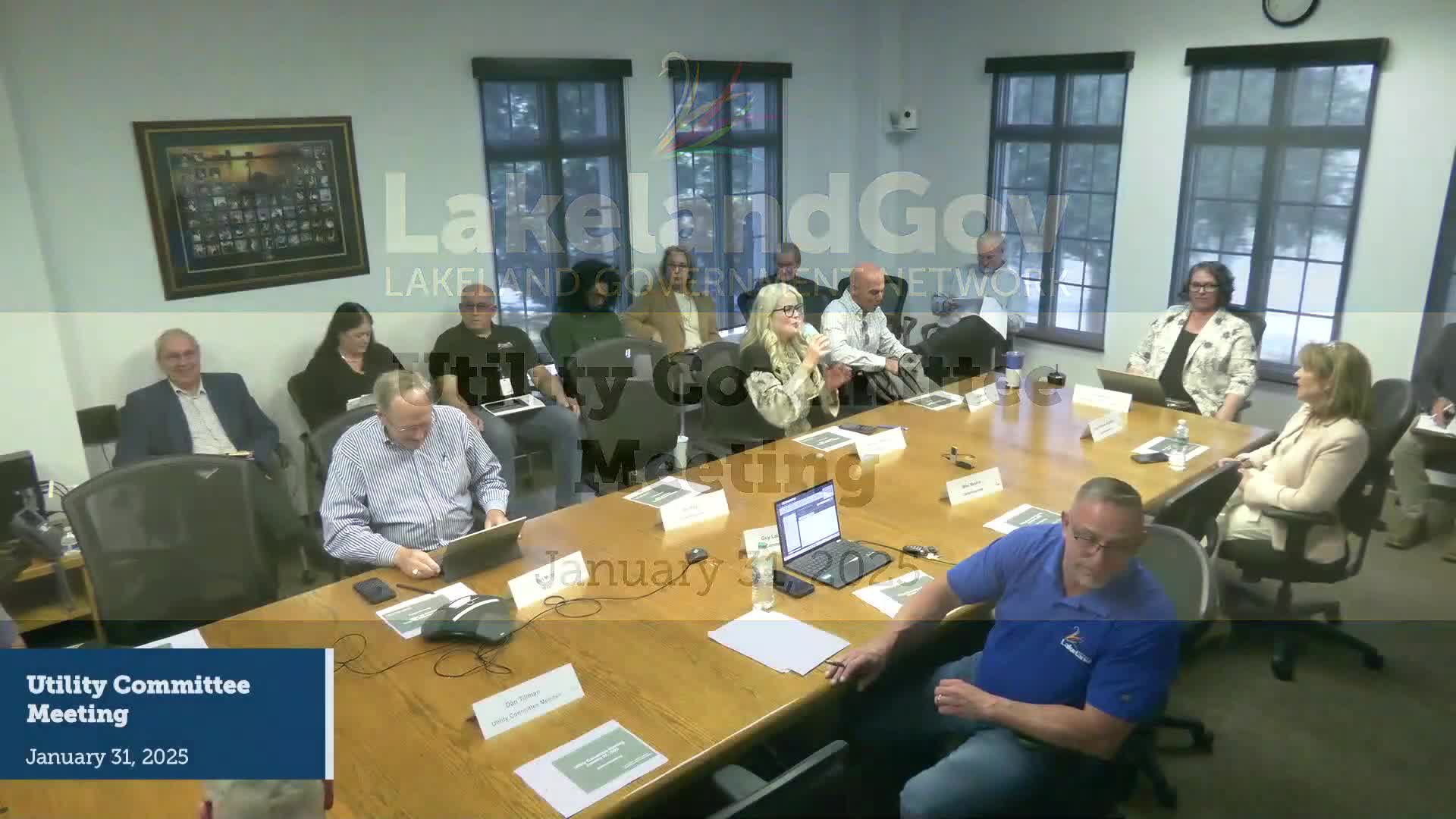
Lakeland utility committee reviews capital plan, undergrounding and Unit 5 outage; approves outage contracts
Summary
Lakeland City staff presented a 10‑year capital forecast, described a planned 72‑day outage for Unit 5 and discussed undergrounding and storm‑hardening priorities. The committee approved two contracts to support the Unit 5 outage.
Lakeland City Utility Committee members heard staff explain how annual capital budgets are spent on generation maintenance, delivery hardening and technology modernization, and approved two contracts tied to a planned Unit 5 outage.
General Manager Munson told the committee that all six new engines are commissioned and ‘‘we literally have got, things going down to the wire on these … units,’’ while also warning there remain early maintenance issues on Unit 1 and Unit 5 that staff are addressing. Munson said the city will run the six engines together in a proving period, then shift into a maintenance phase for the young units.
Tory, production lead for capital and production, told the committee the utility’s total capital budget is roughly $46,200,000 and that production and delivery each account for about half of annual capital. ‘‘Our capital budget is fairly pretty flat,’’ Tory said, explaining the utility expects modest year‑to‑year increases and that much spending on production is driven by hours and starts on large units.
The committee heard a technical update about Unit 5: staff said a planned major outage will run Feb. 2–May 4 (a 72‑day outage) to perform required major maintenance on combustion and steam sections. Dave Holmer, identified in the transcript as a plant manager/manager‑type role, said staff found a damaged anchor bolt in a foundation during preparations and are conducting hardness and contamination tests to determine if the problem is isolated or requires adding properly specified anchor bolts. Holmer said test results were expected in about a week and that staff would return with a repair plan.
Scott Bishop, assistant general manager for delivery, framed undergrounding and storm hardening as a reliability‑driven, prioritized set of projects. ‘‘The standard going forward, where possible and always, is an underground solution,’’ Bishop said, while noting undergrounding existing neighborhoods requires customer engagement, property easements and a customer share for service changes. He said the utility already serves about 40% of primary miles with underground primary and described recent neighborhood projects where property owners contributed to the cost of moving meter services and installing pad‑mount transformers.
Bishop outlined delivery‑side capital categories: tools/equipment/fleet; reliability work (reclosers, sectionalizing); pole replacement/storm hardening; and large technology lifts (asset/workforce management, engineering design tools and meter/data systems). He said the delivery budget includes about $8 million for crews, fleet and equipment and about $3.1 million annually for reliability work.
On alternative projects and partnerships, Munson and staff reported that Block Energy has withdrawn from the microgrid business and will not continue planned microgrid deployments. Staff said the Edge Solar project remains active with Williams (a private developer) continuing development work; Williams has proposed doing an economic analysis — at no cost to the city — of adding battery storage to the Edge Solar sites. Mike Dammer (identified in the transcript as Master of Origin Technology) and staff said Williams remains committed to the Edge Solar investment and the company is proceeding with interconnection work.
Votes at a glance
- Task authorization with IEM Energy Consultants for outage engineering support services (not to exceed $183,705). Staff said the work will provide oversight and review of inspection and repair work during the Unit 5 outage; funding is included in Electric FY25. The committee approved the authorization by voice vote; individual tallies were not recorded in the transcript. Outcome: approved.
- Agreement with RMS Energy for isolated phase bus testing, evaluation and repair services for Unit 5 (not to exceed $354,399). Staff said the request for proposals produced a lower bid that took exceptions, so the recommended award went to RMS Energy. Funding is included in Electric FY25. The committee approved the agreement by voice vote; individual tallies were not recorded in the transcript. Outcome: approved.
Why this matters
Committee members said the presentation was meant to explain tradeoffs between production and delivery capital needs, why undergrounding is used selectively, and how limited annual capital constrains the pace of hardening. Staff urged the committee that expanding undergrounding beyond new developments requires customer buy‑in and that many reliability improvements come from targeted circuit work, pole replacements and sectionalizing.
What’s next
Staff will return with test results and a repair plan for the Unit 5 anchor bolt matter, proceed with the scheduled Unit 5 outage planning and execute the approved task authorization and agreement. Staff also said they will continue to pursue competitive purchasing, directional boring and other tactics to reduce unit costs for undergrounding projects.