Get Full Government Meeting Transcripts, Videos, & Alerts Forever!
Get email alerts on the Building Permits Fees topic
No spam. Unsubscribe anytime.
Building-permit fee study proposes tiered charges as city weighs budget impact
Summary
City staff presented a consultantbacked proposal to shift building-permit fees into five tiers, aiming to raise fees on small jobs and reduce rates for very large projects; staff said the change would be studied further and presented to City Council before implementation.
City staff described a proposal to restructure building-permit fees into five valuation "tiers" that would raise fees for many small projects while cutting permit charges for the largest developments, and said they will analyze budget impacts before taking the plan to City Council.
The proposal, presented during the Fort Myers City Community Development/Building Division meeting, was framed by Greg (presenter) as an attempt to address a perceived imbalance: "we are getting not enough money for the smaller projects to cover our costs, but we're taking way too much money for the bigger projects." Program and fiscal manager Beth Stark told the board that combined general fund permit revenues for the four months ending Jan. 31, 2025, totaled $2,038,833 and were 54.9% of the $3,710,000 budget.
Why it matters: The Building, Planning and Inspection (BPI) fund carries a large reserve and has been running revenue surpluses driven by major permits. The fee study aims to align permit charges with the actual staff and inspection workload so smaller residential and repair permits do not rely on large commercial projects to keep the division solvent.
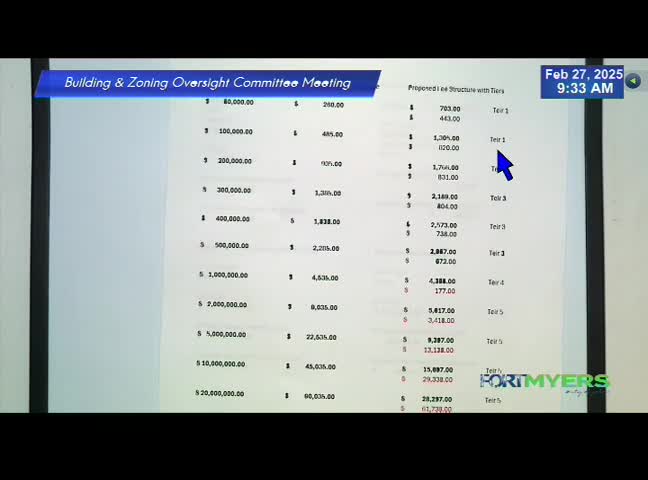
Under the consultant's examples, a small residential renovation with a $48,000 valuation that previously produced $251 in BPI fees would move to a proposed tiered fee of $678; a new single-family home with an $800,000 valuation that previously generated roughly $5,454 in BPI fees would see a proposed fee of about $3,798. Conversely, several very large commercial projects would pay substantially less under tier 5 (an example $370 million project would pay under $500,000 instead of more than $2.5 million under current fees).
Staff, board members and other speakers pressed for more detail on how the study accounted for division-wide overhead and for types of inspections that the city does not perform when a threshold inspector is required. Brent Brewster, the city's building official, noted that many very large projects — including the hospital project discussed at the meeting — are subject to threshold inspection by a third party or state-credentialed inspector, which reduces the number of inspections BPI must perform: "They have to use a threshold inspector by law...we don't duplicate those inspections." Beth Stark confirmed the figures presented at the meeting were BPI-only and did not include engineering, fire, planning or other permit-related fees.
Board members and staff said they favored several elements of the proposal, including flat fees for single-inspection permit types (for example, re-roofs, AC change-outs, irrigation and small fence permits) and agreed on the need to verify whether the tiered structure would cover total BPI costs across all functions. The group discussed using reserves to phase in changes if needed. Steve Bell, community development director, said staff would take a deeper financial review before bringing the ordinance or fee schedule to a council workshop.
The board did not vote on a fee schedule at the meeting. Members asked staff to present a refined financial analysis showing the effect of the tiers on BPI's budget, the city's overall permit revenue, and the projected reserve trajectory before any implementation decision.
Ending: Staff said they will return with a deeper cost allocation analysis and a recommended outreach/presentation plan to City Council; no implementation timeline was set at the meeting.