Get Full Government Meeting Transcripts, Videos, & Alerts Forever!
Get email alerts on the Maintenance And Conservation topic
No spam. Unsubscribe anytime.
Committee pushes for public‑art inventory, maintenance funding and anti‑rust treatment
Summary
Committee members and city staff agreed to digitize the public‑art asset list in GIS, seek appraisals/insurance, prioritize repainting and consider OSFO anti‑rust treatment for bronze sculptures; staff will return with cost estimates and a maintenance plan.
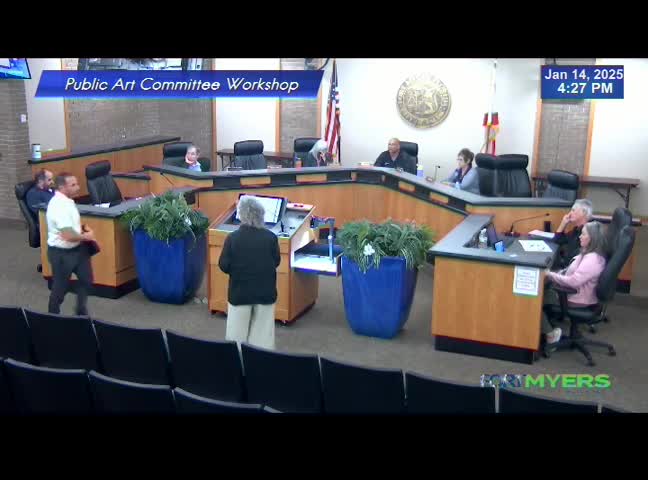
The Fort Myers Public Art Committee used the Jan. 14 workshop to press staff for better asset management, a maintenance schedule and insurance valuation for the city’s public art collection.
Abraham, Parks & Recreation staff, described work already under way to integrate public art into the city’s GIS and work‑order system and said doing so would help coordinate maintenance: "If we had that design we could put it on our layers for GIS, so when any constituent goes on 'what ward I'm in' they will see that green icon, and they'll just kind of help promote the public art," Abraham said. Committee members asked that the existing art inventory be refreshed and uploaded to GIS so Parks can more efficiently plan maintenance tasks and record materials and labor used.
The committee raised immediate maintenance questions: repainting the bases of 23 Carmona sculptures, paying outstanding Autocast invoices, and commissioning condition assessments so the artworks can be listed correctly as city assets. City staff told the committee there is roughly $25,000 in maintenance funds for the current year, about $7,000 already spent, and an estimated $11,000 remaining for maintenance invoices; an additional roughly $140,000 of capital public‑art funding exists but requires appropriation decisions.
Members also discussed conservation treatments for corroding metalwork. A committee member described a phosphate rust‑conversion treatment (often referenced as an iron‑phosphate/OSFO treatment) that can stabilize ferric oxide and reduce ongoing staining to adjacent paint and concrete; staff agreed to consult conservation vendors (Rosa Lowinger & Associates was suggested) and to return cost and environmental constraints. Parks staff noted storm‑water regulations limit use of some cleaning chemicals and that any process must avoid harmful runoff.
The committee directed staff to provide: (1) a GIS asset export showing artwork locations by ward; (2) cost estimates to repaint bases and to apply conservation treatments where needed; and (3) an appraisal/insurance‑valuation estimate to confirm the collection’s value for risk and asset accounting. Staff said those data will support next‑year budget requests and help prioritize projects the committee asked be included in the draft annual plan.
Ending: Staff and committee will reconvene with GIS exports, budget estimates, and conservation vendor guidance so the committee can approve maintenance priorities and request funding from city council if needed.