Get Full Government Meeting Transcripts, Videos, & Alerts Forever!
Get email alerts on the Court Hearings topic
No spam. Unsubscribe anytime.
Clayton County State Court issues plea, bench warrants and counsel appointments at virtual arraignment calendar
Summary
At a virtual arraignment in Courtroom 304, Judge Tammy Law Kayworth accepted a plea in one case, entered not-guilty pleas in several others, issued multiple bench-warrant bond forfeitures, ordered appointments of counsel in conflict situations and reset one aggressive-driving case to April 3.
At a virtual arraignment calendar for Courtroom 304 of the State Court of Clayton County, Judge Tammy Law Kayworth processed a slate of misdemeanor and low-level felony cases, accepting a negotiated plea in one matter, entering not-guilty pleas in others, issuing multiple bench-warrant bond forfeitures and appointing conflict counsel where needed.
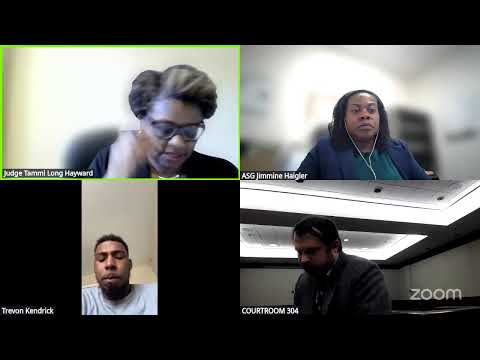
The most consequential action came in State v. Trevon Deshane Kendrick (2022CR0500580), where Kendrick pleaded no contest to counts 2 and 3 and the state agreed to no process on count 1. The court imposed a $100 fine (plus surcharges) on one count, suspended a $300 fine on the other, ordered the fines to run concurrently and gave Kendrick 30 days to pay. The factual basis recited by the state described a November 29, 2021 traffic stop in which officers said Kendrick failed to maintain his lane and did not follow verbal commands; the state’s account was presented in court by a prosecutor.
The arraignment produced several administrative outcomes affecting defendants’ next steps. The court granted bench-warrant bond forfeitures for multiple defendants who did not appear, including Marvin Lester Dupree, Joshua Lee Mitchell, Jerry Moore Jr., Adrian Delaflor Nash, Martika Darshell Neal (for whom the court also appointed conflict counsel in advance of any pickup on the bench warrant), Deyani Jackson and others listed on the calendar. The state announced it would “no process” (decline to prosecute) the case against Estacio Figueroa; the court released him at the hearing.
Parties agreed to a 30-day reset in the aggressive-driving matter involving Marquis JaShawn Beard and a codefendant; the court set the new date for April 3 at 1 p.m. and instructed the defendant to stay in contact with appointed counsel. The court also appointed counsel or arranged for appointed counsel intake for multiple defendants who requested representation or for whom conflict issues existed; several defendants were directed to provide contact information via the Zoom chat to the courtroom staff (Taz Taylor) so an appointment could be finalized during the session.
Judge Kayworth read defendants their rights and cautioned them about potential consequences of convictions. As she told one defendant: “If you were convicted at trial, the maximum penalty could be up to 12 months in jail, a $5,000 fine, or both per offense.” She also warned about bond-condition violations and the possible additional charge of aggravated stalking: “You could also be charged with additional misdemeanors or felonies, including the felony of aggravated stalking, punishable by up to 10 years in prison, a $10,000 fine, or both.”
Several defendants who were present entered not-guilty pleas and were released subject to bond conditions while their cases move forward; the court repeatedly directed defendants to obtain copies of bond conditions from the State Court Clerk’s Office before leaving. The calendar included multiple breakout-room conferences during the session so defense counsel and prosecutors could discuss offers or discovery; the court then announced agreed dispositions or continuances on the main call.
At the hearing the court also clarified an overlap with Superior Court orders in one domestic-related matter. Defense counsel raised that a defendant (Dwight Deshaun Amadou) had a superior-court child-exchange order that provided supervised or station-based child exchanges; Judge Kayworth said the superior court’s order governs that exchange mechanism and that such limited, supervised contacts did not violate the state-court no-contact terms so long as they complied with the superior-court order.
The court concluded by recapping the calendar outcomes, including pleas, resets, appointed counsel and bench warrants, and said she would process the documents and sign orders after the session. Defendants still facing active warrants or bond forfeitures remained subject to arrest until their matters are resolved.