Get Full Government Meeting Transcripts, Videos, & Alerts Forever!
Get email alerts on the Public Safety topic
No spam. Unsubscribe anytime.
Gainesville Fire Rescue reports rising calls and staffing progress in quarterly update
Summary
Gainesville Fire Rescue told commissioners its call volume and fire incidents have increased in Q1 FY25, while turnout times remain below national standards; staff reported recruitment gains, training programs, and expanded community health work including medication‑assisted treatment and mobile integrated health.
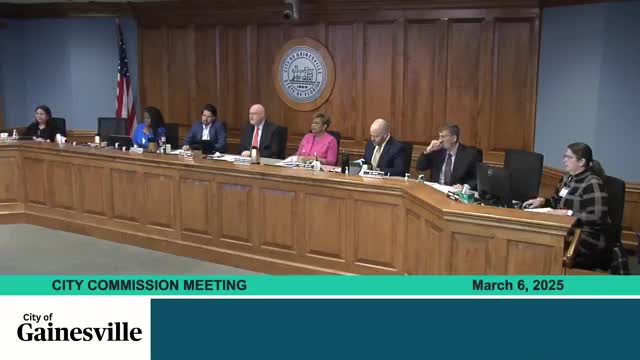
Gainesville Fire Rescue (GFR) presented its FY25 first‑quarter update March 6, reporting an increase in call volume and continuing efforts to staff and equip the department while expanding community health and prevention programs.
Interim Fire Chief Sean Hill House said GFR’s call volume for the quarter was 7,413, with emergency medical service calls the majority at 4,948 and fire responses 2,066. "Our department average [turnout time] is 47 seconds," Hill House said, citing a national turnout standard of 60 seconds; travel time across the city averaged 4 minutes, 56 seconds, slightly above the 4‑minute national benchmark but showing no sudden spike, he said.
Prevention and inspections GFR’s risk‑reduction and inspection activity included more than 6 million square feet inspected and about 99 plan reviews in the quarter. Hill House said the department’s risk‑reduction bureau completed two of six audit recommendations and is addressing the remainder over multiple years.
Stations and apparatus Hill House reported plans to replace Station 9 — which is currently operating out of a temporary trailer — and Station 3. For Station 9, the department is negotiating land with a health‑care institution on Archer Road near I‑75; staff estimated a two‑ to three‑year construction timeline after land acquisition. Hill House also said apparatus delivery times remain long — about three years for ambulances and ladder trucks — and staff will explore options to shorten that turnaround or simplify specifications.
Staffing and training GFR reported improved recruiting results. Orientation class 25‑1 began Feb. 10 and will bring new personnel on line; after a recent resignation GFR reported four firefighter vacancies and expected to reach full staffing by year‑end with a second orientation class planned. Lieutenant Dallas Baker was singled out for leading a CDBG‑funded training pathway that enrolled 10 residents in firefighter and EMT training; the first group graduates with firefighter and EMT credentials in May, and one graduate has already been hired by GFR.
Community health, CRP and behavioral health Brandy Stone, director of community health initiatives, described expanded behavioral health and substance use work. Stone said GFR’s mobile integrated health and community paramedicine programs logged 202 patient visits during the quarter, with Meridian Health peer specialists accompanying the team. Stone said 15 patients were newly enrolled and 10 connected to Meridian services, and the department provided 11 home vaccinations and multiple community engagement events.
The department reported ongoing work under opioid abatement settlement funding and one‑year milestones for the medication‑assisted treatment (MAT) program: 10 patients received MAT during the quarter and 68 doses were administered. Stone said staff are preparing an annual MAT report.
Gun‑violence intervention and Impact GNV Britney Coleman, gun‑violence intervention program manager, said Impact GNV remains active and has expanded staffing and office space at the Santa Fe Blount Center. The BOLD program now has a program director, two full‑time intervention specialists and a part‑time staff assistant; for Q1 the BOLD program reported 28 clients served with referrals to education and employment supports. Coleman said the Children’s Trust awarded $235,150 to support gun violence prevention and intervention work shared between city and county partners.
Community response in storms and events Hill House credited community partnerships during recent weather and shelter responses, noting the Community Resource Paramedicine (CRP) team supported the general population shelter during Hurricane Milton, providing medical evaluations, wound care and supplies; the shelter reached capacity at one point with 254 guests.
Professional development and public education GFR’s fire‑safety educator logged 44 public education events and engaged 1,871 students in the quarter, and several staff completed professional development including crisis intervention training and EMT certification. Chief Hill House acknowledged city hiring staff and the city manager’s office for supporting the department’s transition to the 24/72 staffing model and said the department is the closest to full staffing it has been in about a decade.
Ending Commissioners praised the department’s community programs and staffing gains and asked staff to continue reporting on station replacements, apparatus procurement timelines, and community health program outcomes.