Get Full Government Meeting Transcripts, Videos, & Alerts Forever!
Get email alerts on the House Bill 581 topic
No spam. Unsubscribe anytime.
Stephens County commissioners schedule three public hearings on House Bill 581 amid data gaps and tight March deadline
Summary
At a called meeting, Stephens County commissioners discussed House Bill 581 — a statewide measure that caps homestead assessment increases and allows a local sales-tax option — and directed staff to schedule the three public hearings required to consider opting out before the March 1 deadline while seeking more state data to model local impacts.
Stephens County commissioners on [date not specified] directed county staff to schedule the three public hearings required under state rules for jurisdictions that choose to opt out of House Bill 581, while several commissioners said they do not yet have the data needed to forecast the bill’s local fiscal impact.
Mr. Hamilton, a county staff member who opened the item, said the county was convened to discuss “House Bill 581 and the potential ramifications as well as benefits of this bill,” which the Georgia General Assembly approved and voters ratified in a November 2024 referendum; Hamilton said the effective date was Jan. 1 and that counties and municipalities were automatically opted in unless they complete the opt-out process by March 1.
The bill, as discussed at the meeting, has two distinct elements that affect local finance: a cap on how much a primary residence’s assessed value can increase in a year (commonly referenced at the meeting as a homestead assessment cap) and a local-option sales tax (referred to repeatedly in the meeting transcript as a “floss” or “flossed”) that jurisdictions may pursue by intergovernmental agreement and voter referendum.
Commissioners and staff repeatedly emphasized that key data needed to model local impact — notably the digest and the specific inflation/index rate the state will apply to cap assessments — are not yet available to counties. County staff said the state digest information will not arrive until April, after the March 1 opt-out deadline, making precise financial forecasting difficult. Commissioners said that uncertainty, together with the March timeline, is driving the decision to hold public hearings so residents can weigh in before the deadline.
Commissioner Oglesby noted that the bill applies only to a property’s primary residence and does not cover commercial properties or second/third homes. Staff reiterated that opting in by default does not automatically create the sales-tax option: the county must negotiate an intergovernmental agreement with local municipalities and place a sales-tax referendum before voters; if approved, that sales tax would initially operate by right for a five-year cycle and would require new local/state authorization to continue beyond that period.
Commissioners voiced mixed views. Chairman Simmons said he felt rushed by the timeframe and lacking sufficient information to make a final decision by March; other commissioners raised concerns about long-term equity effects if assessment increases are capped indefinitely for long-term homeowners while new buyers pay market-based assessments. Several commissioners noted the policy could benefit more urban counties with many visitors and shoppers (where sales-tax receipts come from nonresidents) while offering less benefit to more rural counties whose tax base is concentrated among local homeowners.
James (the county finance director) briefed the board that the county could take steps to freeze or reduce spending if necessary, but stressed that without the state-provided digest and the exact index the state will use to compute assessment caps, the county could not produce reliable revenue forecasts. Commissioners asked staff to reach out to state legislators and the Capitol’s research team for county-specific forecasting help.
The board also discussed schedule logistics and notice requirements. Staff explained statutory notice rules require a legal advertisement in the newspaper and at least seven days’ advance public notice before the first of three required hearings; based on the county’s meeting calendar and newspaper publication days, staff recommended advertising by the newspaper edition of Jan. 16 so hearings could begin Jan. 28 (meeting participants noted newspaper deadlines and the need for a week between hearings). Commissioners directed staff to publish the notice of intent to opt out and to schedule all three hearings in the initial notice so the county meets the procedural requirements if the board later decides to proceed.
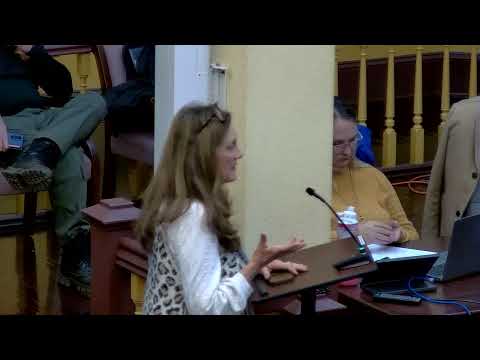
Public comment reflected divergent local views. Miss Jeffers, a resident, said she moved to the county from out of state and described unequal assessments among neighbors; she said she would favor opting out and instead exploring an additional local sales tax as a way to spread tax burden more broadly. Other residents and commissioners said they voted against the referendum in November because the ballot language was general and did not supply the detailed mechanics now of concern.
No formal opt-out or opt-in vote was taken at the meeting. Instead, the board’s recorded directions to staff constitute the principal outcome: staff will publish the required legal notice and schedule three public hearings (the first planned to begin Jan. 28, subject to newspaper-advertising timing) and will request state data and analysis to help the county assess fiscal effects before making a final decision.
Looking ahead, commissioners said they may use the hearings to solicit public input and that the board can choose not to adopt an opt-out resolution after the hearings if it prefers to remain in the law as enacted by voters. Staff also agreed to clarify procedural questions about canceling later hearings or revoking the opt-out notice if the board chooses not to proceed.