
Pickens County presents updated local emergency operations plan; adds damage assessment and animal services annexes
Get AI-powered insights, summaries, and transcripts
Subscribe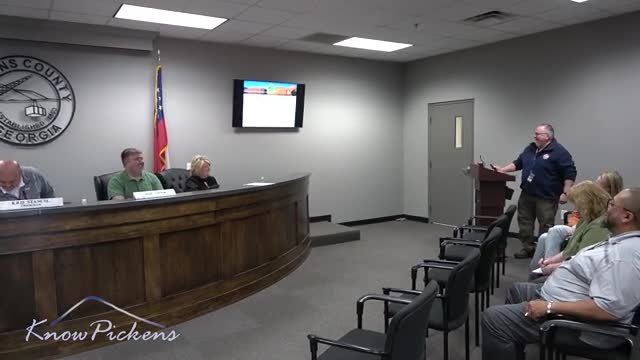
Summary
Emergency Management Director Dr. Robbie Westbrook outlined the 2025 Local Emergency Operations Plan (LEOP), submitted to state emergency management for approval, emphasizing multi-jurisdiction integration, incident annexes, training and exercises, and two added emergency support functions: damage assessment and animal services.
Dr. Robbie Westbrook, Pickens County’s emergency management director, presented the county’s updated Local Emergency Operations Plan (LEOP) during the March work session and said the plan has been submitted to the state emergency-management agency for approval. Westbrook said the LEOP, updated every four years, is intended to align county response and preparedness activities with federal and state doctrine and serves as the organizing document for incident annexes, standard operating guides and training exercises.
Westbrook said the plan is multi-jurisdictional and has already been shared with the city of Jasper, the town of Talking Rock and the city of Nelson for their review and separate approval. He described the LEOP as a living document that will be used to generate a library of incident-specific annexes — checklists departments can use during events — and a multi-year training-and-exercise schedule developed with stakeholders across public-safety agencies.
The presentation outlined Emergency Support Functions (ESFs) and agency leads the county expects to use during a response. Westbrook identified the Pickens County School District as the coordinating agency for transportation, Pickens County 9-1-1 as the coordinating agency for communications, and Pickens County Fire Rescue as the coordinating agency for firefighting (with the City of Jasper Fire Department listed as lead inside city limits). He noted two ESFs the county added: ESF-16 (damage assessment), led by Planning and Development with Emergency Management support and mutual-aid agreements in development, and ESF-17 (animal services), led by the Pickens County animal shelter and the marshal’s office.
Westbrook highlighted hazard-specific annexes that will be part of the LEOP library, including tornado, winter weather, flash flood and dam-break annexes. He said the county’s preliminary inventory lists 47 dams, 18 of which he described as high-category (category 1) dams — a local planning detail he said the county will use in prioritizing road clearance and evacuation routes.
Westbrook explained activation procedures: the commission chairman consults with the emergency management director (or deputy director, identified in the presentation as Philip) and the public-safety director to determine whether to activate portions of the LEOP and whether to declare a local state of emergency. He said a local state of emergency triggers county disaster ordinances and enables easier access to state resources and potential fee waivers for damaged properties.
The presentation also covered public-information coordination (external affairs), mass-care planning (including growth of partnerships with Red Cross and volunteer organizations), public-health and hospital coordination, HAZMAT response, agriculture and business-recovery engagement, and continuity-of-government planning. Westbrook said the LEOP is already informing other county plans and will be actively used rather than filed away.
Commissioners thanked Westbrook and noted ongoing operational items: the county’s Code Red messaging integration with the emergency-management Facebook page and the importance of real-time weather updates. The commission chair also raised a separate state-level item — pending NextGen 9-1-1 funding in the Georgia state budget — and encouraged attention to potential funding outcomes.