Get Full Government Meeting Transcripts, Videos, & Alerts Forever!
Get email alerts on the Land Use Extraction topic
No spam. Unsubscribe anytime.
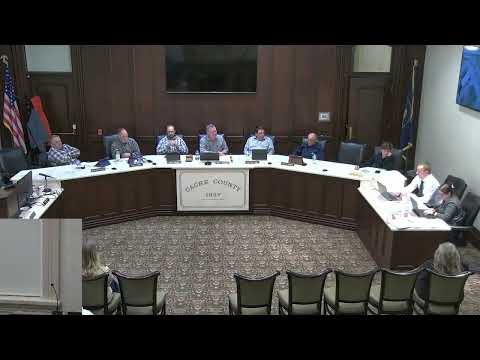
Cache County approves temporary minor-mineral extraction permit for Cronquist site with limits and conditions
Summary
The Cache County Planning Commission on March 6 approved a conditional use permit allowing a temporary minor-mineral extraction operation on 4.97 acres at the Cronquist property, subject to 27 conditions intended to limit traffic, dust and other neighborhood impacts.
The Cache County Planning Commission on March 6 approved a conditional use permit allowing a temporary minor-mineral extraction operation on 4.97 acres at the Cronquist property, subject to multiple conditions aimed at limiting traffic, dust and other neighborhood impacts.
The permit authorizes excavation limited to the surveyed 4.97-acre cut area and requires a recorded reclamation agreement and a pre-recording survey. Commissioners approved the permit after amending and adding conditions that restrict hours, vehicle types and volumes, require various permits and approvals, and set a deadline for completing removals.
Connor, a development-services planner, summarized the staff review and history: previous zoning clearances in 2014, a 2020 withdrawn application, notices of violation in 2022–23, and a land-use hearing officer decision that denied portions of the applicant's appeal. Connor said the applicant's letter of intent (LOI) describes using excavation to "create a level pasturage area" by removing material from a 4.97-acre cut and placing 1.4 acres of fill on-site. He noted an engineering estimate of about 190,000 cubic feet of cut and 37,000 cubic feet of fill, and that the county code limits a minor extraction operation to less than 5 acres.
Wayman Stoddart, the applicant's agent, said the applicant would stipulate to most conditions and to the LOI limits, and asked specific wording changes. "We're prepared to stipulate to every condition as well as continue to operate under the letter of intent," Stoddart said, and asked clarifying language on the materials definition, allowed vehicle types, and how any future permit requests on the parcels would be framed.
County engineer Matt Phillips said the county requires an encroachment permit for any work inside the public right of way, and engineering recommended limiting the largest combination truck/trailer types unless the county can complete further analysis. Phillips said the recent traffic impact study analyzed many truck classes but that certain combination vehicles raise sight-distance and overhang concerns at the site exit.
Several residents warned about dust, noise and safety on Smithfield Canyon Road. Resident Bobby Dansey described recurring dust in his home and said his daughter has asthma: "It endangers my family, my home, my property," Dansey said. Other commenters urged denial based on road safety and quality-of-life impacts.
The commission debate focused on whether conditions could reasonably mitigate anticipated impacts. Commissioners added or clarified conditions that require: - a pre-recording survey that fixes the <5-acre extraction footprint; the permit explicitly prohibits using that surveyed area as a staging yard for material from other parts of the property; - a recorded reclamation agreement before operations begin; - hours of operation limited to 8 a.m. to 6 p.m. on days of activity (commission amendment); - a cap of 20 loads per day and 50 loads per week, with an allowance for a small number of larger-week exceptions specified in the LOI subject to notice; the LOI must be amended to reflect these limits; - vehicle restrictions: standard dump truck and side-dump trucks allowed; use of certain longer combination units ("pups") is permitted only with county-engineering approval; - dust and stormwater controls consistent with Utah Department of Environmental Quality requirements; if industrial stormwater (MSGP) coverage is required by the state, applicant must obtain it and provide the county with documentation; - the applicant may not fill water trucks from on-site sources until any water-right or state investigation affecting that water use is resolved; the applicant may still fill water trucks from municipal hydrants off-site and provide receipts as evidence; - coordination with Smithfield City and county public works if any right-of-way or utility infrastructure could be affected; and - applicant must amend the LOI and submit requested technical details (vehicle types, VINs if required) and a geotechnical report for moderate slope work.
The commission also added a time-limited restriction on further extraction permits tied to remediation: the permit includes a clause barring additional temporary extraction permit applications on the identified parcels for a period of 10 years after the county accepts remediation of the existing excavation (applicant and commission negotiated wording to avoid creating a perpetual land-use restriction). The commission set a project completion timeline: the permit requires the applicant to substantially complete the authorized removal within two years of recording the CUP, as amended during the meeting (the commission later adjusted timing in the final motion; see Actions below).
After deliberations and two motions, the commission approved the CUP with the amended conditions described above and with the requirement that the applicant file amended LOI language and technical submittals before the permit is recorded. The approval was not unconditional: the permit is tied to the listed mitigation conditions and to county reviews and required state permits where applicable.
The commission and staff repeatedly described the permit as temporary, narrowly scoped to the surveyed cut area, and contingent on documented compliance with dust and stormwater controls and on limits to vehicle types and volumes. If the applicant exceeds any condition, the county indicated it will rely on its enforcement options under county code and state permits.
The commission record shows extensive public comment and technical exchanges with staff and the applicant; members said they tightened conditions in response to resident concerns while preserving the applicant's limited agricultural objective.
Ending: The county's Development Services office will not record the CUP until the applicant has submitted the amended LOI, the <5-acre survey, a recorded reclamation agreement, the required stormwater/dust documentation, and any engineering approvals for vehicle types; the county will monitor compliance through its permitting and inspection processes. The applicant may seek further amendments only through formal county channels; the permit as approved is time-limited and narrowly scoped.