Get Full Government Meeting Transcripts, Videos, & Alerts Forever!
Get email alerts on the Special Education topic
No spam. Unsubscribe anytime.
Liberty County updates special education services, says district met state indicators and is below 1% cap for alternate assessment
Summary
District special-education staff reported serving about 1,627 students, meeting state indicators under IDEA, and adjusting placements after the state’s 1% cap on alternate assessments resumed.
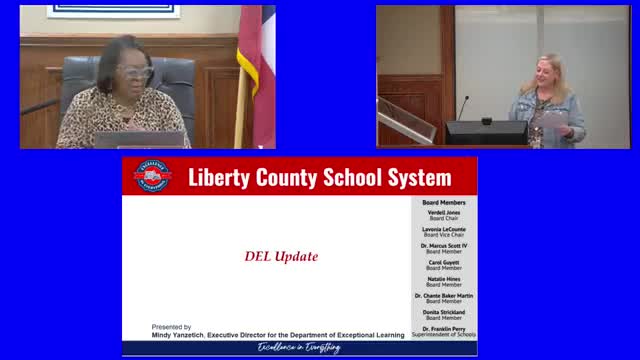
Mindy Ansevit of the Liberty County Department for Exceptional Learning told the board the district currently serves about 1,627 students ages 3 through 21 with services across all campuses, including contract occupational, physical, speech and nursing services.
Ansevit said the district “has the certified staff for the areas under IDEA” and operates a local GNETS Coastal Academy placement and supports inclusion, pull-out resource classes and self-contained settings. She said the district added a part-time teacher this year who works with both high schools to support graduation planning for students with disabilities.
On assessments and compliance, Ansevit told the board that the Georgia Department of Education requires reporting on specific indicators for students with disabilities and that Liberty County “met requirements with a % for all of those indicators” this year. She said the district did not have any significant disproportionality, no disproportionate representation and no significant discrepancy in suspension or expulsion rates for students with disabilities.
Ansevit discussed the state’s alternate assessment (GAA2) and Every Student Succeeds Act (ESSA) guidance that places a 1% statewide cap on participation in alternate assessments. She said the cap and recent guidance have led to reassessments of which students should be assigned to GAA2; placement decisions are made by the student’s IEP team using provided state guidance. “Significantly impaired is defined as below 55 IQ,” Ansevit said, and the district reviewed every student’s records to give guidance to schools about who qualifies for GAA2.
Board members asked about literacy training and whether special-education teachers receive the same literacy training as general-education teachers. Ansevit responded that special-education teachers must complete the same literacy training required for general-education staff and that the department provides monthly training for special-education paraprofessionals and crisis prevention/de-escalation training for staff.
Ansevit said the district’s extended school-year services are provided based on IEP-team review of goals and needs and that the district offers family engagement events and Special Olympics programming. She invited the board to upcoming Special Olympics events in March.
The presentation was informational; no board motion was recorded on these items during the work session.