Get Full Government Meeting Transcripts, Videos, & Alerts Forever!
Get email alerts on the Housing Homelessness Safe Stays topic
No spam. Unsubscribe anytime.
City staff recommend making Safe Stay pilot a longer‑term homelessness response; council raises siting, design and cost questions
Summary
Staff presented outcomes from the Safe Stay community pilot and recommended moving the model from a temporary pilot to a longer‑term program. Staff cited housing exits and reduced emergency calls; councilors asked about permanent building forms, permitting changes and costs.
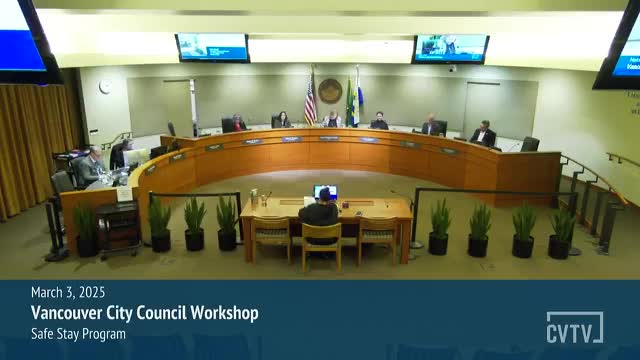
City staff recommended that the council consider transitioning the Safe Stay community pilot from a temporary emergency model to a longer‑term component of Vancouver’s homelessness response during a March 3, 2025 council workshop.
Jamie Spinelli, who led the presentation, said Safe Stay began as a 2021 pilot to address a shortage of year‑round non‑congregate shelter beds and has grown into four sites that to date have served 424 individuals across Clark County. "Today we're gonna talk about the future and whether council would like to transition safe stays from a temporary pilot model, to a long term more embedded component of our homelessness response strategy," Spinelli said.
Why it matters: Staff told the council Safe Stays have produced measurable outcomes including housing placements and fewer emergency service calls around sites. Formalizing the model would require changes to city permitting and possibly the comprehensive plan, staff said; councilors expressed broad support for keeping the model but raised questions about facility form, durability, shared public costs and neighborhood impacts.
Reported outcomes and data: Spinelli summarized program outcomes and system context: - The shelter system prior to 2021 had fewer than 100 year‑round beds for single adults countywide, with more seasonal than year‑round capacity. - Safe Stay has served 424 individuals in total; 87 were in the four sites at the time of the briefing. - A total of 325 people have exited the Safe Stay sites; of those exits, 168 people (about 50%) transitioned into permanent housing. - Staff said 57% of those who moved into housing did so without an ongoing subsidy. - About 229 people served would be considered chronically homeless under HUD definitions; roughly 10% of participants were veterans.
Spinelli said the Safe Stay program has been associated with reductions in emergency services calls (staff cited an average 30–40% decline near sites) and that the model is producing peer employment outcomes — multiple former Safe Stay residents are now employed in shelter operations.
Permitting and program form: Staff described the largest legal/administrative barrier to long‑term use as the city’s temporary‑use permitting framework. Temporary‑use permits used for Safe Stay sites are limited to three years; Site 1 had already reached the three‑year limit and Site 2 was nearing its limit in April 2025. To enable Safe Stays as an ongoing program, staff recommended partnering with the Planning Department to identify a new permit designation or code change — likely as part of the comprehensive plan and code update process — so safe‑stay sites can be evaluated as a standard component of the shelter system instead of repeatedly operating under short‑term permits.
Council questions and concerns: Council members broadly supported keeping Safe Stay as a continuing tool but urged caution about form and cost. Councilor Fox said she supports the program concept but not the temporary tiny‑structure form in perpetuity and urged consideration of longer‑lived brick‑and‑mortar options. Council members asked how a code change would be processed; the city manager and planning staff said changes would follow the comprehensive plan/ordinance public hearing and Planning Commission steps, including public comment opportunities. Other councilors raised tradeoff questions about investing in permanent structures versus building more shelter and housing capacity given local housing costs; one councilor referenced Vancouver Housing Authority per‑door costs cited at roughly $550,000.
Site‑level issues and mitigation: Spinelli said community engagement showed generally positive responses but noted actionable neighbor concerns such as local parking pressures near the Outpost site. Staff advised continuing mitigation discussions with property owners (for example, Vancouver Housing Authority where relevant) and local partners.
Staff recommendation and next steps: Spinelli recommended formalizing Safe Stays as a longer‑term program while continuing site‑by‑site evaluation, neighbor engagement and code changes through the comprehensive plan update. "Formalizing the program would just ensure that we're able to continue using this model as part of our shelter response," Spinelli said. Council members asked staff to return with options on code language, funding and facility form so the council can evaluate tradeoffs before committing the city to a specific long‑term footprint or permitting approach. No formal vote occurred at the workshop.
Ending: Councilors signaled support for continuing to develop the program and requested follow‑up materials on land‑use options, capital costs and public engagement steps before any code change or ordinance adoption.