Get Full Government Meeting Transcripts, Videos, & Alerts Forever!
Get email alerts on the House Bill 581 Opt Out topic
No spam. Unsubscribe anytime.
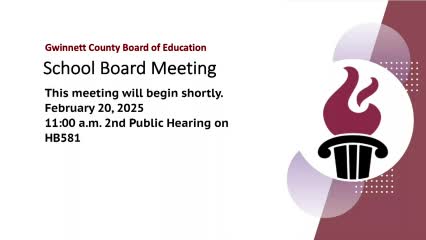
Gwinnett school board holds second public hearing on House Bill 581 opt-out; no vote taken
Summary
Gwinnett County Public Schools held a second of three public hearings on whether to opt out of House Bill 581which caps property-tax growth for homestead exemptions. District staff warned of revenue loss if the board does not opt out, while dozens of residents urged the board not to disregard voters who approved the amendment in November. The
Gwinnett County Public Schools held a second public hearing on House Bill 581 on Feb. 1 as the board prepares for a scheduled vote later the same day on whether to opt out of the law's property-tax cap.
The hearing opened with Chair Dr. Simmons and presentations from Superintendent Dr. Watts, Chief Financial Officer Missana Mallard and Legislative and Educational Policy Administrator Dr. David Goldie. Goldie summarized the bill's legislative history, saying it combined provisions from Senate Bill 349 and House Bill 1185 into House Bill 581, which caps the statewide homestead exemption at inflation while offering local governments a one-time opt-out. He said the law requires public notice and that an opt-out resolution must be filed with the secretary of state by March 2025.
Missana Mallard, the district's chief financial officer, told the board that local property-tax revenue is the most significant revenue source for the school operating budget and summarized a district analysis estimating a loss "anywhere above $35,000,000 a year or $100,000,000 over a 3 year period" if the district were subject to the cap. Mallard said local property tax revenue currently supports roughly 80% of instructional services, and that a reduction in that revenue would threaten programs that the district funds locally, including teacher compensation, school safety, smaller class sizes, special education and multilingual programs. She also said credit-rating agencies had warned the district that opting out "will probably likely be downgraded," which would increase borrowing costs for taxpayers.
The hearing drew 11 scheduled public speakers and additional commenters. Speakers who urged the board not to opt out cited voters' approval of the November ballot measure, rising homeowner tax bills, and the burden on seniors and residents on fixed incomes. Resident Chandler Faith Pitts said rising taxes hurt children who move frequently: "It's hard on them academically." Tim Hodnick said his property taxes "have gone up like 33% in the past 5 6 years" and urged the board to "live within their means." Lisa Rutherford challenged the district's spending and questioned the $10-per-month estimate cited by staff for a $400,000 home.
Other residents presented financial calculations and policy arguments against opting out. David Kessinger and Dan Rich argued the bill slows assessment growth to inflation and reflected that student counts have been essentially flat while the tax digest grew; Kessinger said the millage rate has actually fallen slightly in recent years. Several speakers asked for a thorough public accounting of potential cuts and for the district to publish an itemized plan showing where it could reduce spending before approving an opt-out.
Board members acknowledged the public concern and debated the tradeoffs between taxpayer relief and maintaining local school funding. Board member Ms. Ruffin Stone, a former district teacher, framed the decision as a statutory duty to "advocate for the best interest of children" and cited OCGA section 20-2-49. Stone said the district had "exhausted all available state and local funds necessary for our schools to thrive" and repeated her call for "a comprehensive forensic audit" of district finances. She warned that class-size caps removed under the district's strategic waiver could worsen if funding dropped, saying core academic classes "had upwards of 36 students" and resource special-education classes often exceeded intended caps.
Board member Mr. Knudson emphasized the district's financial reserves, bond rating and the limits of state funding, noting past state austerity cuts and arguing the district needs local revenue flexibility to respond to future funding volatility. Several board members said they want to work on millage-rate reductions to provide taxpayer relief while retaining the option to access local revenue if needed.
A citizen raised a legal-compliance concern, saying the district had not posted the required advertisement on its website seven days before a prior hearing. Resident Brian Faloni presented screenshots and asked the board to schedule another hearing if necessary. Director of communications and staff responded during the meeting that staff had documented the required advertising and that the district's legal team had reviewed the evidence; the district said a fourth hearing was not necessary.
No formal opt-out vote was taken at this hearing. The meeting concluded with routine business: Mr. Knudson made a motion to adjourn, seconded by Mr. Gasper, and the motion passed unanimously. The board said a final vote on the opt-out resolution was scheduled for the evening public meeting.
Reported actions and next steps: the district will hold the third public hearing and the scheduled adoption vote later in the day; staff stated they have collected evidence of the required public notices and legal counsel advised no additional hearing was necessary. The district reiterated that if the board adopts an opt-out resolution it must be filed with the secretary of state by March 2025.
The public record presented at this hearing centers on the tradeoff between voter-approved property-tax relief and the potential, recurring loss of local revenue the district says supports core educational services. The board and staff signaled interest in pursuing a forensic financial audit and exploring millage reductions as part of any effort to balance taxpayer relief with sustaining district programs.