Get Full Government Meeting Transcripts, Videos, & Alerts Forever!
Get email alerts on the Accessory Dwelling Units topic
No spam. Unsubscribe anytime.
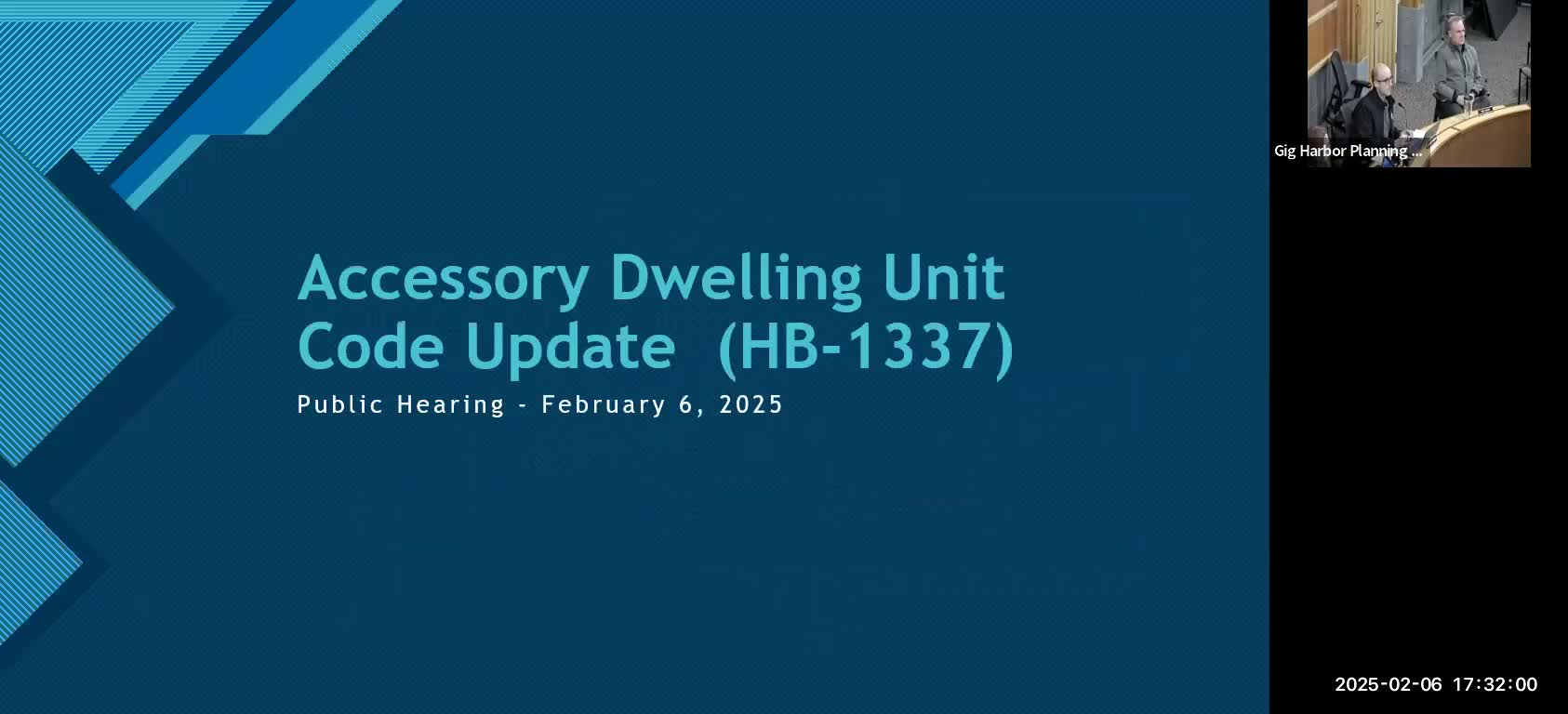
Gig Harbor planning commission recommends ADU code updates, raises size and short‑term rental questions
Summary
The Gig Harbor Planning Commission voted to forward draft accessory dwelling unit (ADU) code revisions to City Council with an amendment increasing the maximum unit size to 1,200 square feet; commissioners and residents also debated density, whether garages count toward unit area, and short‑term rental limits.
The Gig Harbor Planning Commission voted to recommend that the City Council consider revised regulations for accessory dwelling units (ADUs), including an amendment that raises the draft maximum unit size from 1,000 square feet to 1,200 square feet.
The change comes after a public hearing and more than an hour of discussion at a planning commission meeting where staff reviewed how the draft implements House Bill 1337 and related state guidance on ADUs. Planner Jeremy (city staff) said the draft is intended to bring Gig Harbor into compliance with the state law and to reduce permitting barriers that previously limited ADU construction.
The draft ordinance removes the older “accessory apartment” definition and the conditional‑use permitting requirement for ADUs in the city’s single‑family and residential business zones. Jeremy told the commission that the city has had eight conditional‑use applications for accessory apartments since 2007, with five decisions issued and the remainder withdrawn, and that the 600‑square‑foot threshold in the older code was a barrier for property owners.
Why it matters: HB 1337 (2023) requires cities to adopt regulations that make ADUs easier to build as part of a broader state effort to expand housing options. The planning commission’s recommendation, if approved by council, would change how property owners can add ADUs in Gig Harbor and is likely to affect homeowners, renters and the city’s housing supply.
Key decisions and staff proposals
- Density exemption: Jeremy said the draft can explicitly state that ADUs are exempt from the underlying zoning density calculations (an addition staff offered in response to public comment). That language was proposed for the code and discussed by the commission.
- Maximum size: Commissioners debated several options (a flat larger maximum, a percentage of the primary dwelling, or a hybrid). The commission adopted an amendment to increase the draft maximum ADU size to 1,200 square feet (total building area) from the staff’s 1,000 square feet. The amendment passed by voice vote and the chair indicated the motion carried.
- Habitable area and garages: Public commenters and commissioners asked whether garages, carports and other non‑habitable spaces would count toward the maximum size. Jeremy and Director Baker told the commission the city can clarify the code to measure a unit’s maximum by habitable floor area (calculated from finished wall to finished wall) and exempt non‑habitable garage area from that cap; commissioners asked staff to draft language to that effect.
- Parking and impact fees: The draft sets a one‑space‑per‑unit parking requirement and leaves impact fees to Public Works; Jeremy noted the state and other jurisdictions commonly cap certain fees and that public works will apply statutory limits (including provisions in state law limiting some impact fees).
- Short‑term rentals (STRs): The draft includes a prohibition on using ADUs as short‑term rentals (a new General Requirement J). Commissioners and public speakers pressed whether that prohibition should extend to the principal dwelling on lots with ADUs. Planner Jeremy said the code could include such a restriction, but commissioners did not adopt that change; instead they agreed to flag the question for City Council and asked staff to supply additional data and analysis before council action.
Public input
Three residents testified in the hearing. Michael Shipman urged the commission to slow the process and said the draft omitted necessary clarifications; he described the current language as “insufficient” and offered to work with staff. Wade Perrault (listed at 9109 North Harborview Drive) pointed to a “catch‑22” in the draft he said would leave some legal lots unable to qualify because of density calculations; he asked the commission to keep the record open for additional public comment and to clarify whether garages and covered decks count in the gross floor area calculation. Edward Nadler praised the draft’s alignment with HB 1337 and supported the addition prohibiting ADUs as STRs; he asked the commission to consider also prohibiting short‑term use of the principal dwelling when an ADU exists.
Commission deliberations and next steps
Commissioners discussed multiple policy tradeoffs: larger ADUs can house more people but increase construction cost and may reduce the likelihood those units remain affordable; stricter limits on STRs help preserve long‑term rental housing but can affect owners’ financing assumptions. Several commissioners asked staff to collect baseline data on local STRs and on ADU inquiries after the code is adopted.
The commission voted to forward the staff draft, as amended, to City Council for consideration. The planning commission did not leave the record open after the hearing; staff and several commissioners said there will be another formal public comment opportunity at City Council hearings on the ordinance.
Quotes
“House Bill 1337 seeks to ease the barriers of construction and use of accessory dwelling units and provides expanded housing options,” Planner Jeremy said during his presentation.
“I have concerns that if we ramrod this bill through the system ... we’re gonna miss some things,” Michael Shipman told commissioners during public comment.
“The catch‑22 that existed in the code would be addressed,” Wade Perrault said, urging an explicit density exemption and clearer language about how floor area is measured.
“The spirit of this legislation ... is to encourage the use of accessory dwelling units for long‑term housing,” Edward Nadler said. He added that prohibiting ADUs as STRs helps preserve long‑term units.
What’s next
The Planning Commission’s recommendation, including the 1,200‑square‑foot amendment and the direction to clarify habitable‑area measurements, will be transmitted to the Gig Harbor City Council for review and public hearing. City Council will hold its own public comment period and decide whether to adopt the ordinance as drafted, to modify it, or to return it to the commission for further changes.