Get Full Government Meeting Transcripts, Videos, & Alerts Forever!
Get email alerts on the Coastal Development topic
No spam. Unsubscribe anytime.
Zoning hearing officer continues Seaside View kayak‑club coastal permits after public‑trust dispute
Summary
The San Mateo County zoning hearing officer continued action on a coastal development permit and design review for a proposed kayak club in Princeton after a public commenter raised a legal claim that could affect shoreline title and public‑trust status.
The San Mateo County zoning hearing officer on March 20 continued consideration of a coastal development permit and design review permit for a proposed kayak club on West Point Avenue in Princeton after a public commenter raised a potentially dispositive legal issue about title to adjacent tidelands.
The project, filed by Seaside View LLC (applicant Kenneth Hope), would place a modular kayak‑club facility on a substandard 3,893‑square‑foot parcel on the east side of West Point Avenue. County staff described the proposal as a small, portable modular unit with a 384‑square‑foot base containing office and changing space, a roughly 200‑square‑foot loft for storage accessed by a wall ladder, an attached 80‑square‑foot deck, an ADA‑compliant entrance ramp, two on‑site parking spaces, four‑foot fencing, an 80‑square‑foot kiosk, and an approximately 50‑foot water‑main extension to connect to the Coastside County Water District.
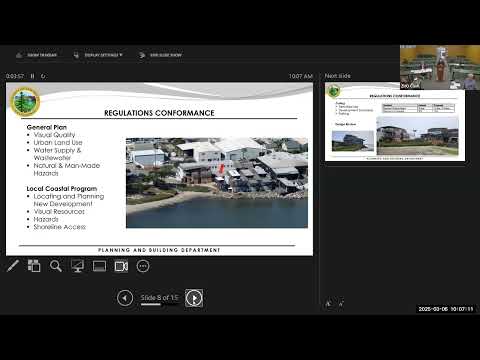
Staff told the hearing officer that the project has been reviewed for consistency with the San Mateo County Local Coastal Program (LCP) and that the County concluded the project meets waterfront zoning and design‑review standards. Staff recommended approval with conditions including measures addressing coastal hazards and a skirting condition to enclose the modular unit’s support elements. Staff also reported that the California Coastal Commission reviewed the referral and requested conditions (numbered 17–21 in the staff report) related to coastal hazards, potential unpermitted riprap adjacent to the parcel, and debris screening under the unit.
In public comment, John Callan, representing Wayward Lot Investment Company, asked that the hearing be continued and argued the parcel is excepted from the public‑trust doctrine under the so‑called Rancho lands exception. “The proposed plan violates access to the ocean,” Callan said, asserting that federal patent history and case law mean tidelands on this shoreline are not held in public trust. County staff and the hearing officer said they were not familiar enough with the legal argument to resolve it at the hearing and agreed the issue requires further research before a final decision.
Because of the legal question raised by Callan about the applicability of the public‑trust doctrine and the Rancho lands exception (a matter Callan tied to a 1984 U.S. Supreme Court decision he cited), the zoning hearing officer continued the item to a future meeting date to allow staff to investigate the title and jurisdictional issues; the officer said the county will aim to place the item on the April 17 agenda but did not set a firm continuance date.
The continuation means no final county action was taken on the coastal development permit or the design review permit at the March 20 hearing. Staff had emphasized that if approved, the applicant would be required to work with the Coastal Commission within 60 days of a final county approval to address any unpermitted riprap or related Coastal Act compliance issues and to implement the county’s conditions of approval including the added skirting requirement.