Get Full Government Meeting Transcripts, Videos, & Alerts Forever!
Get email alerts on the Sustainability Programs topic
No spam. Unsubscribe anytime.
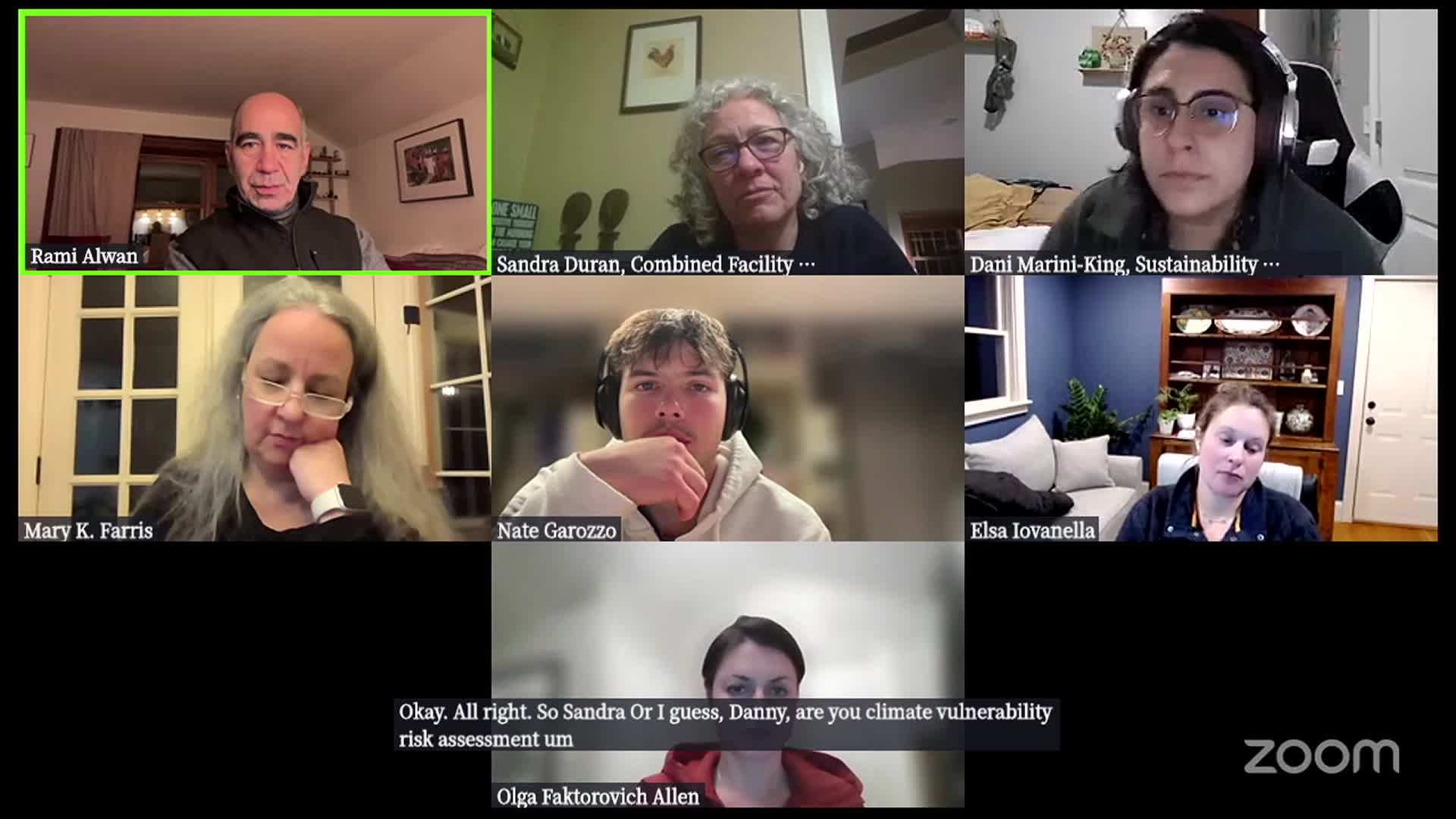
Sudbury committee advances climate‑resilience procurement, MVP seed project and outreach plans; opts to withdraw solar‑account warrant article
Summary
Committee approved selection of Weston & Sampson for a climate vulnerability risk assessment, discussed a Municipal Vulnerability Preparedness seed project and locally grown fairs, agreed to prepare a funding decision tree and metrics, and decided not to pursue a warrant article to change the solar account at Town Meeting.
The Town of Sudbury Energy and Sustainability Committee reported progress on several programmatic items: the committee has selected Weston & Sampson to perform a climate vulnerability risk assessment, finalized the framework for a Municipal Vulnerability Preparedness (MVP) seed project, and advanced outreach plans for a pair of "locally grown" fairs intended to increase food resilience.
Danny, the committee’s sustainability coordinator, told members that Weston & Sampson was selected after a competitive procurement and that their proposal came in "just under that 59,000 and some change," which is below the $60,000 allocation the committee had planned. Committee staff said they are confirming the consultant’s ability to meet the RFP milestones and expect to have a fully executed contract in the near future.
On MVP (Municipal Vulnerability Preparedness) the committee is finalizing a seed‑project plan prepared with consultant MAPC. Staff said the likely seed project will be either a "how‑to" handbook or an assessment checklist to guide small-scale home resilience upgrades, paired with training for a youth climate corps to help residents apply the guidance. The seed project plan must be approved by the Massachusetts Executive Office of Energy and Environmental Affairs before implementation; staff said the plan must be finalized and approved prior to April 2025, with roughly nine months available for implementation after approval.
The committee also outlined a locally grown initiative linking climate change, food security and community health. Staff said the first locally grown fair is scheduled for Saturday, May 31, with a second fair planned for fall/winter to showcase in‑season local foods. Organizers plan coupon booklets to make market purchases more affordable for lower‑income and climate‑vulnerable households and are coordinating with the Sudbury Housing Authority, Sudbury Food Pantry, the Senior Center and the Coolidge to identify eligible recipients. Staff is awaiting guidance from the Massachusetts Department of Agricultural Resources (MDAR) on whether SNAP and WIC can be accepted at the fairs; if not, organizers said coupon amounts will be adjusted to cover eligible households.
The committee agreed to prepare a formal decision tree and funding criteria modeled on the Green Communities grant guidance to make grant and revolving‑fund allocations more transparent. Members discussed including a standard set of outcome metrics for applications—clean energy generated, kWh reductions, greenhouse‑gas avoided, resilience measures and number of households reached—and suggested a 6–12 week application timeline with a staged review (initial presentation, follow‑up meeting, final decision). Jim Cummings has been asked to analyze energy savings from projects paid by the solar revolving fund since its 2016 inception; staff has obtained Mass Energy Insight access and expects two to three months to prepare a presentable inventory of savings and broader impacts.
The committee also discussed governance and forward planning. Members proposed an in‑person workshop in early spring to clarify the committee’s goals, align metrics, and map how the solar revolving fund and other resources will be used to advance emissions reduction, risk management and community outcomes. Several members volunteered to help draft a funding criteria template and to build a project tracking document.
On one procedural item, Rami said he and Olga had met with Town Manager Andy Sheehan and that, after the discussion, they would not bring a warrant article to Town Meeting to change how the solar account is used. "He understands it, he won't be looking to that account as sort of the defacto way of kind of bailing out the town for shortfalls in projects," Rami said; the committee agreed not to advance the warrant article at this time and to instead document decision criteria for the account.
Other brief topics included the opt‑in stretch energy code: Rami plans to present a draft to the Select Board and to hold contractor and resident outreach sessions ahead of Town Meeting; and community aggregation rates, where staff said Eversource’s recent market purchases temporarily undercut the town’s community aggregation rate. Staff said community aggregation still offers a greener product and less price volatility, but that residents who prefer the lower short‑term Eversource rate may choose to opt out; staff will publish explanatory material for residents.
Finally, members discussed school composting. Committee members agreed to ask Brad (school operations contact) for a meeting to coordinate with Sustainable Sudbury, school staff and other stakeholders on a pathway to implement composting in the schools and to consider forming an advisory group for implementation.
No formal votes were taken on most items at this meeting; the committee recorded contractor selection for the vulnerability assessment and multiple direction items for staff and volunteers to complete next steps.