
Charlottesville staff outline options to close $1.6 million solid-waste funding gap; cart-based pay-as-you-throw recommended
Get AI-powered insights, summaries, and transcripts
Sign Up Free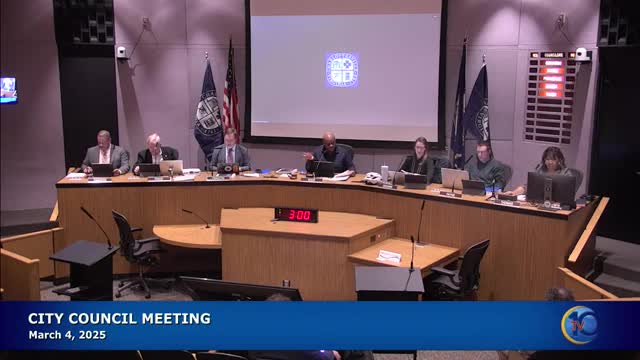
Summary
Charlottesville City Council heard a presentation March 4 from Public Works Director Steven Hicks and consultant Seth Cunningham showing core solid-waste costs of about $2.7 million and sticker-and-decal revenue of roughly $1.1 million; staff proposed a near-term sticker increase and a longer-term move to cart-based pay-as-you-throw.
Charlottesville City Council heard a presentation March 4 from Public Works Director Steven Hicks and consultant Seth Cunningham outlining a solid-waste rate study that shows core collection, disposal and recycling processing costs of about $2,700,000 per year while annual revenues from the city's sticker-and-decal program total roughly $1.1 million to $1.2 million.
The study, prepared by NuGen (NuGen/"NewGen" in the presentation), recommended two near-term options: (1) an interim increase to the existing sticker-and-decal program (staff highlighted a 25% sticker increase as a preliminary step) and (2) a longer-term transition to a cart-based pay-as-you-throw (PAYT) system with automated collection. Seth Cunningham said the current revenue covers “about 40 to 45% of the cost” of core services and that, without change, rising contract and operating costs could create an additional roughly $22 million strain on the general fund over the next ten years.
Why it matters: Councilors were presented with concrete figures that show the program has not been updated in many years (staff cited ordinance rates going back to 2004 and 2007) and that maintaining the status quo will widen the gap between user fees and the cost of providing service. The choices councilors make about rate structure, subsidies and the pace of implementation will affect households differently and will involve operational, billing and procurement steps that cannot be completed overnight.
Most important facts - Costs and customers: Presentation materials put core service costs at about $2.7 million per year and additional services (leaf collection, large-item collection, compost drop-offs, street sweeping and related items) at about $1.1 million per year. Staff estimated roughly 15,300 customers currently pay into the sticker/decal program (audit underway could change that figure). - Current revenue: Sticker and decal revenues have been relatively stable in the $1.1M'$1.2M range; large-item collection contributes roughly $70,000. - Rate examples: Cunningham presented sample monthly-equivalent figures for cart-based billing using a three-size mix (32-, 64- and 96-gallon). In one sample distribution (30% 32-gallon, 55% 64-gallon, 15% 96-gallon) monthly bills of about $10, $16 and $22 would generate roughly $2.7M per year (sufficient to cover the core services in the example). A simpler, across-the-board change to stickers would require an approximately 50% increase in sticker and decal prices to bring sticker revenue close to core costs. - Interim and implementation steps: Staff recommended an interim sticker/decal increase and using the next fiscal year for outreach, billing procurement and an implementation plan for cart procurement and automated collections. The current refuse-collection contract includes CPI or similar annual escalators and the refuse collection contract expires in November 2026.
Council reaction and concerns Several council members and speakers raised equity and enforcement concerns. Multiple councilors said a sudden monthly bill of $10 to $22 could represent a substantial increase for low‑volume, fixed‑income households that currently rely on stickers. Several councilors urged staff to explore options that minimize regressive impacts, including keeping a low-cost option for households that generate very little waste and considering bill design that encourages smaller carts and recycling.
Councilors also asked about operational issues: enforcement and auditing of stickers sold through external vendors (staff reported FY2024 internal sticker sales of 18,872 and external vendor sales of 16,997, for about 35,000 stickers sold that year), collection efficiency with bag-or-sticker systems versus carts, truck compatibility with multiple cart sizes, inventory and maintenance of different cart types, and the feasibility of in-house collection vs. contractor service.
Direct quotes (from presenters) "The revenue is about 40 to 45% of the cost," Seth Cunningham said, summarizing the current sticker/decal funding level compared with core service costs.
"[If] you made no changes and your costs continue to go up, over the next 10 years that would equate to roughly another $22,000,000 impact to the general fund," Cunningham said, describing the fiscal trajectory if rates remain flat.
Implementation and clarifying details - Staff noted some sticker prices on the ordinance date to 2004 and 2007 and told council the small sticker currently listed at $1.05 (staff cited the treasurer's office data for historical rates). - FY2024 sticker sales reported to council: 18,872 internal stickers and 16,997 external stickers (about 35,000 total sold citywide); staff said sales are tracked but household-level sticker purchases are not currently linked to individual service accounts. - Estimated customers: about 15,300 households in the city are included in the sticker/decal customer pool (does not include larger multifamily complexes serviced by dumpsters). - Example operational timeline: staff recommended an interim sticker increase in the near term and planning to align any cart-based procurement or a decision on city-operated collection with the November 2026 contract expiration.
What happens next Councilors asked staff to return with further detail on sticker-adjustment options, distributional impacts, enforcement approaches and more refined cost estimates for different cart-size mixes and phased implementation plans. Multiple councilors expressed openness to gradual increases over time and asked staff to perform additional outreach and modeling before any decision.
Ending note No vote on rates or structure was taken at the March 4 work session; staff and the consultant left council with a set of policy choices and a request for direction and further study.