Get Full Government Meeting Transcripts, Videos, & Alerts Forever!
Get email alerts on the Utilities Rates topic
No spam. Unsubscribe anytime.
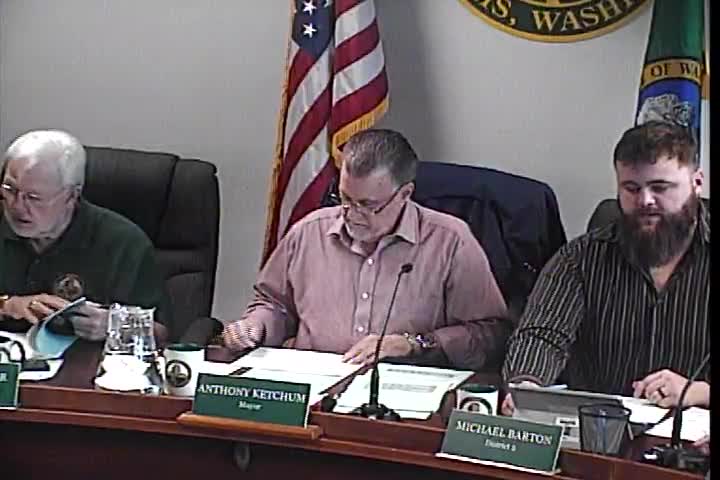
Chehalis council hears utility rate study, approves first reading of water, sewer and stormwater rate ordinances
Summary
City staff presented a multi-year plan to raise water, wastewater and stormwater rates through 2029 to fund capital projects and a planned water-rights purchase; council approved first readings of three related ordinances and kept the purchase and some project timing under review.
The Chehalis City Council opened a public hearing on proposed utility rate increases on Feb. 10, 2025, and approved on first reading three ordinances that would raise water, wastewater and stormwater rates over the next five years.
City staff and the study presenter said the increases are intended to fund aging infrastructure, planned capital projects and a forecasted purchase of additional water rights. Staff presented monthly examples based on an average consumption of 7 CCF (hundred cubic feet) and described the structure as a fixed monthly charge plus a variable usage charge.
The study includes year-by-year increases through 2029. Staff said the current monthly wastewater base of $98.50 would rise to $101.43 in 2025 (a $2.93 increase) with further scheduled increases in later years. Stormwater’s current monthly charge of $9.45 was presented as increasing by about $1.51 in 2025 and stepping up in subsequent years. Water’s current monthly base of $36.54 was presented as rising to $44.22 in 2025 (a $7.68 increase) with additional increases slated for 2026–2029. Staff also proposed raising capital facility charges per equivalent residential unit (ERU): water from $2,071 to $4,093; wastewater from $3,030 to $5,103; and stormwater from $489 to $1,342.
Staff explained the model uses CCF as the billing volume unit (one CCF ≈ 748 gallons) while ERUs are a planning metric (the draft code language referenced an ERU of 300 gallons per day, which staff said the 2022 comp plan revised to 285 gallons per day); staff said the city is updating its code to match the comp plan.
Councilors and staff discussed the schedule and whether the rate increases already assume the city will complete a purchase of water rights from TransAlta. Staff said the city’s capital plan currently forecasts a TransAlta water-rights purchase in the 2025–2026 timeframe, and the purchase amount shown in the plan is roughly $5.9 million for one TransAlta item and roughly $7.15 million for related intake infrastructure (figures presented as program estimates). Staff said the capital plan smooths rate impacts over multiple years but acknowledged the timing of the purchase and of state approvals could change and that if the purchase does not occur the city could revisit rates later.
During the public hearing, a resident asked about a “pinch point” on South Market Boulevard and whether that work is included in the rate forecast. Staff said the Market Boulevard capacity work is in the water capital improvement plan and estimated cost is under $5 million; the project is contingent on coordination with the county and the urban growth area process. A second commenter asked technical questions about bimonthly vs. monthly billing and how ERUs convert to CCF; staff walked through the conversions and noted monthly rates shown in the study were based on 7 CCF as an average.
After public comment and extended council discussion about transparency and timing, the council took the ordinances from the table and approved the first reading of ordinance 1107-b (sewer), ordinance 1108-b (stormwater) and ordinance 1109-b (water) on a voice vote. The transcript records the motion and that the motion passed; it does not include a roll-call tally in the public record excerpt.
Councilors asked staff to provide more regular updates on the capital improvement program and on when specific projects move from planning to design and construction. Staff also said the city intends to move billing from bimonthly to monthly and will give at least a 60-day notice to customers before changing the billing cadence.
The ordinances returned to the council as first readings; staff indicated further hearings and ordinance steps will follow as required by code.