Get Full Government Meeting Transcripts, Videos, & Alerts Forever!
Get email alerts on the Council Policies Procedures topic
No spam. Unsubscribe anytime.
Camas council spends hours on draft policies and procedures, asks for clearer agenda rules and transparency
Summary
Councilors at a March 3 workshop debated a draft policies-and-procedures document that covers quorum rules, agenda preparation, remote attendance and the selection process for mayor pro tem. They directed staff to return revised language and kept the pledge of allegiance in the draft after a head‑nod vote.
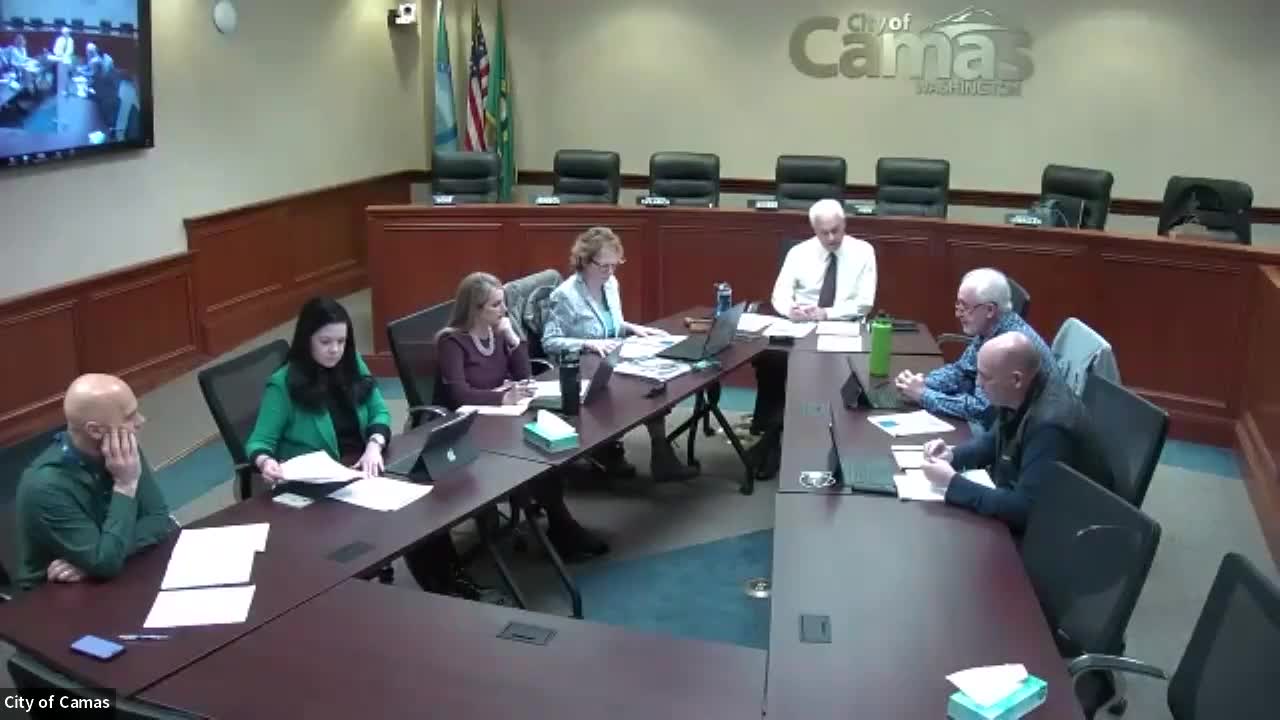
Camas City Councilors spent the bulk of a March 3 workshop reviewing a draft policies-and-procedures document intended to codify how the council runs meetings, sets agendas and appoints a mayor pro tem.
Councilors said the draft — a compilation of practices drawn from other cities and prior council practice — needs clearer language about how agenda items are added or removed, what counts as a quorum, remote participation, and how nominations for mayor pro tem should be handled. The group also took a nonbinding head‑nod vote to leave the pledge of allegiance in the draft rules.
The document’s origin dates back several years, councilors said; it was compiled from other cities’ policies and tailored with local practices. “The planning calendar should give you the months‑forward view,” City Administrator Quinn said during the workshop, urging use of the calendar to sequence work so staff can meet project timelines. Clerk Sydney told the council she would “make changes that you guys are in consensus on” and circulate an edited draft for review.
Why it matters: Councilors said clearer rules would reduce last‑minute agenda surprises for members and the public and avoid procedural confusion when items appear or shift shortly before a meeting. Several members cited an example involving C‑TRAN that they said appeared on a workshop agenda with little advance notice and prompted complaints about transparency.
Key discussion points - Agenda timing and transparency: Councilors debated how early the full agenda — and a shorter “draft” agenda for council review — should be distributed. Staff said a planning calendar already gives multi‑month visibility; several councilors asked for a draft agenda to be sent to members 24 hours before publication so members can flag or request removal of items before they go public. - Quorum and voting thresholds: The draft at one point defines a quorum as a majority (four of seven) but later language refers to different vote thresholds; several councilors asked legal staff to confirm whether some actions require a majority of the whole council or a majority of members present and asked staff to remove inconsistencies. - Remote attendance and continuity: Councilors asked for explicit notice procedures for remote participation (who to notify) and for legal clarification on whether a meeting can continue if a quorum is lost during a virtual session. - Consent agenda and item pulls: The draft preserves the practice that any council member may pull an item from the consent agenda for discussion; some members worried that pulled items can sometimes “go into a black hole” and asked staff to confirm that pulled items will move to the regular agenda and be voted on that meeting. - Mayor pro tem selection and meeting conduct: Members opposed a strictly seniority‑based method for selecting the mayor pro tem and asked that nominations be discussed in a workshop with advance notice before any formal vote. Several councilors also proposed removing or revising suggested limits on debate (for example, “speak only twice on the same subject”) to avoid unintentionally silencing follow‑up clarification.
Action taken and next steps The council did not adopt the document at the workshop; members repeatedly noted they cannot formally vote in a workshop and instead directed staff to consolidate comments and return a revised draft. Clerk Sydney said she will incorporate consensus edits and reissue the document for review.
On whether to remove the pledge of allegiance from the draft, councilors used a head‑nod count during the workshop: 4 in favor of keeping it, 1 in favor of removing it and 1 abstention. The head‑nod vote kept the pledge in the draft for now; staff recorded the result and will reflect it in the next draft. (The head‑nod was taken during a workshop and councilors did not adopt an ordinance or change municipal code.)
What remained unresolved: Councilors asked staff to check the state law (RCW) and guidance from MRSC (Municipal Research and Services Center) about what constitutes a quorum and how agenda changes may be made without violating the Open Public Meetings Act. They also asked legal staff to clarify the rules about excused and unexcused absences and whether the council needs to vote to excuse absences.
Councilors agreed to continue the discussion at a future workshop and to place selection of the mayor pro tem as a standalone workshop topic so members can weigh procedures and nomination timing with advance notice.
Ending: Staff will produce a consolidated draft that integrates the council’s edits and circulation preferences; members asked that draft be provided with enough lead time for the next review so the council can present a clearer document to the public and a newly seated seventh council member when that member joins.