Get Full Government Meeting Transcripts, Videos, & Alerts Forever!
Get email alerts on the State Legislation topic
No spam. Unsubscribe anytime.
Elbert County commissioners summarize CCI meeting positions on state bills
Summary
A commissioner summarized positions and discussions from a recent Colorado Counties, Inc. meeting covering multiple state bills, including a bipartisan signature-verification proposal, a child-support measure and a marijuana-regulation streamlining bill that Elbert County commissioners said CCI opposed.
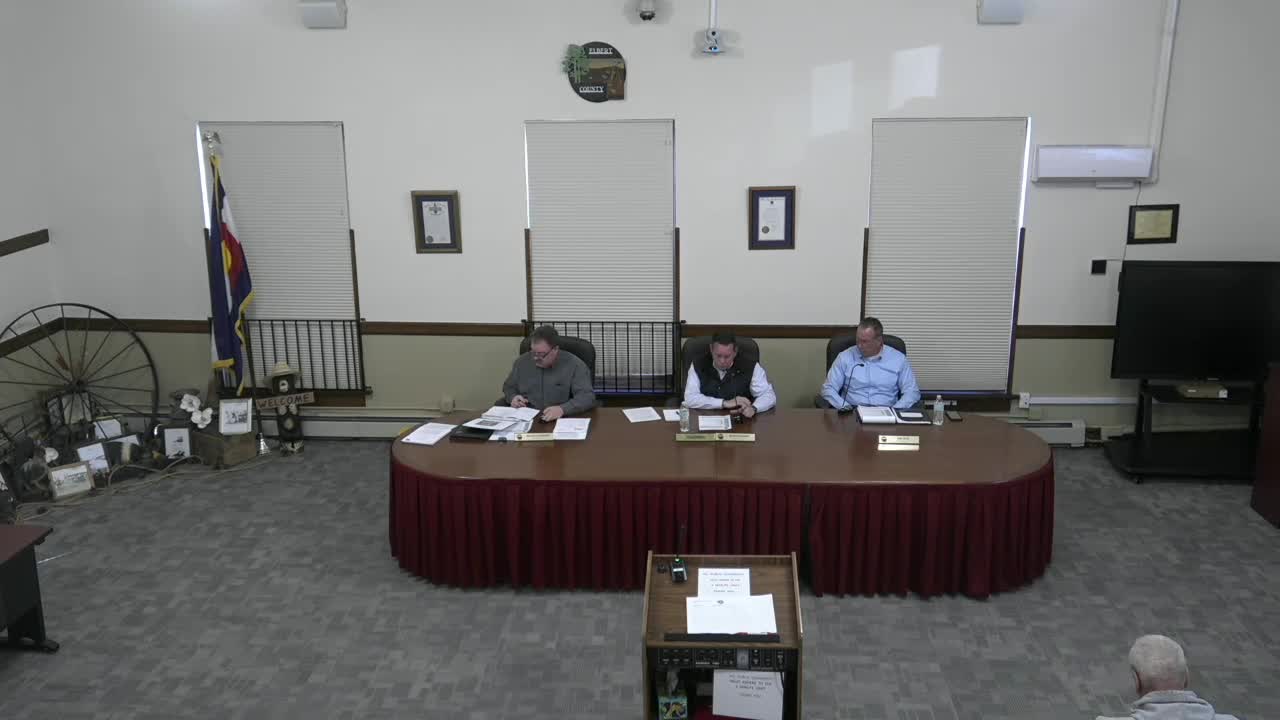
During the Feb. 26 meeting, a commissioner provided an update on actions and discussions from the recent Colorado Counties, Inc. (CCI) meeting and highlighted several state bills that county staff and commissioners had reviewed.
The commissioner said he and Clerk and Recorder Rhonda Braun testified in favor of a bipartisan proposal to require bipartisan teams at the first tier of signature verification for ballots, observing that the current process can be handled by a single person. He identified House Bill 1159 as a measure discussed at CCI and said a staff member appointed to a commission had helped draft changes intended “to smooth out and even child support payments” and address a cliff in payment calculation tied to overnight stays.
The commissioner said CCI debated a bill described in the meeting as "House Bill 25, 12 09," characterized in the meeting as a marijuana-regulation streamlining bill that would among other things increase retail purchase limits (a referenced proposal would increase a purchase limit from 1 ounce to 2 ounces). The commissioner said the CCI position on that bill was one of opposition. He also described other listed bills and CCI positions: a proposed Senate bill intended to reduce costs of state regulation, items on metropolitan district transparency and a bill described in the meeting as a potential semi-automatic firearm restriction; CCI took varying positions (support, oppose, or monitor) on these matters.
The commissioner cautioned that some measures would have administrative implications for counties if enacted; he referenced Teller County’s review estimating additional administrative staff and deputies would be needed to implement certain firearm-related amendments. He also said CCI at times votes on positions by percentage thresholds and that some measures failed to reach the 65% threshold required for a CCI position.
The update was presented as information only; no formal county-level policy changes or votes were recorded at the Feb. 26 meeting on these bills.
Ending: Commissioners said they will continue to monitor the bills and report back to the board as more details become available.