Get Full Government Meeting Transcripts, Videos, & Alerts Forever!
Get email alerts on the School Budget topic
No spam. Unsubscribe anytime.
Waunakee budget committee advances preliminary 2025-26 budget plan, flags insurance and compensation decisions
Summary
The Waunakee Community School District Budget Committee voted to advance the preliminary 2025-26 budget planning document to the full board, highlighting a projected 5% health insurance cost increase, referendum-funded hourly pay boosts, and the need to restore post-employment benefit funding.
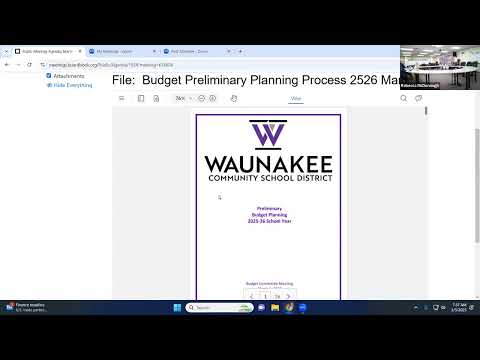
The Waunakee Community School District Budget Committee on March 5 voted to move the preliminary 2025-26 budget planning document to the full school board for approval at the March 9 meeting, with staff noting upcoming decisions on health insurance renewal and compensation that will affect the draft budget.
Committee members were told the district’s insurance proposals indicate roughly a 5% year-over-year cost increase for the district’s contribution to health insurance — about $250,000 on top of roughly $5,000,000 the district invested in 2024-25 — and that the HR committee will review vendor responses in April before the board acts. “This month, we would just be looking for approval to take [the document] in the full board next Monday,” Allie (Staff member) said when presenting the packet.
The committee heard that compensation planning for the 2025-26 school year has two main prongs: (1) implementing referendum-funded hourly pay increases (the November 2024 referendum included $500,000 in 2025-26 and another $500,000 in 2026-27 to raise hourly staff toward county averages) and (2) broader salary/CPI negotiations and compensation-system changes tied to collective-bargaining and district policy. Steve (Staff member) summarized timing: insurance proposals will be considered in April and compensation decisions are slated for May, though staff cautioned about state budget timing. “There is a bit of protection right now in the school budgeting process and that there's a number in the current law,” Steve said, referencing the state-level figure staff used in modeling.
Committee members also discussed post‑employment benefits (OPEB). Staff reported the district’s OPEB liability has decreased because the district is paying previously banked pension/point obligations now rather than deferring them, and an HRA account has grown. However, administrators said the district has drawn on a secondary trust built before COVID and must shift some funding back into current-year budgets to meet OPEB obligations in 2025-26. Dr. Brown (Staff member) and Steve described staff efforts to identify internal reallocation opportunities (for example, reducing redundant software subscriptions) so the district can prioritize OPEB without a large one‑year shortfall.
The committee approved advancing the planning document to the full board. The committee’s action was procedural: it advances the draft so the board can see a first budget and consider insurance and compensation decisions in the coming months. No final insurance or compensation decisions were made in committee; staff will return with the insurance committee’s recommendations and detailed compensation proposals.
Committee members asked for more detailed figures and staged options (for example, multi‑year “stair step” approaches) should the board prefer to spread costs across years. Staff said vested funds released when employees leave the district (previously noted as sometimes up to $50,000 in a single year) could be part of a short‑term strategy to smooth the transition. The committee did not adopt a specific reallocation plan at the meeting.
The packet and discussion emphasized distinctions between discussion, staff direction, and formal action: advancing the planning document is a procedural vote to place the draft before the full board; separate formal decisions on insurance renewals and compensation will follow the HR and board processes described by staff.
Votes at the meeting were recorded verbally; the committee called for and received an affirmative voice vote to advance the planning document. The committee adjourned after covering the agenda.