Get Full Government Meeting Transcripts, Videos, & Alerts Forever!
Get email alerts on the Temporary Encampments topic
No spam. Unsubscribe anytime.
Burien planning commission backs permanent permitting framework for temporary encampments, asks for stronger notice and legal review
Summary
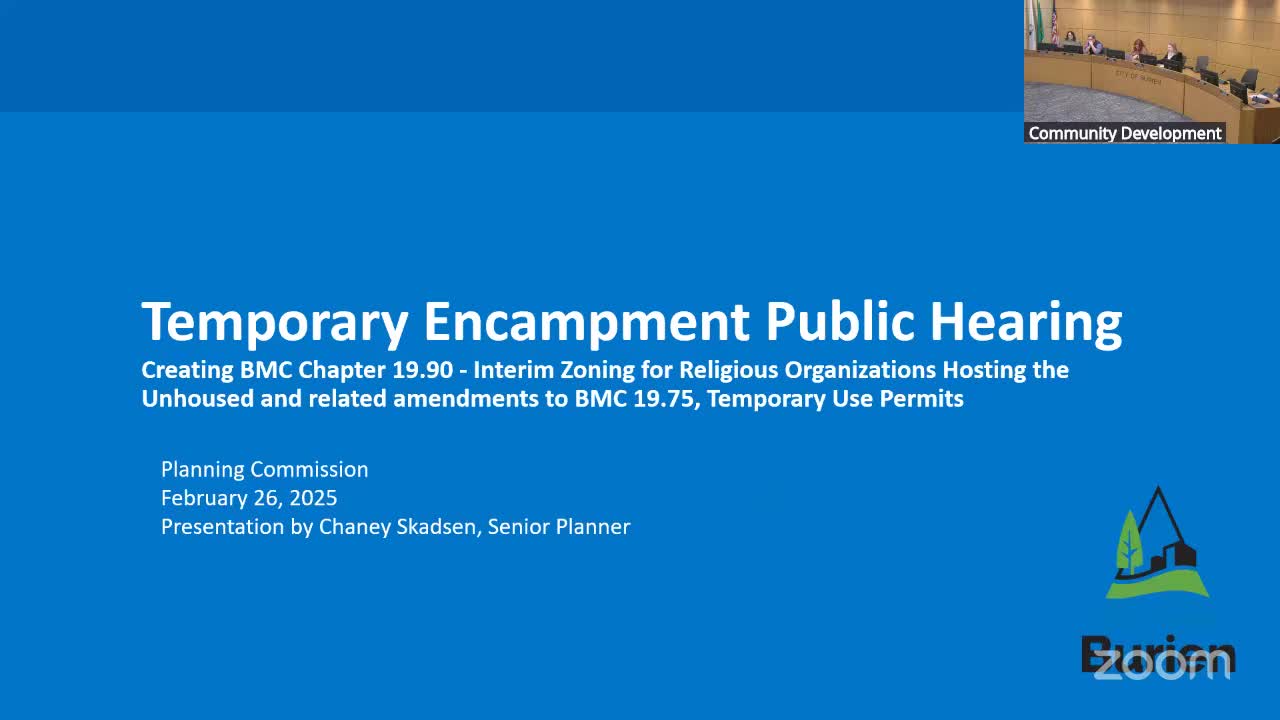
The Burien Planning Commission on Feb. 26 recommended that the City Council adopt permanent permit provisions to allow temporary encampments hosted on property owned or controlled by religious organizations under House Bill 1754, and asked staff to require broader public notice and to ask the city attorney whether an on‑site organizational representative can be legally required.
The Burien Planning Commission on Feb. 26 recommended that the City Council adopt permanent permit provisions to allow temporary encampments hosted on property owned or controlled by religious organizations under House Bill 1754, while asking staff to require broader public notice and to check with the city attorney about whether an on‑site organizational representative can be required.
The recommendation follows a staff presentation by Chaney Skadsen, senior planner, who said that “House Bill 1754 … required cities like Burien to allow the siting of temporary encampments on property owned or controlled by religious organizations.” Skadsen told the commission the draft code implements the statute’s forms of temporary encampments, procedural safeguards, and public‑notice and memorandum‑of‑understanding (MOU) requirements.
Why it matters: The draft code is meant to replace an interim zoning ordinance and create a permanent permitting pathway for tents, vehicle resident safe parking, small (up to 120‑square‑foot) on‑site shelters, and indoor overnight shelter uses on religious property. Supporters said a permitting framework can improve sanitation, site design and public safety compared with uncoordinated encampments. Critics and some commissioners raised concerns about community notice, on‑site management, buffer distances and legal limits set by state law.
Key facts and provisions
- Statutory basis and schedule: The staff presentation noted HB 1754 (2020) requires cities to allow temporary encampments on religious property. Staff said the draft code mirrors the interim zoning ordinance and that tentative City Council dates are March 24 and April 7 for ordinance consideration. (Chaney Skadsen, senior planner.)
- Types of allowable temporary encampments: The draft code implements the statute’s four forms: tents/outdoor encampments; vehicle resident safe parking; temporary small on‑site shelters (capped at 120 square feet by statute); and indoor overnight shelters.
- Term limits and renewal: Small on‑site shelters and indoor overnight shelters may operate for up to one year; outdoor tent encampments and vehicle resident safe‑parking are limited to six months in a calendar year. The code allows renewals; staff said renewal terms and public notice requirements must be documented in an MOU between the city and host. The draft also allows a three‑month break between some successive operations to avoid back‑to‑back uses in the same location.
- Health, sanitation and inspections: The draft ties sanitary standards to guidance from Public Health — Seattle & King County and requires applicable building, electrical and fire permits and inspections. Staff said the public‑health guidance will be included in the permitting packet for applicants. (Chaney Skadsen.)
- Unit size and spacing: Staff noted the statute requires a maximum unit size of 120 square feet and units set at least six feet apart; those limits are reflected in the draft code.
- Safety checks and law‑enforcement checks: The code requires hosts to ask the police to run an offender registry or active warrants check; staff clarified dispatch returns a yes/no response and that detailed case information is not shared by dispatch.
Commission response and public input
Public comment included a Gregory Heights resident who asked for clarification of buffer and notice rules. Commissioners pressed staff on how the code interprets buffer measurements (staff said the city measures from the property perimeter and expands that distance for notification) and whether the 10% parking allowance for vehicle safe‑parking could be increased by MOU. Staff confirmed the code sets 10% as an available baseline and allows larger allocations if the MOU specifically agrees to them.
Several commissioners urged stronger community engagement. One commissioner proposed monthly meetings during operations; staff and other commissioners noted the state statute prescribes minimum requirements and cautioned that imposing additional mandatory conditions on religious hosts could be preempted by the statute or invite legal challenge. Staff repeatedly recommended running proposed additions by the city attorney and said the ordinance and any added requirements must be defensible under state law and constitutional limits.
Commission motion and commission direction
Commissioner Jimmy moved that the planning commission recommend the temporary encampment permit provisions to city council with three specific additions: (1) revise proposed code section 19.91.20 to require all forms of notification rather than allow alternatives; (2) have proposed code section 19.90.050(6) (the provision that now reads “strongly encouraged”) reviewed by the city attorney to determine whether the city can legally and defensibly make an on‑site organizational representative a requirement rather than a recommendation; and (3) direct the Community Development Department to work with the Human Services Division to assemble best‑practice informational materials for future applicants. The motion was seconded and, following a recorded vote, the commission approved the recommendation and the listed additions (the minutes record a messy roll call and staff noted the final motion passed). The motion text as read at the meeting will be included in the official minutes and packet sent to council.
What staff will do next
Staff said they will: (a) prepare ordinance language translating the draft code into ordinance form for council; (b) run the commission’s requested changes and the “strongly encouraged” language past the city attorney; and (c) coordinate with the Human Services Division to produce outreach and best‑practice materials to provide to applicants. Staff repeated the tentative council schedule of late March and early April for council consideration.
Ending
The proposal aims to balance state law allowing religious hosts to site temporary encampments with locally required public‑health, safety and notice provisions. The City Council will receive the commission’s recommendation and the draft ordinance for further action on the dates staff provided. Further technical changes may follow the city attorney’s review.