Get Full Government Meeting Transcripts, Videos, & Alerts Forever!
Get email alerts on the Railbelt Energy Scenarios topic
No spam. Unsubscribe anytime.
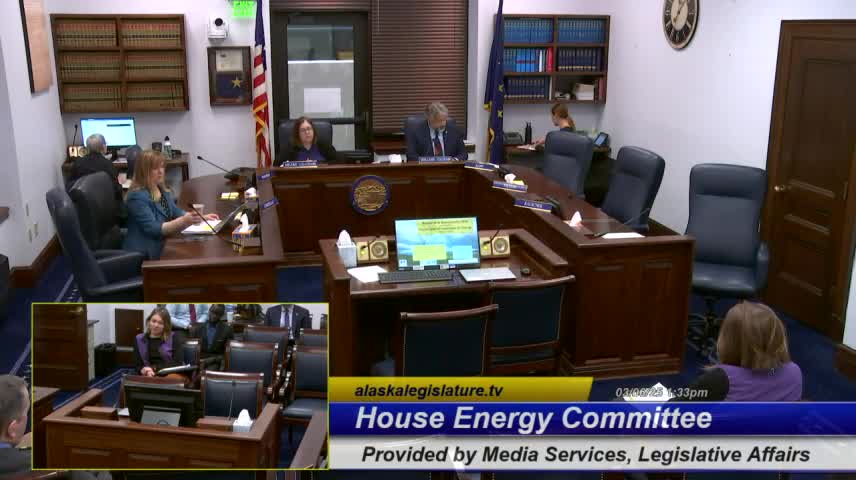
House Energy Committee hears UAF analysis: Railbelt can meet double the load by 2050 but will still need dispatchable generation
Summary
Researchers from the Alaska Center for Energy and Power told the House Energy Committee that the Railbelt could accommodate a scenario in which electricity demand doubles by 2050, but even high renewables buildouts would still require significant thermal or other dispatchable capacity, extensive transmission upgrades, and added grid controls.
The Alaska House Energy Committee on March 6 heard new modeling from Steve Colt, research professor at the Alaska Center for Energy and Power (ACEP) at the University of Alaska Fairbanks, showing the Railbelt can accommodate a scenario in which electricity demand doubles by 2050 but would still rely on significant dispatchable generation and transmission upgrades.
Colt said ACEP’s updated mid-2024 scenario set — which the committee reviewed again in Juneau — deliberately tested a high-growth “doubling” demand case driven largely by electrification (including widespread electric vehicle adoption and potential new large loads such as data centers). “We could meet the doubled load with a minimal additional investment in thermal capacity,” Colt told the committee, noting that the production-cost modeling runs hour-by-hour to ensure reserves and reliability.
Why it matters: the presentation shows that even an aggressive “wind + solar + batteries” pathway still produced roughly 20–25% of annual generation from existing thermal units in ACEP’s simulations, because thermal plants provide the synchronous inertia and dispatchable energy needed in dark winter hours. Colt told lawmakers the blue (wind/solar) scenario used only proven technologies and avoided so-called anchor resources (large projects forced into other scenarios such as Susitna–Watana hydro, Cook Inlet tidal, or small modular reactors) in order to test a near-term, commercially proven pathway.
Key findings and assumptions included: ACEP modeled a high-demand scenario that could be driven by EV adoption and some industrial loads, treated about 20% of EV load as flexible/dispatchable (a modeling “hack” Colt said engineers accepted electrically), assumed existing lithium-ion battery costs (mostly 2-hour and many 30-minute systems, with no long‑duration storage beyond ~6 hours), and applied an Alaska construction cost multiplier (~1.3). Fuel was assumed available in 2050 at roughly $14 per million BTU for gas (the study used that fuel-price baseline in many cases). Colt also said the analysis used a 5% interest rate for debt-financed capital in its cost calculations.
On reliability and grid operations, ACEP’s engineers ran focused tests on the most challenging hours (typically dark, low‑wind winter periods) and concluded that a large increase in inverter-based resources (wind, solar, batteries) reduces system inertia. To replace synchronous inertia, the engineers found batteries outfitted with grid‑forming inverters, synchronous condensers or other equipment and targeted transmission upgrades are required. Colt said some grid-forming or stability solutions failed in early tests and that the final stable option included batteries with grid‑forming inverters and additional equipment placed strategically on the system.
Transmission: the study assumes major transmission upgrades are available and modeled the Kenai–Anchorage 230 kV upgrade and a 230 kV northern intertie upgrade to Fairbanks; ACEP included those upgrades’ costs in capital estimates. Colt noted the model used a unified economic dispatch that produced much larger and often bidirectional flows on the interties than exist today, which increases transmission utilization and the need for robust lines and controls.
Costs and sensitivities: ACEP’s capital-stack estimates show much higher up-front capital for high‑renewable or anchor‑resource scenarios versus a fuel‑dependent business-as-usual (BAU) case. However, Colt said the model’s sensitivity runs (25 cases) produced broadly similar projected retail costs across scenarios under the base set of assumptions; if fuel prices ran materially higher, wind/solar scenarios became relatively more favorable. Colt cautioned that construction‑cost uncertainty and federal incentive levels (the team used a 30% tax‑credit assumption but noted some expect higher credits under the Inflation Reduction Act) materially affect outcomes.
Limitations and unresolved areas: Colt told the committee ACEP did not deeply model demand‑side programs beyond treating 20% of EV load as flexible, and the team did not fully explore co‑locating large loads (data centers, mines) with generation sites. He also said the team lacks ongoing licensed-model capacity to run rapid new scenarios without funding and personnel to maintain the tool chain.
Representative questions singled out data centers and the timing of load growth, transmission costs and placement, battery-duration assumptions, and whether demand could be shaped to reduce capital needs. Colt’s closing recommendation to lawmakers was to emphasize “optionality” in planning — prioritize projects that preserve flexibility rather than foreclosing future choices — and to continue more granular analysis of transmission, operations, and demand response options.
The committee did not take formal action or vote on legislation at the March 6 meeting; Colt’s presentation concluded the substantive agenda. Co‑chair Holland thanked Colt and ACEP for the updated analysis and closed the hearing.