Get Full Government Meeting Transcripts, Videos, & Alerts Forever!
Get email alerts on the Campus Protest Hb 6602 topic
No spam. Unsubscribe anytime.
Bill would suspend HOPE for students convicted in campus protests; lawmakers debate scope
Summary
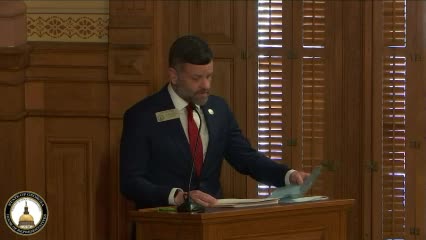
Representative James Fleming, a member of the Georgia House of Representatives, introduced House Bill 6602 to the House Rules Committee on crossover day, describing it as a measure to strip state financial support from students convicted of certain acts of violence, vandalism or aggression on college campuses.
Representative James Fleming, a member of the Georgia House of Representatives, introduced House Bill 6602 to the House Rules Committee on crossover day, describing it as a measure to strip state financial support from students convicted of certain acts of violence, vandalism or aggression on college campuses.
The bill would apply to students who receive state scholarships, loans or grants — "such as HOPE" — at Georgia public and private postsecondary institutions and would suspend their state financial support for one semester following a conviction, Fleming said. "We're not talking here about peaceful protest," Fleming said. "...once the line is crossed and there are laws broke, that is what we're going after." (Representative James Fleming)
Why it matters
HOPE is a major state scholarship program used by thousands of Georgia students; altering eligibility rules would affect students' ability to pay tuition and remain enrolled. Supporters framed the bill as a tool for campuses and systems to address unruly or criminal conduct; critics said the text as drafted could reach peaceful civil disobedience.
What lawmakers debated
Representative Miller pressed the bill’s sponsor on scope and consequences, saying, "My concern is this if a student on a campus violates the criminal code, gets arrested, gets convicted, gets sentenced, gets suspended or expelled from school," and asking how the bill would interact with disciplinary and criminal processes. (Representative Miller)
Representative Webb sought specifics about earlier committee language and whether actions such as "booing, hissing, and a sit in" could be penalized under the new measure. Fleming responded that the bill targets criminal conduct and reiterated that peaceful protest was not the intent.
Representative Evans pointed out a factual limit in the sponsor’s framing: "you can peacefully violate the law," arguing that civil-rights–era protests that were peaceful nonetheless were unlawful at the time and could produce criminal convictions. Fleming replied that the bill requires conviction and due process before the sanction — "you have to go through the due process... and you have to be convicted." (Representative James Fleming)
Committee chair (referred to as Mr. Chairman in the transcript) urged members to continue discussions outside the hearing after several lawmakers asked for further clarification. "I'm gonna suggest that all of you have conversation offline," the chair said before the committee moved on to other items.
Where the bill stands
No committee vote or formal action on HB 6602 appears in the transcript. Lawmakers asked for follow-up conversations and clarifications about language in the bill that the transcript cites as including the phrase "otherwise unlawful" (line 36 in the bill text, as referenced during the hearing).
Clarifying details from the hearing
- Penalty: suspension of state financial aid, including HOPE, for one semester following a conviction (Representative James Fleming). - Scope: applies to students who receive state scholarships, loans or grants "such as HOPE" at Georgia public and private postsecondary institutions (Representative James Fleming). - Threshold: sanction triggers only after criminal conviction and due process, per sponsor's statements. - Contested language: committee discussion highlighted the phrase "otherwise unlawful," which members said could be interpreted to cover peaceful but unlawful civil disobedience.
What’s next
Committee members requested further discussion and clarification of the bill’s language and potential unintended effects; the transcript records no final vote or formal committee action on HB 6602 during this session.