Get Full Government Meeting Transcripts, Videos, & Alerts Forever!
Get email alerts on the Housing topic
No spam. Unsubscribe anytime.
Council hears draft middle-housing code update; parking and utilities emerge as major concerns
Summary
Planning staff briefed the council on a draft middle-housing code update required by recent state legislation. Council members raised concerns about on-street parking, utility hookups and potential unintended consequences for historic streets and short-term rentals.
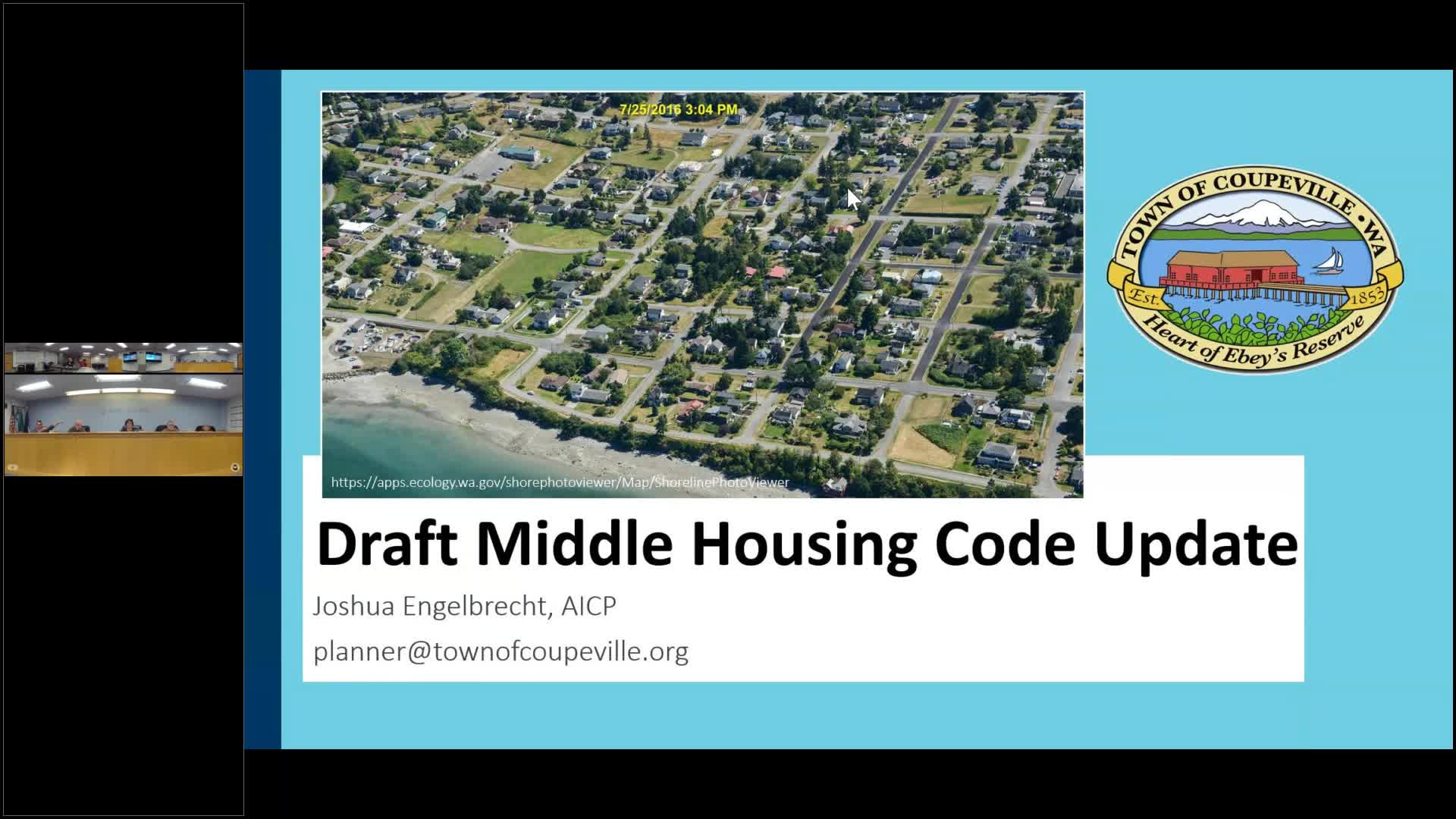
Town planning staff presented a draft middle-housing code update Jan. 14 that responds to recent state laws expanding accessory dwelling unit (ADU) allowances and requiring tools to encourage ‘middle housing’ (duplexes, triplexes, cottage courts and townhomes).
Planning staff member Joshua (last name not provided in the meeting transcript) said the project began in March 2024 with a $35,000 Department of Commerce grant and community engagement meetings. The draft adds a unit-lot subdivision mechanism (a condominium-style ownership model) and allows up to two ADUs per single-family lot in compliance with state law. The draft also expands allowed uses in residential zones to include several middle-housing types and proposes supplemental standards intended to keep new buildings compatible with single-family neighborhoods.
Council members asked detailed follow-up questions about parking, narrow historic streets, stormwater and how utility hookups and meter rules would apply when multiple dwelling units share a single parent parcel. Several councilors said narrow historic rights-of-way and the town’s existing stormwater/ditch network limit on-street parking and that any program that effectively increases demand for curbside parking could change the town’s character and create enforcement headaches.
Council discussion touched on several points staff flagged as open questions: whether the town should offer fee waivers or incentive packages (for example, reduced parking or hookup requirements) tied to permanent affordability restrictions; whether to permit residential units at ground level in commercial zones; and how to ensure deed-restricted affordable units are enforceable and monitored. Staff noted the Department of Commerce runs a reimbursement program that can offset locally waived hookup fees in some cases, and said many details — including the precise wording of parking incentives — would be refined before the planning commission’s public hearing process.
Why it matters: the draft implements state housing mandates and could materially change the form of new housing in Coupeville — enabling more small multi-unit and accessory units in areas now dominated by single-family homes. Council members said they support the goals but emphasized the potential for unintended consequences tied to parking, narrow historic streets and utility billing.
Next steps: staff will revise the draft based on council input and expects to submit a near-final draft in late January for Planning Commission review; the planning commission is likely to open a public hearing in February, with subsequent hearings and council review anticipated in March if the schedule remains on track.