Get Full Government Meeting Transcripts, Videos, & Alerts Forever!
Get email alerts on the Land Use Design Review topic
No spam. Unsubscribe anytime.
Council hears overview of state-mandated design-review changes, city staff to propose clearer objective standards
Summary
Interim planning director Shane Hope and planning manager Mike Clugston briefed the council on state legislation (House Bill 1293) requiring streamlined, clear and objective local design-review standards; staff will return with proposed code amendments, images and options for administrative vs. board review.
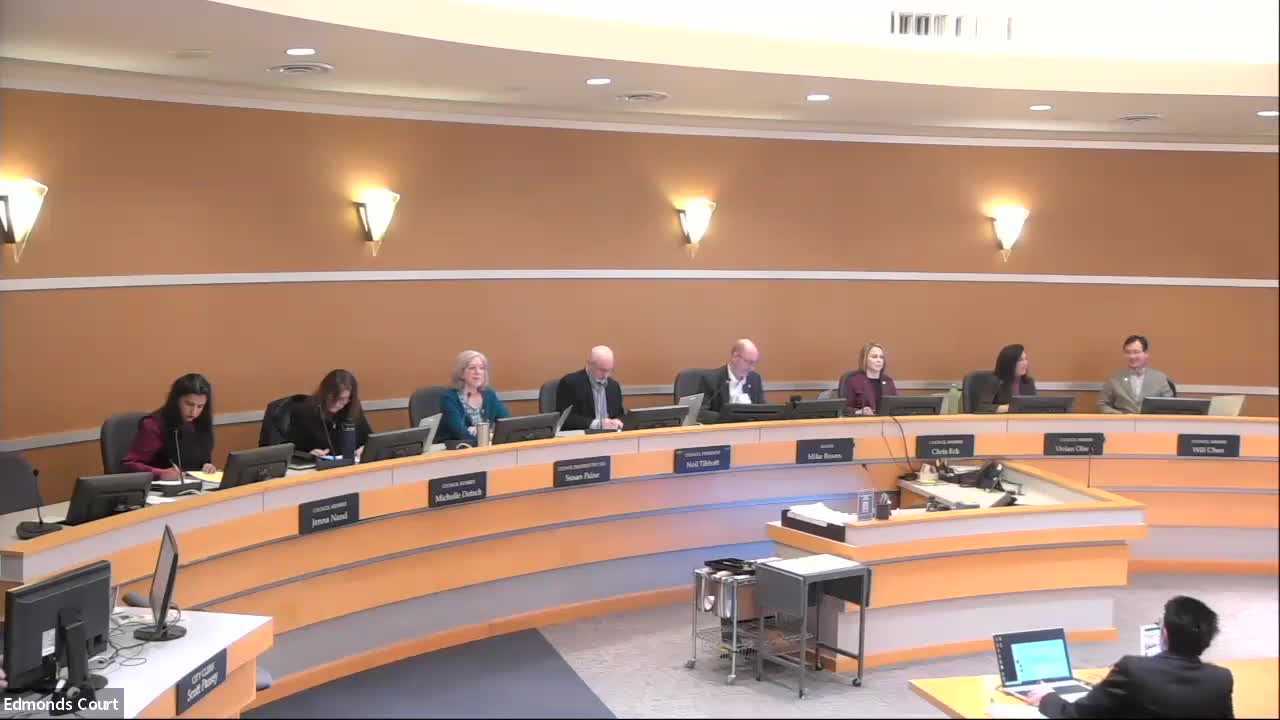
Interim Planning and Development Director Shane Hope and Planning Manager Mike Clugston briefed the Edmonds City Council on Feb. 25 about upcoming development-code work prompted by state law requiring clearer, objective design-review standards.
Hope summarized the state requirement (House Bill 1293) and its principal requirements: design review should be streamlined, use clear and objective standards, be conducted concurrently with consolidated project review and avoid multiple public hearings for the same decision unless state law requires otherwise. He said the legislation is intended to shorten uncertain, costly review paths and reduce variance between projects by giving applicants and the public more predictable rules.
Hope and Clugston described Edmonds’ current mix of design-review processes: administrative staff review for many small projects; staff recommendation plus Architectural Design Board decisions for larger projects; and a two-phased district-based review that applies in certain zoning districts (for example, downtown and some Highway 99 sites). Hope noted the city’s comprehensive plan currently contains some design guidance that functions like policy but is not written as clear, objective code standards for daily permitting.
Staff identified three broad tasks for forthcoming code work: (1) consolidate and relocate design standards from the comprehensive plan into development-code chapters so they are enforceable, (2) convert vague “should” guidance into objective criteria (dimensions, percentages, measurable thresholds and drawings where useful) and (3) define which project types should be reviewed administratively and which require board review under the state rules. Hope said the planning staff will prepare options for the planning board and council, including example graphics and “plug-and-play” language drawn from Department of Commerce materials and other jurisdictions, with the aim to complete code updates by mid-2025.
Council members and board members in attendance discussed trade-offs: images and diagrams can clarify expectations and reduce subjectivity, but some community members want local design character preserved. Hope said local character can be maintained through district-specific objective standards. Several council members supported more visual examples in the code and urged staff to reuse prior ADB / planning-board work where appropriate. Hope said the city will prepare examples and trade-off analyses for subsequent hearings.
Ending: Staff will return with proposed code amendments, illustrative graphics, and options on administrative versus board review; the council did not adopt any code changes at the Feb. 25 meeting.