Get Full Government Meeting Transcripts, Videos, & Alerts Forever!
Get email alerts on the Public Safety Fire Ems topic
No spam. Unsubscribe anytime.
South County Fire reports 60% cardiac-arrest survival rate, details contract metrics and community programs
Summary
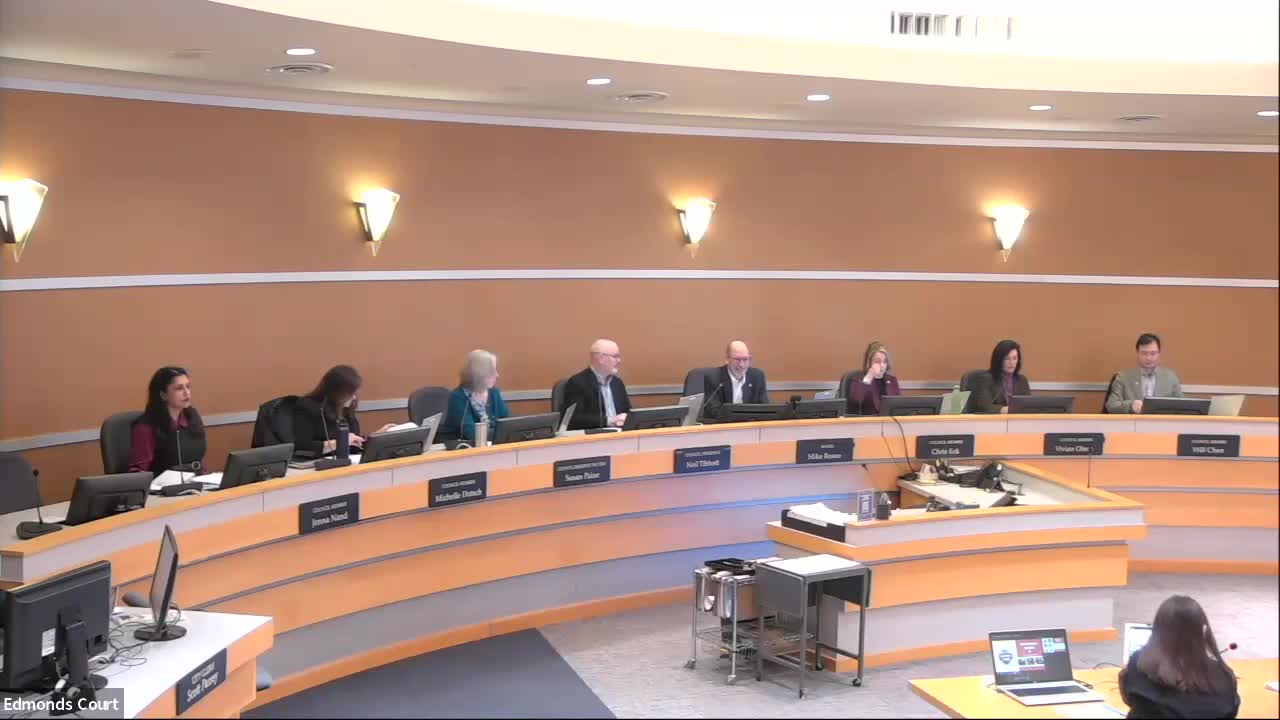
South County Fire and Rescue presented its 2024 annual report to the Edmonds City Council on Feb. 25, reporting 6,334 calls in Edmonds, a preliminary 60% cardiac-arrest survival rate in the city, and detailed contract and response metrics tied to the interlocal agreement with the regional fire authority.
South County Fire and Rescue delivered its annual report to the Edmonds City Council on Feb. 25, outlining response volumes, patient outcomes and the regional contract framework that governs service in Edmonds.
The presentation said the agency responded to 38,676 calls across its service area in 2024, with 6,334 of those calls in Edmonds. Communications Director Christy Haley told the council, “South County Fire is proud to be serving the Edmonds community for 15 years.” Haley and agency chiefs emphasized that most calls are medical in nature and that the department trains and staffs for that demand.
The report highlighted cardiac-arrest outcomes in Edmonds, where the RFA’s preliminary survival rate was reported at 60 percent — well above commonly reported national averages. Haley said the rate has held near 50 percent for at least the last 10 years and that “we think this rate will probably go up. But right now, we know it's at least going to be 60 percent.” The department credited “high performance CPR” protocols, multi-person responses (typically nine to 12 firefighters on cardiac arrests) and equipment such as mechanical compression devices (Lucas) and whole blood carried on the medical services officer unit.
The presentation reviewed the Community Resource Paramedic program, which the RFA said reduced 911 calls by participating clients by about 50 percent. Haley said RFA staff trained more than 25,000 people through an “act” program, including 2,775 Edmonds residents, and that in 2024 the community paramedic program had 307 Edmonds clients, equal to 22 percent of the program’s clients. Assistant Chief Sean Maxwell described the rough dollar calculus for avoided emergency costs: “There’s various estimates on what it costs to respond, to each response, say, $4,000 or $5,000 for an EMS response,” and hospital admissions can multiply those costs.
Chief Eastman and other RFA leaders reviewed contract- and ILA-related metrics the city and RFA report annually: 90th-percentile total response time (dispatch to arrival), turnout time (dispatch to en route) and unit-hour utilization. The RFA reported a 90th-percentile total response time of 9 minutes, 32 seconds, and a turnout-time 90th-percentile of 2 minutes, 50 seconds, slightly outside Edmonds’ adopted turnout standard of 2 minutes, 45 seconds. The RFA’s standard-of-cover metrics and the interlocal agreement’s neighbor-unit utilization and transport-balancing calculations were shown in slides and discussed at length by council members and RFA staff.
When asked about the status of the contract after Feb. 2025, Chief Eastman said any future agreement outside annexation would require “parity,” meaning service and tax/benefit levels consistent with RFA members, and would not be structured as a cost-plus contract. “If we move forward with an agreement that’s outside annexation, it has to be what we call parity,” Eastman said.
Council members pressed on several recurring technical issues raised in the report: why so many personnel are dispatched to multi-vehicle collisions (RFA staff explained the choreography of triage, extraction and scene safety), how unit-hour utilization and neighbor-unit utilization factors are calculated, the recent imbalance in transport-balancing numbers, and how hospital offload times affect field availability. Assistant Chief Maxwell described operational tactics the RFA uses to manage hospital backlogs, including deploying community paramedics to observe patients so ambulances can be returned to service.
Public comment during the meeting included multiple speakers urging clarity on the fiscal impacts of any annexation to the RFA, and some residents urged support for annexation to preserve the current level of service. Retired firefighters and longtime residents also spoke in favor of maintaining service levels and emphasized the RFA’s cardiac-arrest outcomes.
The council did not take a final policy vote on annexation or contract changes that evening. The council proceeded to routine agenda votes (approval of the agenda and consent agenda) after the presentation. RFA staff said more detailed reports, options for future contract structures, and additional analysis will be brought back to the council and to public meetings as the city and RFA continue their discussions.
Ending: The RFA presentation provided detailed metrics and described programs the RFA credits with improved outcomes in Edmonds, but it also surfaced several technical, budgetary and process questions that the council and public asked the RFA to clarify in follow-up briefings. The city and the RFA indicated they will return with more granular data on transport-balancing, unit-hour utilization and possible contract options before any final decisions are made.