Get Full Government Meeting Transcripts, Videos, & Alerts Forever!
Get email alerts on the Homelessness Policy Hb1380 topic
No spam. Unsubscribe anytime.
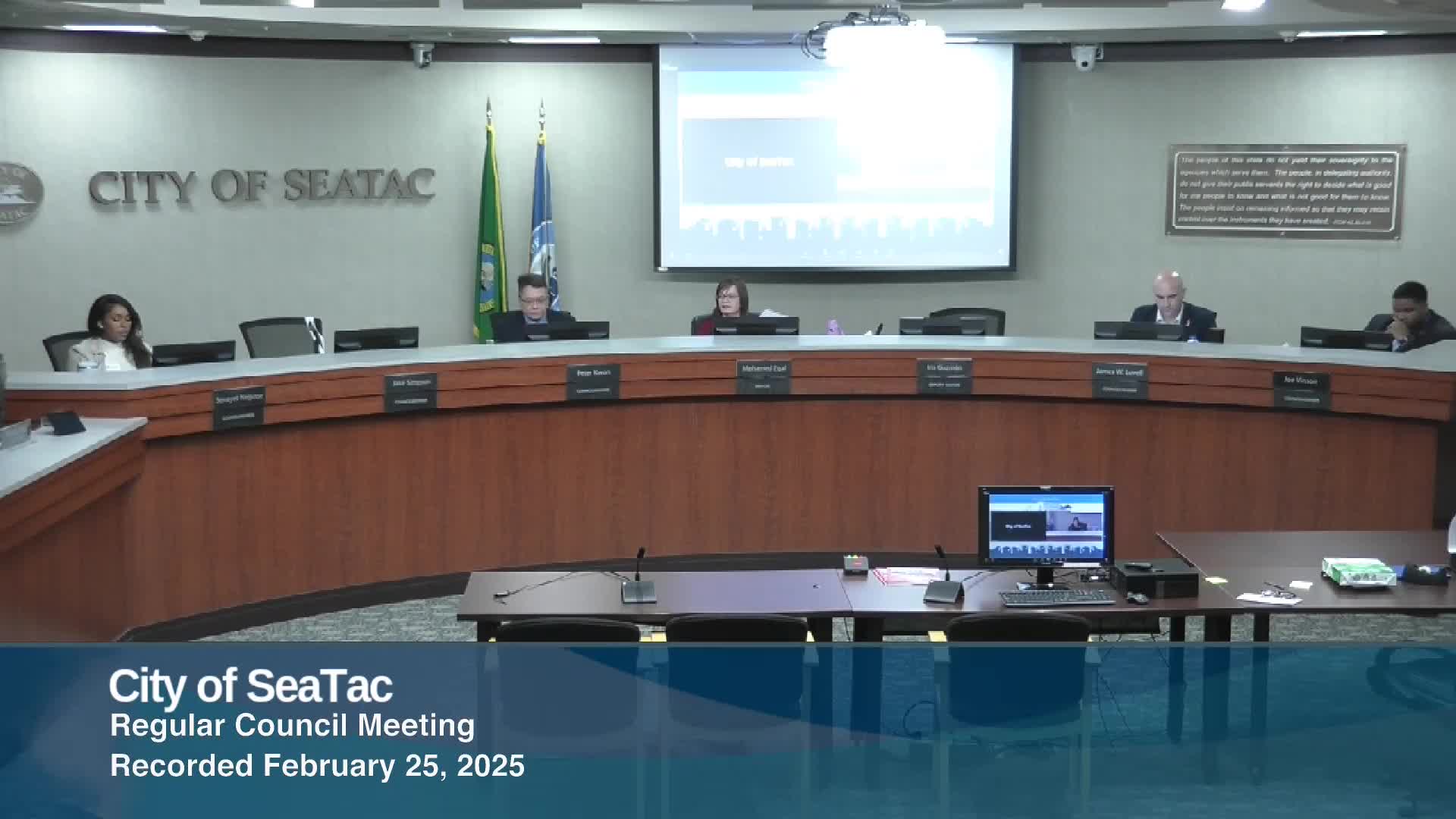
SeaTac council weighs state bill on camping restrictions; members split on AWC position
Summary
City Manager briefed council on House Bill 1380 (siting/time/manner test for camping restrictions). Councilors split: some urged support for Association of Washington Cities' concerns about litigation risk, others want clearer statewide standards.
City Manager Jonathan Young asked the council for direction on House Bill 1380, a state proposal that would require municipalities to make restrictions on public camping objectively reasonable as to time, place and manner and could allow people experiencing unsheltered homelessness to sue local governments, he said.
Young told council the Association of Washington Cities (AWC) has raised concerns that an “objectively reasonable” standard could increase litigation against cities and reduce deference that followed the U.S. Supreme Court’s recent Grants Pass v. Johnson decision. He asked whether SeaTac should take a position different from AWC’s stated concerns.
Council response was split. Council Member Lovell said he supports the bill’s clearer standard and has repeatedly attended legislative sessions to voice support; "I'm kind of holding the left flank on this one," he said. Council Member Kwan argued SeaTac should remain engaged with AWC because the association represents every city in Washington and offers a strategic statewide lobbying platform.
Several councilors asked for more information before taking a formal position, including a clear list of risks the city could face under the bill’s language and examples of how the standard would apply to SeaTac’s camping and enforcement policies. Council Member Neguse asked staff for clarity on whether the bill is an effort to create statewide consistency after changes in federal and circuit precedent.
Young summarized the legal context: Martin v. Boise (Ninth Circuit) previously constrained camping enforcement; Grants Pass v. Johnson reversed much of that deference, allowing cities more local discretion. He said AWC’s concern is that an objectively reasonable test could open cities to litigation.
Council did not direct staff to break from AWC. Young said staff would continue to monitor the bill and pursue engagement through AWC and direct contacts with state legislators; members asked staff to return if language changes or if the city should consider a distinct position.
No formal council vote was taken on a city position during the meeting.