Get Full Government Meeting Transcripts, Videos, & Alerts Forever!
Get email alerts on the Public Comment Policy topic
No spam. Unsubscribe anytime.
SeaTac council debates prioritizing local speakers in public comment rules
Summary
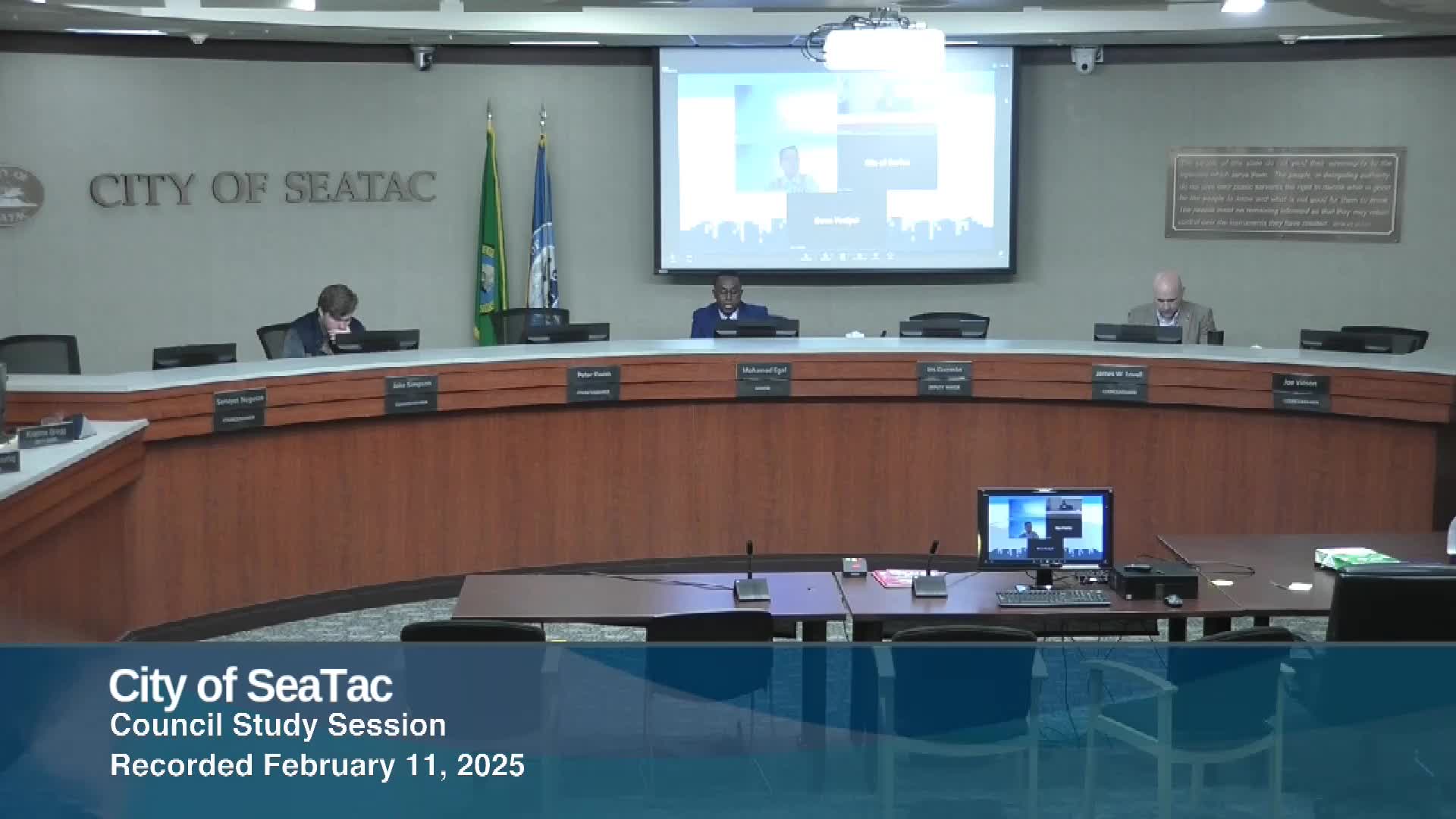
SeaTac City Council members discussed proposed administrative-procedure language to prioritize local residents and businesses for public comment but did not adopt new rules during the study session.
SeaTac City Council members spent part of a study session reviewing proposed changes to the council administrative procedures that would prioritize “local voices” during public comment, but they did not adopt new rules.
The city clerk, Christina Greg, said the language under discussion was provided by Council Member Vinson and had already been reviewed by the city attorney’s office. Greg told the council staff had prepared three options: (1) explicitly prioritize local residents and businesses for speaking order, (2) a narrower prioritization, or (3) remove prioritization language. She said staff had been leaning toward option 3 (removal) but was seeking direction.
Council Member Peter Kwan said legal review had been completed and posed no barrier to any option. Council Member Simpson and Mayor LaVelle both described the proposal as a “solution looking for a problem,” noting the city rarely receives more than a handful of commenters and that the current sign-up and mayor’s prompts already control length and order. Several members said they were worried about enforcement — specifically, how the city would verify claimsof residency or business affiliation if the council were to prioritize local speakers. Staff noted the sign-in sheet could be closed 15 minutes before a meeting so staff could check affiliations, but verification would largely rely on an honor system without additional procedures.
Several councilmembers said they preferred to keep the existing flexible practice for now and to return with clearer, enforceable language if the council wants a prioritization policy. There was no formal vote; staff were directed to bring back clarified language and implementation options in a future iteration of the administrative procedures.
Why it matters: public-comment rules shape how residents and other stakeholders are heard at council meetings. The discussion identified trade-offs between prioritizing local speakers, the practical limits of verifying affiliation at the door, and preserving open access for nonresidents.