Get Full Government Meeting Transcripts, Videos, & Alerts Forever!
Get email alerts on the Land Use topic
No spam. Unsubscribe anytime.
Council rejects Sheetz site plan after hours of testimony on wetlands, traffic and lighting
Summary
The City Council voted against a conditional-use site plan and variances for a proposed Sheetz at Fish Creek and Stow Road after planning staff, consultants and dozens of residents debated wetland impacts, traffic mitigation and lighting variances.
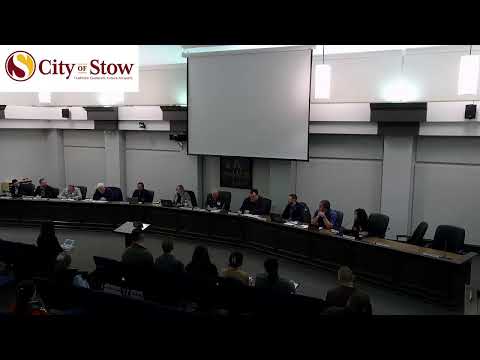
A majority of Stow City Council voted down a conditional-use site plan and related variances for a proposed Sheetz convenience store, gas station and drive-through at 4984 Fish Creek Road on Thursday, rejecting the applicant’s request after hours of presentations and public comment.
The project, applied for by Sheetz and represented in Stow by Diane Kalta and a technical team, sought conditional-use approvals for a gas canopy and a drive-through and four variances including a taller, internally lit fuel canopy and an exemption to the code’s minimum interior parking landscaping percentage.
Planning Director Zach Cowan described the site as two parcels totaling 4.68 acres in a C-3 commercial district and said the company revised the layout between planning-commission hearings to preserve an additional 2,700 square feet of wetland. Cowan said the plan otherwise met building and setback code requirements but required variances for (1) canopy height (proposed about 21–22.5 feet where code limits are lower), (2) internal illumination of the canopy, (3) higher-than-permitted lighting at two access points (up to roughly 3.1 foot-candles vs. a 0.5-foot-candle standard at property lines) and (4) an interior-parking landscaping percentage of 2.46% where 5% is required.
Sheetz representatives said the company revised the site to preserve more wetland and designed an underground stormwater detention system sized to meet the city and Mudbrook Watershed District requirements. Traffic consultant Kevin Westbrooks (GPD Group) told council that much of the site’s trips are "pass-by" traffic — industry data shows roughly three-quarters of gas-station traffic is already on the road — and that the applicant’s improvements (right- and left-turn lanes into each driveway and a developer-funded right-turn lane on Fish Creek) would keep intersection performance "no worse than today." He said the driveways were pushed as far from the intersection as site constraints allow and that left-turn storage at the new driveways was about 300 feet from the intersection center.
Wetlands consultant Adam Behringer (HZW) said the on-site wetlands were a lower-quality category (transcript: “category 1”), and that Sheetz proposed mitigation purchasing credits at a mitigation bank outside the immediate county in the Cuyahoga watershed. He said the applicant planned a 2.5:1 mitigation ratio (about 1.7 acres of mitigation credits for roughly 0.654 acres of wetland impact) and that the Army Corps had issued an approved jurisdictional determination (AJD) finding those wetlands isolated. He also said the firm had coordinated with state and federal wildlife and permitting agencies and had not found threatened or endangered species on the parcel.
Residents who live near the corner — several of whom spoke during the public-comment period — urged council to deny the plan. Neighbors raised repeated concerns about: wetland loss and groundwater/pollution risk from underground fuel tanks; increased flooding for homes along Fish Creek Road; pedestrian safety at an intersection that currently lacks safe crosswalks; and the cumulative effect of a third gas retailer clustered at one signalized intersection. Citizen Erin Mundorf, who identified herself as a water-resources engineer, disputed the site consultants’ wetland category and urged the council to prioritize preserving wetland storage rather than approving development. Several neighbors urged that the property remain undeveloped green space.
Planning commission had recommended denial after its February 25 meeting; council members referenced that recommendation during Thursday’s debate. After council discussion, the motion to adopt the planning committee’s forwarded resolution (Res. 25-079) failed on roll call. The roll-call record in the official transcript shows multiple "no" votes and at least one abstention; the resolution did not receive the affirmative votes required to grant the conditional zoning certificate.
With the vote, the applicant’s site plan and variances were denied; the developer may pursue appeals, revised plans or other administrative remedies available under city code.
What’s next: the applicant can revise the plan and reapply, request variance reductions, or pursue appeals as allowed by the city’s land-use procedures. Council and planning staff indicated that additional traffic and wetland information had been central to the deliberations and would be the primary topics to address in any resubmittal.
— Transcript excerpts: Planning Director Zach Cowan’s overview; developer representative Diane Kalta’s presentation; traffic presentation by Kevin Westbrooks (GPD); wetlands presentation by Adam Behringer (HZW); public comments from nearby residents. The planning commission recommended denial at its Feb. 25 meeting; council voted to deny the certificate at the March 6 meeting.
Ending: Council did not approve the Sheetz site plan or variances; residents and staff who testified said the key unresolved points are wetland impacts, stormwater management and intersection safety. The parties may return with revisions or pursue other procedural options under city land‑use rules.