Get Full Government Meeting Transcripts, Videos, & Alerts Forever!
Get email alerts on the Airport Rates topic
No spam. Unsubscribe anytime.
Port approves phased 2025–27 airport rate increases to reduce subsidy
Summary
The Port of Bremerton Commission on Feb. 11 approved a phased 2025–27 airport rates and tariffs schedule, beginning with a 5% increase April 1, 2025, and CPI-plus adjustments in subsequent years, to reduce subsidy of airport operations.
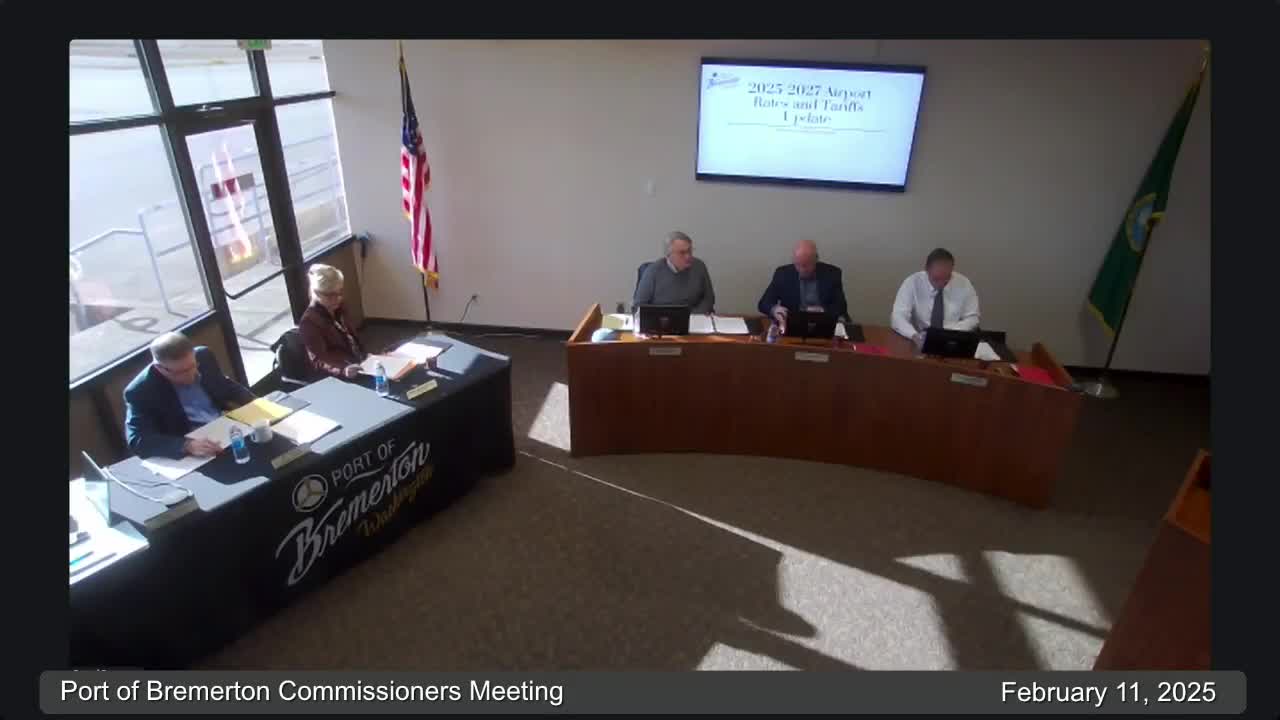
The Port of Bremerton Commission on Feb. 11 approved a 2025–27 airport rates and tariffs schedule, adopting a phased increase that begins April 1, 2025, to reduce the airport’s reliance on port general revenue.
Commissioners approved a motion to adopt a three-year rate cycle that starts with a 5% increase effective April 1, 2025; on Jan. 1, 2026, and Jan. 1, 2027, rates will be adjusted by CPI plus 1%; and on Jan. 1, 2028, the commission will apply a rate survey and market adjustment plus 1%. The motion also authorized setting electrical rates on a cost-neutral basis. The motion passed unanimously (Bozeman, Anderson, Stricklejohn voting yes).
The vote follows staff presentations and public comment on hangar and tie-down rents and on the airport’s operating picture. Port staff told commissioners the airport currently has 62 small T‑hangars, 20 large T‑hangars and 47 tie‑downs, and about 65,000 annual takeoffs and landings. Staff showed an 8% increase scenario (the initial staff proposal) that would move a representative small T‑hangar from $295.54 to $319.44 and a large T‑hangar from $437.46 to $472.41; tie‑downs were shown rising from $59.91 to $64.74 under the 8% scenario. Staff also reported current small-hangar rents are about $0.31 per square foot and would move to about $0.33 under the higher scenario.
Why it matters: Port revenues for the airport have trailed expenses; commissioners were shown figures indicating 2025 airport revenues at about $661,449 against expenses around $1,000,388 (figures presented in the meeting). Commissioners said the increases aim to shrink that gap while keeping the airport competitive with regional peers.
Discussion and public comment: Commissioners first considered an 8% increase but several commissioners and public commenters urged a more gradual approach. Commissioner Jim Rotland proposed, and the commission adopted, a compromise of 5% in 2025 with CPI+1% adjustments in subsequent years. Doug Barton, past president of the Bremerton Pilots Association, urged adherence to a prior understanding that future increases would be tied to CPI and expressed concern for cockpit owners who face fixed incomes; Barton and other pilots said the tenant base is largely working-class and warned about pricing some pilots out of the field. Port staff and commissioners responded by noting rising construction and maintenance costs and the port’s status as a service provider rather than a profit-driven landlord.
Separate staff remarks: The airport presenter reviewed regional comparables — airports such as Kelso, Olympia and Tacoma Narrows — and said the intent of the rate study was to “slot” the port in the market rather than compute a strict average. Staff also discussed hangar square footage benchmarks (roughly 940 sq ft for small T‑hangars, about 1,300 sq ft for large T‑hangars) and noted nationwide hanger-building costs and supply constraints have increased waiting lists.
Next steps and related work: Staff said the commission will re-evaluate rates annually per the adopted schedule and will revisit rates in 2028 with a market survey. Commissioners and staff also announced an upcoming airport feasibility study public meeting (an open-house/presentation planned at City Hall the following month) where consultants will present phase‑1 findings and the commission will take public comment; a subsequent meeting would consider whether to advance to phase 2 (further study or negotiations with airlines and other stakeholders).