Get Full Government Meeting Transcripts, Videos, & Alerts Forever!
Get email alerts on the Public Recognition topic
No spam. Unsubscribe anytime.
Residents urge city to investigate hate flyers, press for public restrooms and raise shoreline-development concerns
Summary
At the March 5 public-recognition segment, residents reported white-supremacist flyers, raised concerns about a new community engagement position and waterfront development, praised a Smith Cove mural and promoted the state science fair. Multiple speakers pressed the city to provide public restrooms for people experiencing homelessness.
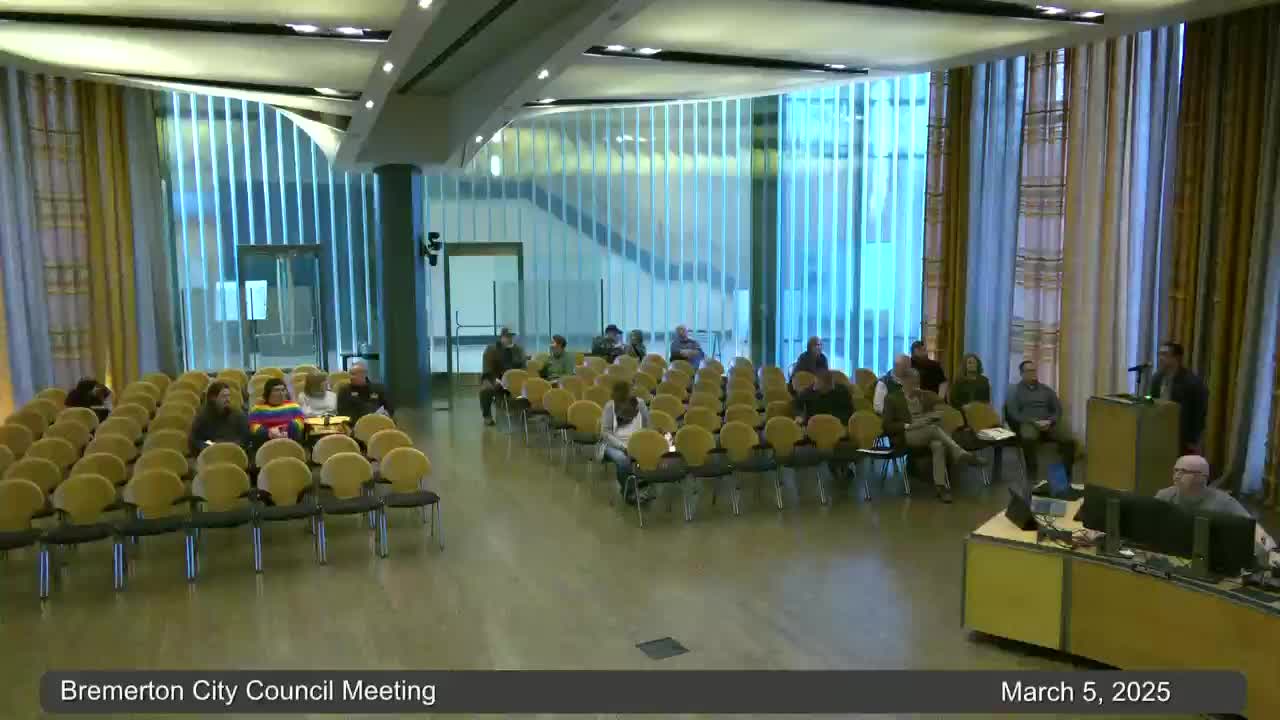
A range of residents used the public-recognition period at the Bremerton City Council meeting on March 5 to raise community concerns and highlight local events.
Justin Law, a Bremerton resident, told the council he had found flyers in Bremerton neighborhoods that he characterized as white-supremacist propaganda and urged the council to investigate the incidents and, if appropriate, treat them as potential hate crimes. Law asked the council to “send a decisive message” rejecting the flyers and to pursue public education on combating white supremacy.
Mary Lou Long, who identified herself as a longtime Bremerton resident and former council member, spoke about a recently retitled city position — from diversity and equity and inclusion to diversity and community engagement manager — and questioned the salary and whether keeping equity-related duties would jeopardize federal funding. Long said she supported diversity and fairness in principle but urged caution on costs and implementation.
Multiple speakers urged the city to provide public restrooms. Jose Camacho, representing Friends at Smith’s Cove and identifying himself as a paralegal, pressed the council to provide public toilets and said criminalizing people without providing sanitary facilities is inhumane and leads to pollution of storm drains and waterways. Robin Weldon echoed that view, saying the lack of public toilets forces people to defecate in public and can send waste into Smith Cove and the Port Washington Narrows. Several speakers linked sanitation and human-rights concerns to homelessness and rising housing costs.
Other public-recognition items included praise for local art and tourism efforts. Robin Weldon recognized Michelle Moshe for the Smith Cove mural and cleanup at a dangerous corner lot. John Hansen, president of the Bremerton Historic Ship Association, gave a tourism update, noting strong visitation in 2024 and upcoming programming including a STEM outreach program that buses students to the ship. Carolyn Stein, executive director of the Washington State Science and Engineering Fair, invited the community to the fair at Bremerton High School and noted that top students advance to the Regeneron International Science and Engineering Fair; she said the international fair will be held in Seattle in 2028 and credited Bremerton’s fair for contributing to that selection.
Alvin Bradford recounted research into the city’s 1987 skateboard ban, told a brief history of the ordinance’s origins and urged the council to consider context when revising longstanding policies.
Daniel Cole briefly accepted an appointment to a citizens advisory committee and thanked the council for the opportunity. The council recognized appointees who were present.
Why it matters: residents used the public-recognition period to press for investigations of hate incidents, to ask the city to address sanitation and homeless services, to question the cost and scope of a renamed city position dealing with community engagement and equity, and to highlight local cultural and educational events.