Get Full Government Meeting Transcripts, Videos, & Alerts Forever!
Get email alerts on the Wastewater Infrastructure topic
No spam. Unsubscribe anytime.
City presents 20-year wastewater plan estimating $430 million in work; public raises sanitation and equity concerns
Summary
Public Works staff presented the 2024 Wastewater Comprehensive Plan update, outlining capital projects, modeling results and a 20‑year fiscal forecast that escalates estimated needs from $270 million to about $430 million. Residents urged public toilets and raised concerns about sewer extension costs for areas such as Anatai.
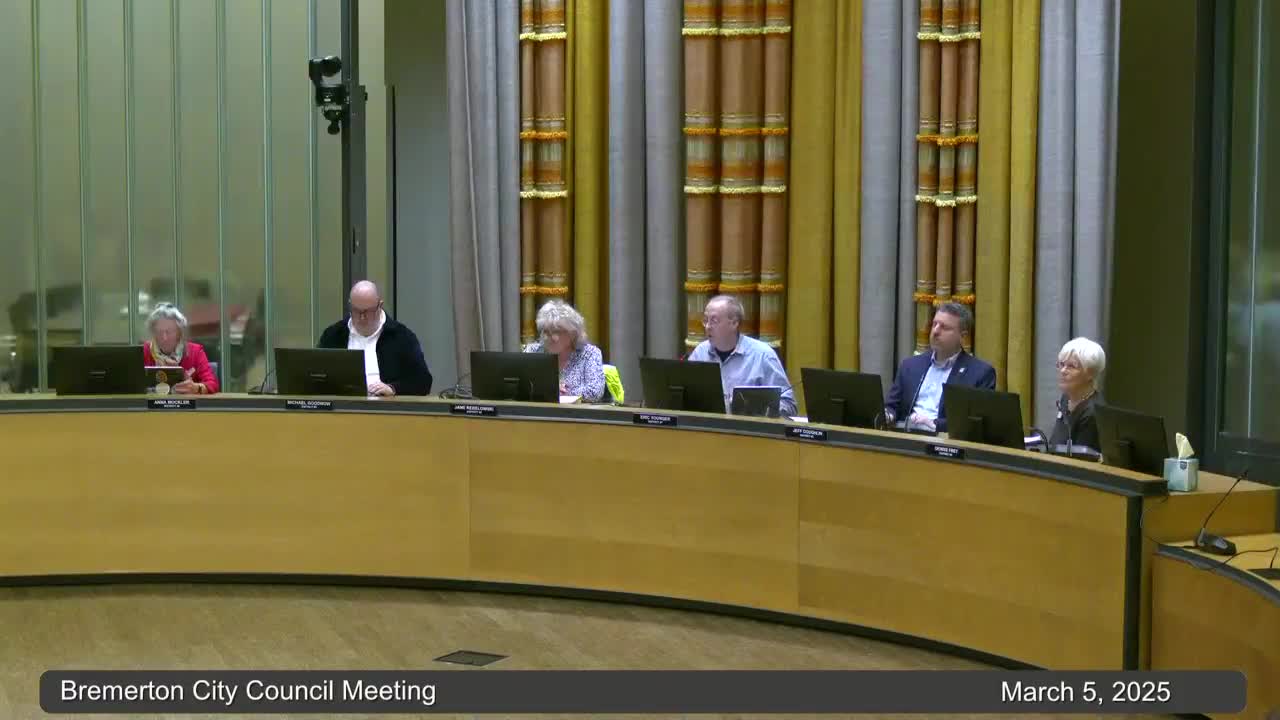
City staff presented an update on the 2024 Wastewater Comprehensive Plan to the Bremerton City Council on March 5, describing required upgrades and a 20-year capital and fiscal forecast that professional consultants estimated at about $270 million in present dollars and approximately $430,004,000 when escalated at 4% inflation over 20 years.
Bill Davis, who led the presentation, said the plan was prepared by consultant Kennedy Jenks and must be reviewed by the Washington State Department of Ecology. The plan includes a 20-year forecast, system modeling for six basins within the city, a new business risk and vulnerability assessment, and appendices with basin plans and interagency agreements (including agreements with Kitsap County Sewer District No. 1 and the Navy). The plan also evaluated the crosstown pipeline, the Puget Sound Industrial Center (PSIC) sewer feasibility, and projected upgrades at the wastewater treatment plant.
Key projects highlighted: - Oyster Bay/Ostrich Bay beach sewer upgrades to remove vulnerable beach sewer sections from service; work will proceed in phases and pursue loans and consultants. - Wastewater treatment plant outfall improvements, including installation of a parallel deep-water outfall, driven by capacity and observed sewer surcharge events at pump stations and the plant. - Crosstown Pipeline Redundancy Project to add a parallel pipeline or other redundancy for the city’s most significant pipeline (approximately four miles long) that currently cannot be taken offline for maintenance. - New aeration basins and grit-system upgrades at the treatment plant; the scope includes biological nutrient reactors and work related to nutrient-permit compliance. - PSIC sewer feasibility study: consultants modeled alternatives to serve the Puget Sound Industrial Center (projected demand as much as 10,000 employees), including sending some flow to Mason County, building a new treatment plant near the Port of Bremerton, or pumping flow into Bremerton; operations staff preferred pumping to Bremerton to avoid operating an additional plant.
Davis summarized the fiscal plan: the capital projects and programs total roughly $270 million in current-dollar estimates; with 4% annual escalation that figure rises to about $430,004,000 over the 20-year planning window. The plan assumes funding from customer rates, facility charges, low-cost loans, grants, private funding and bonds. As an example of rate planning, staff presented a scenario with 3.5% rate increases through 2029 and higher increases thereafter (8.4% in later years), but Davis said other phasing options were possible. Davis also noted an affordability benchmark used in planning: if wastewater fees remain under 2.5% of a community’s median household income, they are generally considered affordable. The plan used a median household income figure of about $74,000 for Bremerton in its example.
Public comment focused on sanitation, equity and specific service-area concerns. Resident Jose Camacho urged the city to provide public toilets and criticized the city’s approach to homelessness and sanitation, saying lack of public restrooms causes human waste to reach storm drains and waterways. Robin Weldon echoed concerns that criminalizing public defecation without providing public restrooms harms unhoused residents and risks pollution to Smith Cove and the Port Washington Narrows. Kathy Lustig pressed for clarity on whether proposed sewer extensions (including Anatai) are included in the $430 million forecast, noting previous published cost estimates for Anatai sewer extensions ranged widely and raising geotechnical and landslide concerns about routing sewer mains. Davis said new service-area extensions were not included in the budgeted forecast and that funding for those extensions would be assumed to be developer-funded unless council directed otherwise; he also said the wastewater plan focuses on collection and treatment system capacity and that public toilets are a policy decision outside the technical scope of the plan.
The draft plan has been posted on the city website for public review with comment open through March 29; Ecology review could take up to four months, Davis said. Council members thanked staff for the presentation and said the wastewater fund currently appears stable and capable of taking on debt for capital projects, though they emphasized uncertainty about funding sources for large projects such as the Crosstown pipeline and the PSEC/PSIC-area improvements.
Next steps: staff will take public comments, respond to Ecology’s review comments and return to council later this year with a finalized plan and ordinance for adoption.
Why it matters: the plan guides sewer upgrades that affect environmental compliance, waterfront infrastructure and rate planning over two decades; residents and councilors pressed for clarity on equity and sanitation measures for people experiencing homelessness, and on how new development areas such as Anatai would be served.