Get Full Government Meeting Transcripts, Videos, & Alerts Forever!
Get email alerts on the Fy26 Budget topic
No spam. Unsubscribe anytime.
Sudbury officials present $131.85 million FY26 budget; warn rising benefits, insurance costs pose risk
Summary
Town Manager Andy Sheehan and Finance Director Victor Grama presented the Town of Sudbury’s proposed fiscal 2026 budget — $131.85 million including $4.24 million in capital — citing a AAA rating, a large free-cash balance and rising employee-benefit costs as key near-term variables.
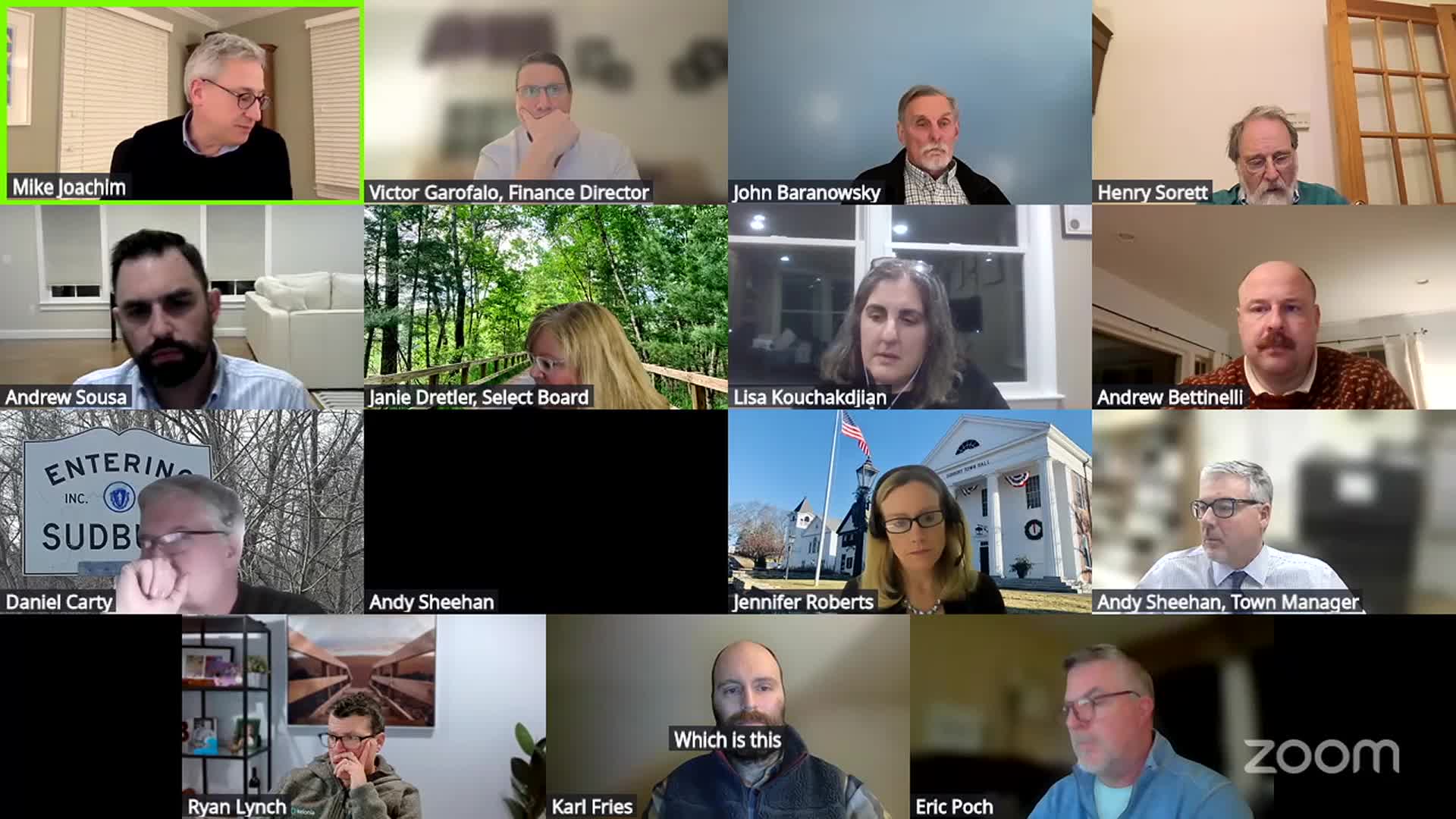
Town Manager Andy Sheehan and Finance Director Victor Grama presented the Town of Sudbury’s proposed fiscal year 2026 operating and capital budgets at a joint Finance Committee and Select Board hearing Monday, March 3, 2025.
Sheehan and Grama said the combined town and school recommendation totals $131,851,238, including roughly $4.24 million in capital requests, and that the town’s AAA bond rating and a strong certified free-cash balance give Sudbury flexibility going into the May town meeting.
The proposed FY26 operating budget totals about $127.61 million, with the full package (operating plus capital) rising about 5.44% over FY25. Real-estate and personal-property taxes remain the single largest revenue source at $112,821,267 (a 3.23% increase), state aid is projected at $7,890,000, and certified free cash this year is a robust $7.2 million, Grama said. Sheehan and Grama cautioned that much of the free cash is nonrecurring and should be used for one-time or reserve purposes rather than ongoing operating expenses.
Why it matters: Sudbury’s budget choices this year emphasize maintaining reserve levels, advancing a modest capital program and keeping recurring operating growth near a level-service baseline while facing faster growth in employee-benefit costs and uncertain health‑insurance renewals.
Key revenue and spending figures presented
- Real-estate and personal-property tax (tax levy): $112,821,267 (projected +3.23%). - State aid (local aid): $7,890,000 (projected +2.53%). - Local receipts (motor‑vehicle excise, investment income): $6,176,000 (projected +10%). - Certified free cash (FY25): $7,200,000 (presented as available for appropriation at town meeting). - Proposed operating budget (municipal + schools): $127,611,118. - Capital requests: $4,240,120 (manager capital operating + warrant articles), for a total FY26 package of $131,851,238 (+5.44% vs FY25).
Education, employee benefits and capital
Education remains the largest cost center at about 61% of the total budget when school spending is included. Sudbury Public Schools (SPS) is budgeted to increase by roughly 3.26%; the Lincoln‑Sudbury regional assessment is shown as increasing modestly as well. Grama said chapter 70 school aid is projected to rise about 3% in the governor’s proposal and that unrestricted local aid is being budgeted conservatively.
Employee benefits (health insurance, pensions, retiree medical, workers’ compensation and other liability coverages) are the town’s second‑largest category and are projected to increase by about 9% overall. Sheehan and Grama flagged health‑insurance renewals as a near‑term risk; final renewal rates had not yet been received at the March 3 hearing.
Free cash, reserves and capital stabilization
The presenters described a multi‑pronged approach to reserves. Proposed uses of FY25 free cash at town meeting include:
- $2.9 million (approx.) for capital appropriations; - $650,000 to capital stabilization; - $400,000 to general stabilization (rainy day fund); - $175,000 to create a pension stabilization account; - $25,000 to create an accrued‑leave reserve; and - a prudential estimate for snow‑and‑ice (about $600,000).
Grama noted the town’s local policy target for free cash is 3–5% of the prior fiscal year’s general fund, while the Massachusetts Division of Local Services (DLS) guidance released earlier in the year suggested 5–7% as a prudent range. The managers said the town aims to continue building its capital stabilization fund toward a policy target equal to 2% of the prior fiscal year’s general fund operating budget.
Sustainability coordinator and staffing
The budget moves the sustainability coordinator position from the Public Works functional area into General Government to "elevate the profile of that position," Sheehan said; the role was vacant at the hearing and actively being recruited. Grama and Sheehan said the prior coordinator had brought grant funding to the town and the position’s job description continues to emphasize grant pursuit, though there is no guarantee that future grant opportunities will offset the position’s cost.
Sheehan and Grama described modest municipal headcount changes: an increase in DPW staff (including park/grounds light‑equipment operator), a net decrease in municipal headcount driven partly by police dispatch regionalization, and targeted staffing changes at the Goodnow Public Library and the Senior Center. Presenters said vacancies across the organization remain a challenge, particularly in the Fire Department.
Pension, OPEB and long‑term risks
OPEB contributions are held at the current recommendation ($650,000); the town’s unfunded liabilities were discussed as a long‑term planning issue. Presenters proposed creating a pension stabilization fund to begin proactively building resources for projected future liabilities.
Next steps
Finance Committee members will review the manager’s recommendations, hold further hearings with department heads and report recommendations to the Select Board; Sheehan said the Select Board will publish the warrant and the town meeting presentation will begin May 5. Presenters reiterated that the FY26 proposal is not an override; additional revenue options for FY27 will be evaluated later this year as state and local conditions evolve.
Quotes
"Chapter 70 is projected to go up 3%," Finance Director Victor Grama said when asked about the state aid assumptions behind school budgets.
"We are a triple‑A community rated by S&P Global Ratings and we have a stable outlook," Sheehan said, framing the town’s flexibility to fund one‑time capital from reserves rather than recurring operations.
Ending
Town officials emphasized the budget is a level‑service proposal with limited new initiatives and asked committees and residents to focus on reserve policy, benefit‑cost trends and the capital stabilization strategy ahead of May town meeting.