Get Full Government Meeting Transcripts, Videos, & Alerts Forever!
Get email alerts on the Workplace Conduct And Climate topic
No spam. Unsubscribe anytime.
Gallupsurvey: about 1 in 5 reported harassment; Legislative Equity Office received 60 reports in 17 months
Summary
Gallup presented a climate survey of the Oregon State Capitol showing roughly 20% of respondents reported harassment in the past five years; the Legislative Equity Office reported 60 reports covering 53 incidents between August 2023 and December 2024 and outlined training and referral activity.
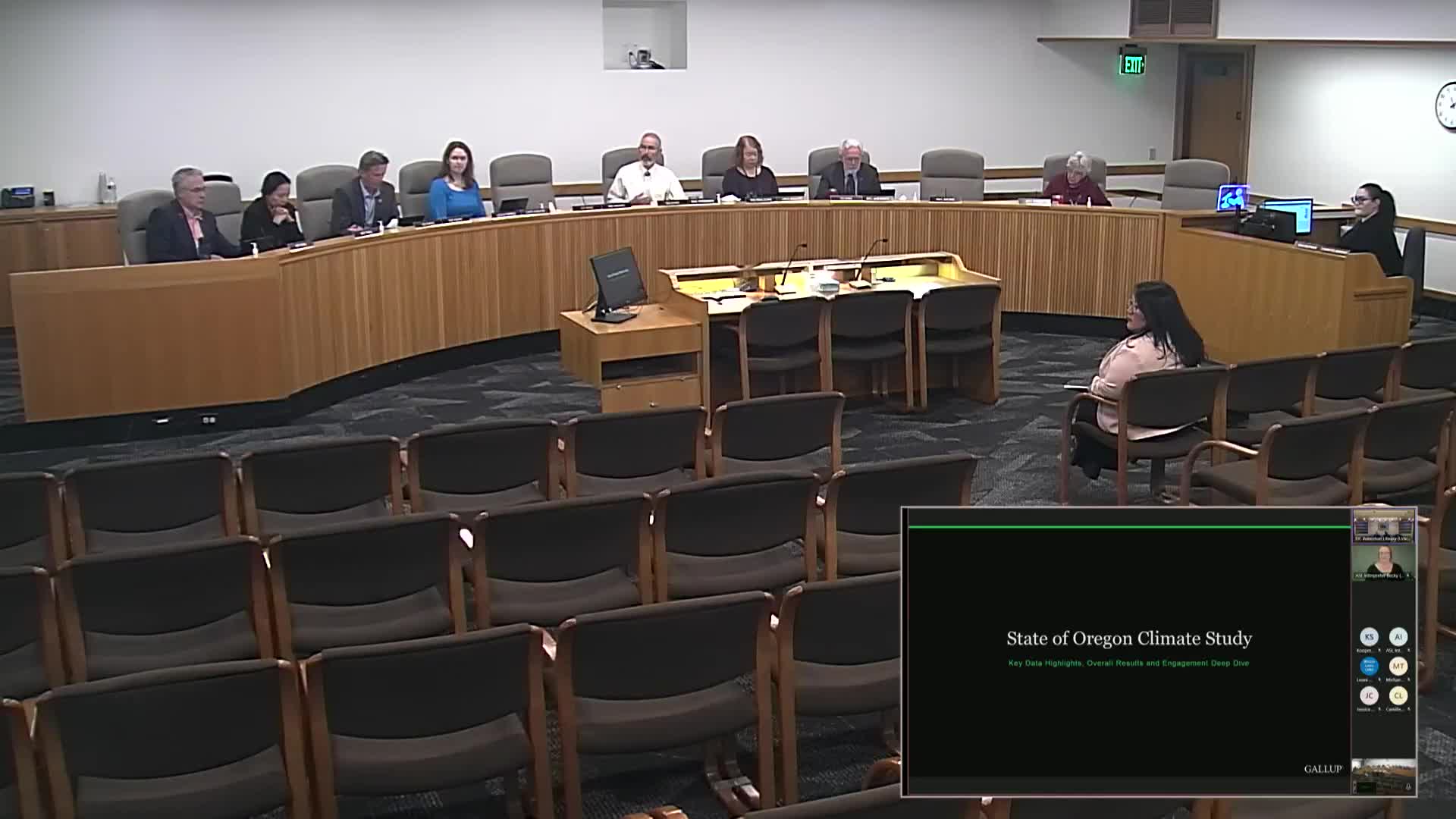
Gallup researchers presented results from a Capitol Culture and Climate Survey to the Joint Committee on Conduct, reporting that roughly one in five survey participants said they had experienced harassment in the last five years and that most people who reported harassment said their most recent incident occurred at the State Capitol Building.
Michael Tilton, a managing consultant at Gallup, said the survey sampled legislative members, branch employees and lobbyists to “understand how people experience the climate of the Oregon State Capitol.” Tilton and colleagues noted overall response rates were sufficient for analysis: branch employees had the highest response rate at about 42 percent, members about 35 percent, and lobbyists a lower rate.
Gallup described three categories of incidents asked about in the survey: harassment (unwanted behavior that impacts work), discrimination (treatment based on protected characteristics) and retaliation (because someone reported or participated in an investigation). When asked to define harassment, Tilton said the survey framed it as “receiving unwanted behavior that impacts your work or impacts your ability to perform your work.”
Key findings Gallup presented included: - About 20 percent of respondents reported experiencing harassment in the last five years; two-thirds of those who described a most recent harassment incident said it occurred at the State Capitol Building. - About 22 percent said they had experienced discrimination in the last five years; respondents cited age and sexual orientation among commonly reported bases for discrimination. - About 4 percent reported retaliation for reporting or participating in an investigation in the past five years, a much smaller group and one for which Gallup said sample sizes were too small to analyze in detail.
Gallup also reported differences by role. Members reported higher rates of harassment in the survey counts (the group was small in absolute numbers but showed higher percentages). Branch employees reported higher engagement scores when they reported no experience with harassment, discrimination or retaliation; Gallup said the engagement gap between those with no incidents and those with at least one was sizeable and correlated with lower workplace engagement and morale.
The Legislative Equity Office (LEO) also briefed the committee. Legislative Equity Officer Boire Yang summarized the offices annual report covering August 2023 through December 2024, saying the office received 60 reports concerning 53 separate incidents during that period. Yang said 74 percent of those incidents were related to Rule 27, the legislative conduct rule, and most incidents occurred at the State Capitol. He said the office made 13 referrals to investigators that equated to nine factual circumstances; investigators declined to proceed after facial review in six matters for reasons including statute-of-limitations or jurisdictional issues.
Yang described trainings delivered while the office was rebuilding after a vacancy. He said the office offered roughly 20 Rule 27 trainings attended by about 1,198 people over an earlier period and 24 sessions attended by about 1,221 people in a later set of offerings; the LEO also collected participant evaluations and several hundred written comments. Yang said about 82 percent of written feedback was positive, 11 percent was neutral (mainly registration logistics), and about 7 percent was critical of scope or content.
Yang told the committee that the LEOs next steps will include working with the capital leadership team and the DEI committee to review the Gallup results and to propose amendments to Rule 27 for committee consideration. He noted that matters do not get referred to investigators without the impacted partys permission and that some serious incidents did not proceed to investigation because impacted parties declined to move forward.
Committee members asked clarifying questions about definitions, response rates and why some incidents are not investigated. Senator Weber asked whether the one-in-five harassment figure indicated a systemic problem; Gallup presenters replied that the survey captured self-reported experiences and that follow-up slides provided detail on types, locations and reporters. Representative Dale questioned whether respondents with issues were more likely to participate; Gallup said response patterns did not show a clear bias toward negative experiences. Yang said the office will use the survey data to inform training plans and potential rule changes in the upcoming cycle.
The committee closed the informational session after the presentations and indicated staff and the LEO would follow up on requests for more detail.