Get Full Government Meeting Transcripts, Videos, & Alerts Forever!
Get email alerts on the Replacement Dwellings topic
No spam. Unsubscribe anytime.
Committee hears farmers and conservationists back cap on ‘‘replacement dwellings’’ to limit trophy homes on working lands
Summary
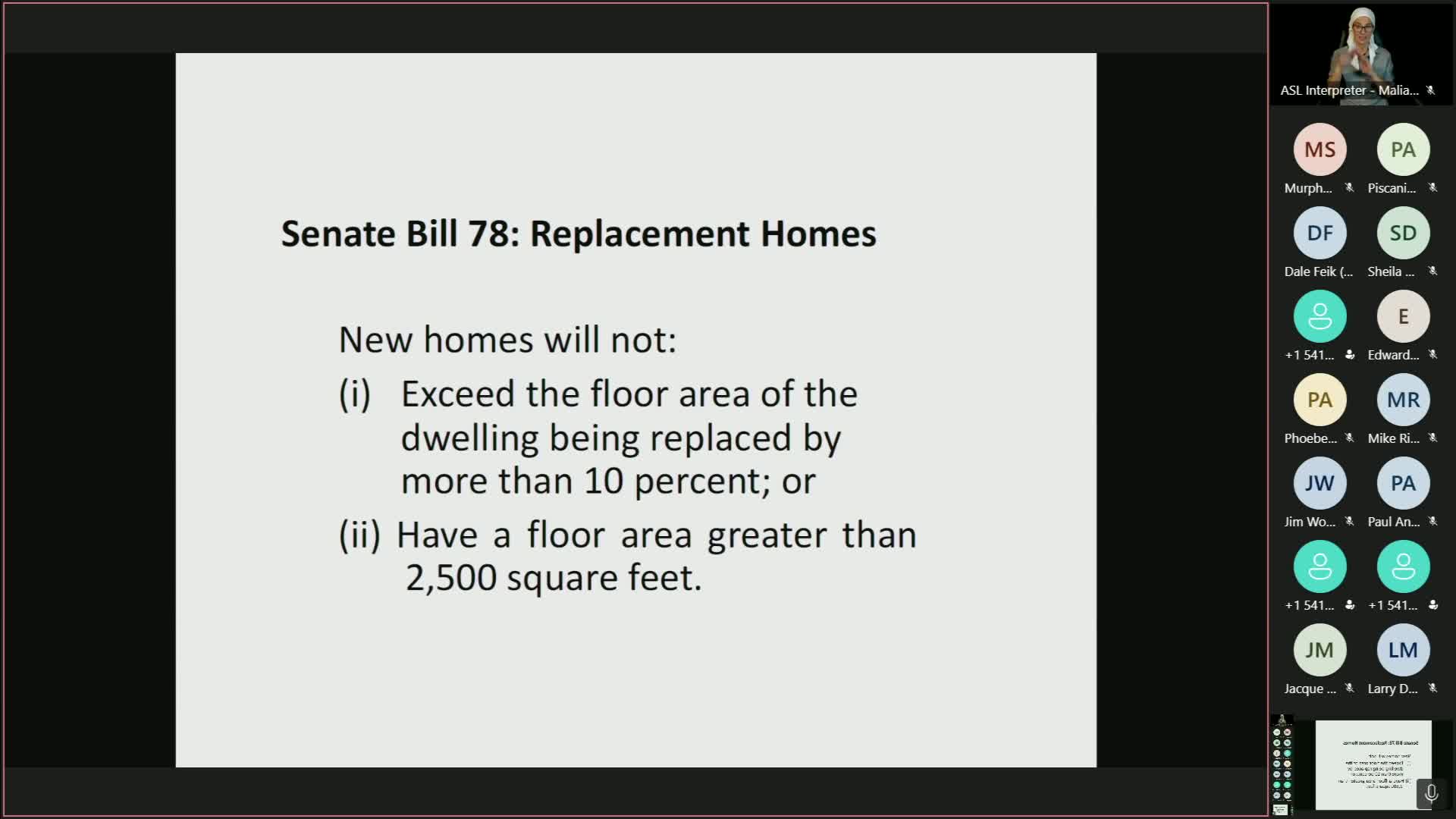
The Senate Committee on Natural Resources and Wildfire heard testimony March 6 on Senate Bill 78, a proposal to limit replacement dwellings on farm- and forest-zoned land to no more than 2,500 square feet or 10% larger than the floor area replaced.
Salem, March 6 — During a grouped hearing the Senate Committee on Natural Resources and Wildfire heard extensive testimony supporting Senate Bill 78, which would impose size limits on replacement dwellings in lands zoned for farm or forest use.
The measure: Staff described SB 78 as adding size limitations to replacement dwellings on lands zoned for farm or forest use, establishing a maximum size of no more than 2,500 square feet or not more than 10% of the floor area being replaced. Proponents said the cap would prevent modest farm homes from being torn down and replaced with large luxury houses that raise land values and put farmland out of reach for working farmers.
Why it matters: Multiple family farmers said replacement-dwelling approvals have been used to permit "mansions, villas and trophy homes" on high-value farmland. Aaron Nichols, co-owner of Stoneboat Farm, gave several local price-change examples and said a 50-acre property went from $20,000 an acre to $106,000 an acre after a modest house was replaced by a 7,300-square-foot luxury home. "Working lands are being turned into luxury housing for people who have a lot more money than farmers and ranchers trying to work the land," Nichols said.
Other witnesses cited county-level examples of replacement dwellings that dramatically enlarged homes and then were marketed as estate properties. Rory Isbell, lands program director with Central Oregon Land Watch, provided permit examples from Deschutes County showing modest homes replaced by dwellings multiple times larger, including one that sold for $7 million after replacement.
Support came from conservation and farm organizations including Oregon Agricultural Trust, Friends of Marion County, Oregon Association of Conservation Districts and many individual farmers. Supporters framed SB 78 as a ‘‘course correction’’ that would preserve large, contiguous blocks of agricultural land required for commercial farming.
Opposition and concerns: Opponents argued the bill may have unintended consequences for multigenerational farm families and caregivers. Mike Riddle, president of the Oregon Home Builders Association, said families sometimes want to replace an older small home with a larger dwelling to accommodate aging parents or multiple generations. Patty Williamson, who said her mother-in-law has Alzheimers and needs ADA-accessible space, told the panel that a 2,500-square-foot cap could prevent replacement of a family home that now serves as a caregiving residence.
Legal and policy context: Witnesses frequently referenced Senate Bill 100 (1973) as the basis for Oregons farm and forest protection program. Hope Segalvacker of Landwatch Lane County cited the state Supreme Court and subsequent Legislature action around replacement-dwelling rules (citing HB 3024) as examples of past adjustments to the statute. Proponents said SB 78 is a modest statutory tightening, not a ban on all replacements.
What's next: The committee did not vote on SB 78 after the hearing. Several witnesses said they would submit written testimony. The record shows organized support from many county farm bureaus and conservation groups and organized opposition from builders, real-estate interests and some rural property owners.