Get Full Government Meeting Transcripts, Videos, & Alerts Forever!
Get email alerts on the Erdc Waitlist topic
No spam. Unsubscribe anytime.
Providers and advocates urge $500 million to eliminate ERDC wait list, cite families and workforce strains
Summary
Multiple providers, hubs and advocacy groups testified that Employment Related Day Care wait lists are causing families to lose work or education opportunities and urged a substantial funding increase; local providers described waiting families and program strain.
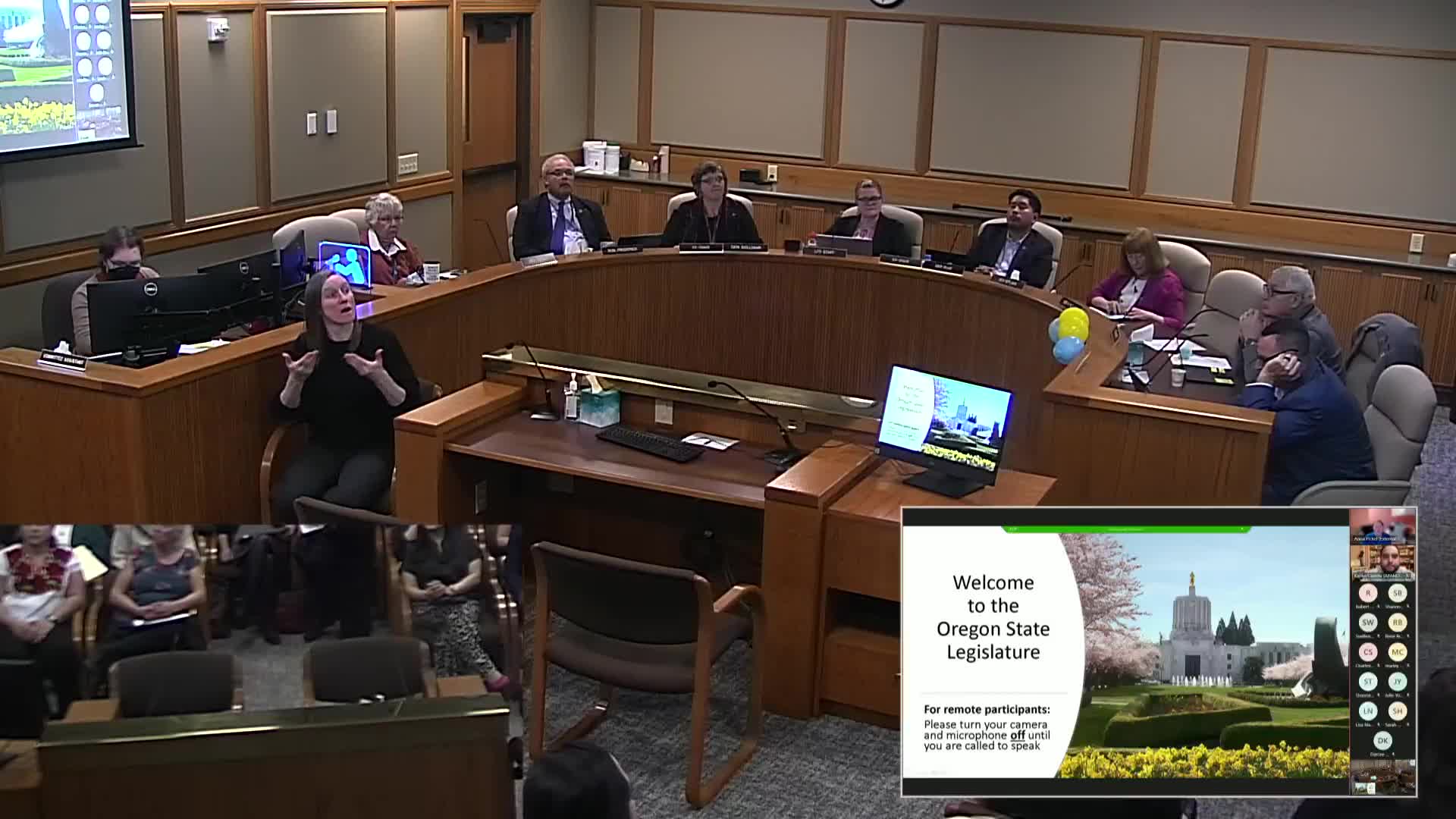
Parents, providers and advocacy groups urged the Joint Committee on Ways and Means - Subcommittee on Education on March 6 to expand Employment Related Day Care (ERDC) funding and eliminate a long wait list that witnesses and coalition leaders said is denying care to eligible families.
"Without access to this very critical program, we are putting young children and families at risk in Oregon," said Anna Pickell, owner and operator of Happy Go Lucky Child Care in Northeast Portland, describing families blocked from subsidy slots.
Multiple witnesses said more than 9,700 families remain on the ERDC wait list. Kaliko Castile, political director at APANO Communities United Fund and co‑chair of the Child Care for Oregon Coalition, testified that an additional $500,000,000 is needed to remove the wait list and ensure access for all eligible families. Marchelle Marcos, political director for Family Forward, repeated the $500,000,000 request and said ERDC currently serves roughly 16,000 families and covers about 30% of the child‑care marketplace.
Local hub testimony highlighted regional impacts: Abby Litzkovsky, an early learning coordinator for Northwest Early Learning Hub, said her hub region has 360 families enrolled in ERDC and 230 more on a local waiting list. Providers testified that blocked subsidy access affects the workforce: parents who cannot find affordable care cannot work or continue their education.
Business and agricultural representatives also testified about the economic impacts. Mike McNally, representing Willamette Valley Wine Foundation and the Children's Institute, said specialty crop producers and other employers depend on ERDC to keep workers on the job and urged additional funding; he proposed a minimum $150,000,000 increase but said $500,000,000 would be preferable.
Testimony also tied ERDC funding to provider stability: speakers described ERDC as a major purchaser in local markets and warned that insufficient subsidy funding can undermine existing capacity and recent investments in workforce development.
Committee members heard requests for both immediate funding to clear the wait list and for longer‑term policy actions to strengthen workforce pipelines and culturally responsive provider networks. The record remains open for additional written testimony.