Get Full Government Meeting Transcripts, Videos, & Alerts Forever!
Get email alerts on the Microcenter Pilot topic
No spam. Unsubscribe anytime.
State licensing division details microcenter pilot, exceptions used to ease small childcare operations
Summary
The Department of Early Learning and Care told senators a June 2024 pilot lets small programs request exceptions to licensing rules to operate as ‘microcenters.’ DELC reported 44 applicants, three active pilot sites and no safety issues so far; workforce shortages and permitting remain key barriers.
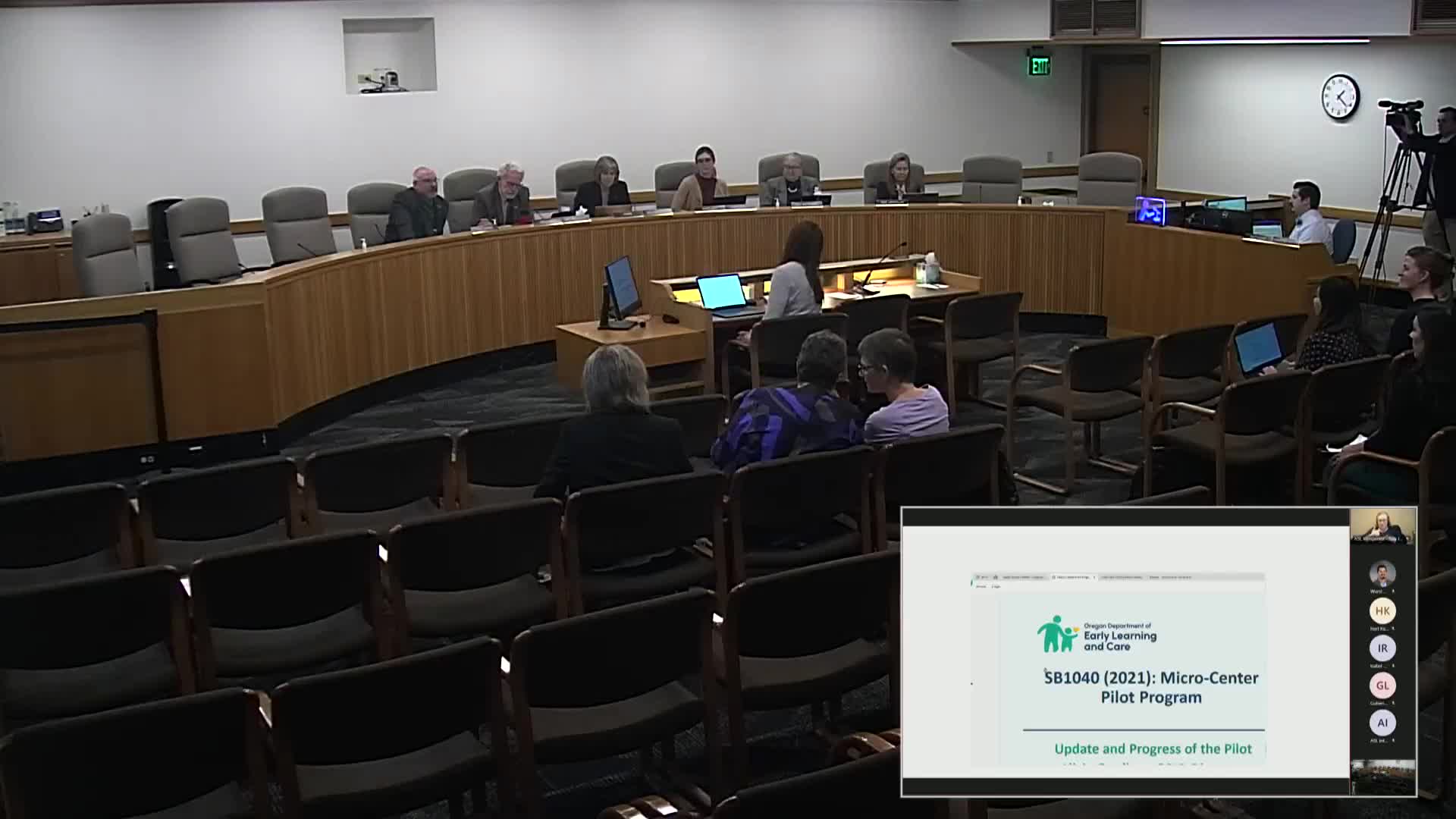
The Senate Committee on Early Childhood and Behavioral Health on March 6 received an update from the Department of Early Learning and Care on Oregon’s microcenter pilot, established under Senate Bill 1040 to test a licensing path for small‑capacity childcare programs serving up to 30 children.
Alicia Gardner, director of the Child Care Licensing Division at DELC, told the committee the pilot began in June 2024 and uses DELC’s existing exception and waiver process to let small programs tailor licensing requirements to their operations while maintaining health and safety oversight. “This individualized approach better supports programs in smaller rural communities that often lack the same level of access to resources,” Gardner said.
DELC said the application window drew 44 providers: four small centers and 40 home‑based providers seeking to expand capacity. Because statute currently limits the number of children allowed in a home‑based setting to 16, DELC could not grant exceptions to increase home capacities; instead the pilot selected three program operators who were in different stages of converting or combining sites in Coos Bay, The Dalles and Pleasant Hill/Springfield.
Permitting and building‑code issues were common barriers. Gardner said DELC granted supervision‑rule exceptions in two pilot centers to allow a family‑home style sight‑or‑sound supervision model in open floor plans; one operator reported the change reduced staffing costs and saved roughly $2,000 a month. Workforce shortages remained the pilot participants’ primary challenge: participants reported difficulty recruiting employees at current wage and benefit levels and did not frequently request exceptions to staff‑qualification rules.
DELC staff described other pilot activities including site visits, cohort meetings, virtual technical assistance and qualitative data collection. Gardner said exceptions are not granted when a requirement is established in statute or would create a health or safety risk; DELC monitors compliance records and reported no current safety or compliance issues tied to pilot exceptions.
Gardner told the committee DELC will continue collecting data and expects to submit a legislative report in September 2025 with recommendations about possible rule changes, shared‑services models and funding options to support facility renovations and pre‑application navigation services for providers.
Committee members asked about the pilot’s scope and next steps; DELC staff recommended considering funding for shared services, translation and pre‑application navigation to reduce permitting delays.