Get Full Government Meeting Transcripts, Videos, & Alerts Forever!
Get email alerts on the Small Modular Reactors topic
No spam. Unsubscribe anytime.
Oregon committee hears wide-ranging testimony on small modular reactors, Measure 7 and three bills to lift the nuclear moratorium
Summary
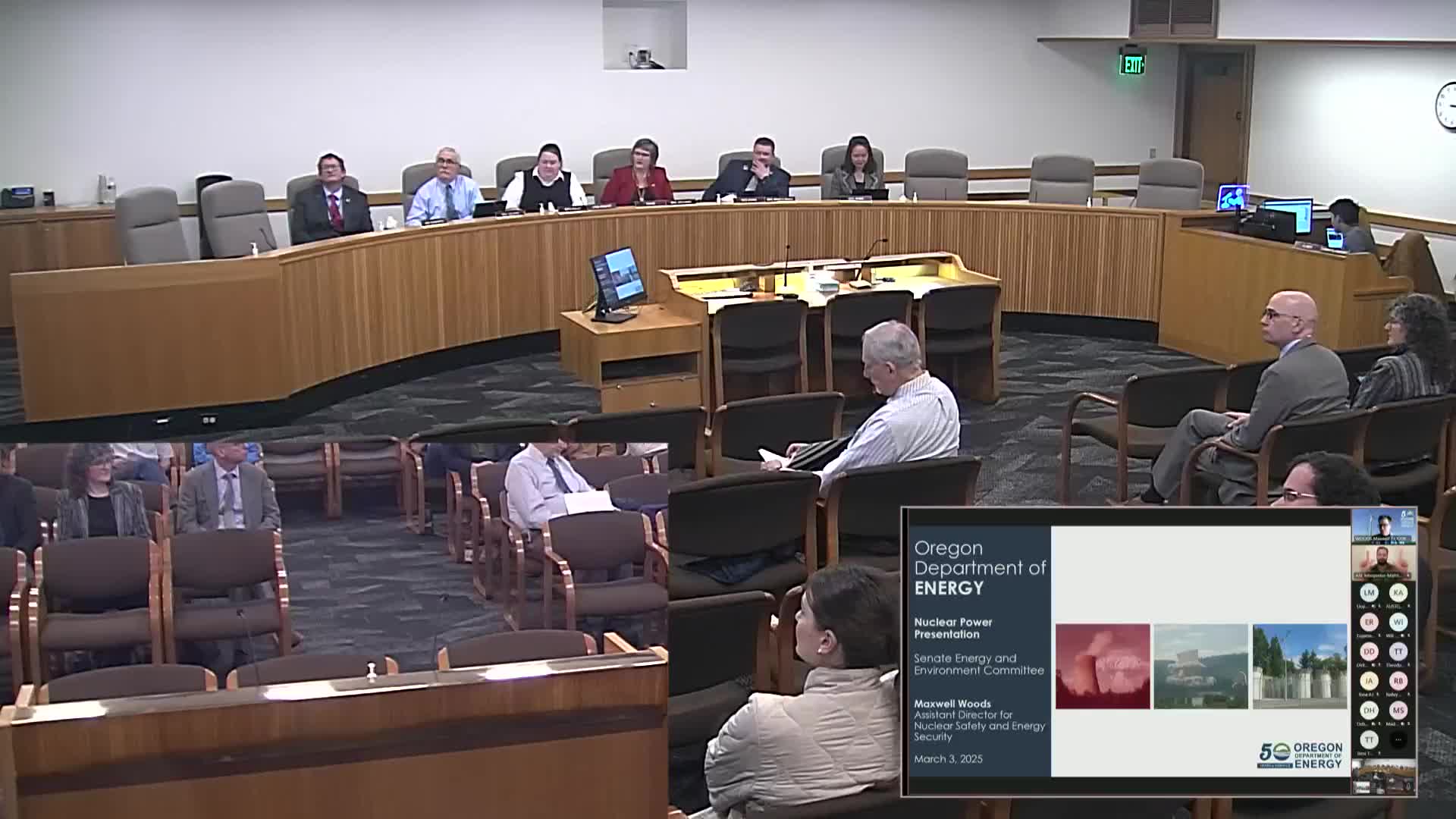
The Oregon Senate Committee on Energy and Environment held an informational session and a public hearing on March 5 that examined small modular reactors, nuclear safety and waste policy and three bills to lift or study the state's 1980 moratorium on new nuclear plants.
The Oregon Senate Committee on Energy and Environment held an informational session and a public hearing on March 5 that examined small modular reactors (SMRs), nuclear safety and waste policy, and three related bills: Senate Bill 215, Senate Bill 216 and Senate Bill 635. Committee members and stakeholders debated whether the state should remove or refer to voters the 1980 restriction that bars approval of a new nuclear power plant until a national permanent disposal location for spent fuel exists and (if that condition were met) requires statewide voter approval.
State and industry presenters described Oregon’s legal limits on new nuclear projects and outlined the national regulatory and technological context. Max Woods, assistant director at the Oregon Department of Energy (ODO), reviewed Oregon’s current statutes and history: he said Oregon voters approved Measure 7 in 1980, which requires a national permanent disposal site for spent nuclear fuel before a new plant could be approved and — even then — would require statewide voter approval. Woods also noted that Oregon is within the emergency‑planning zone for the Columbia Generating Station, the region’s only operating commercial reactor located in Washington state, which he said provides roughly "3% of the electricity that we use" in Oregon.
Industry and research perspectives
Katie Austin of the Nuclear Energy Institute (NEI) described a broad pipeline of advanced nuclear technologies, saying there are water‑cooled small modular reactor designs and non‑water cooled options (high-temperature gas, liquid metal, molten salt) as well as microreactors. Austin said NEI members see potential for roughly 100 GW of new nuclear opportunity by mid‑century and described federal research funding and industry interest in SMRs and advanced designs. Austin also discussed used fuel handling and industry statistics on existing dry cask storage and the U.S. nuclear waste fund.
Chris Hansen, chief executive of La Plata Electric Association and a former Colorado legislator, urged caution on costs and timelines. Hansen and other witnesses cited recent large cost overruns and construction delays on traditional reactor projects worldwide and a number of cancelled or paused SMR projects. Hansen said current market evidence shows SMR and advanced-nuclear installed cost estimates remain high and, unless per‑kilowatt installed costs fall substantially (citing a Columbia University modeling threshold of about $6,000/kW), nuclear is likely to play a limited role in near‑term new builds.
Public testimony and advocacy
Testimony to the committee split along familiar lines. Proponents urged that Oregon revisit Measure 7 and consider SMRs as part of a low‑carbon, reliable portfolio. Representative Ed Deal urged a referral to voters so Oregonians could reconsider the 1980 ballot restriction. Senator David Brock Smith and several proponents said the measure is a barrier to new technology and argued the state should keep options open.
Opponents — including Sierra Club Oregon, Columbia Riverkeeper and multiple local residents — urged rejection of bills to lift or study the moratorium. They emphasized unresolved long‑term waste disposition, high costs and construction delays for new plants, potential environmental impacts and Hanford-area cleanup priorities. Sierra Club Oregon's director said "we oppose SB 215, SB 216 and SB 635 and urge you not to advance them out of this committee." Columbia Riverkeeper emphasized Hanford cleanup and warned that any new SMR near the Columbia River would create long‑term waste stewardship obligations.
Committee action and next steps
Senators said they will carry over the bills and continue to solicit public testimony. Chair Salomon (who left to testify elsewhere) and committee members asked staff and bill sponsors to prepare amendments addressing definitions, siting processes, regulatory gaps and agency resource needs. The committee announced it will continue testimony and carry over those who signed up; an additional hearing date was scheduled for March 10 to allow more oral testimony.
Context and takeaways
- Oregon law (Measure 7, 1980) currently requires a national permanent disposal location for spent nuclear fuel before approval and then a statewide vote before any new nuclear plant approval. That statutory restriction was a central focus of the hearing. - State technical witnesses noted the federal Nuclear Regulatory Commission leads safety licensing for new reactors; Oregon’s Energy Facility Siting Council would play a role if a proposed plant located in Oregon. - Industry witnesses described a range of SMR and advanced designs and said some technologies are expected to reach commercial demonstration in the late 2020s and 2030s, but argued that timelines and costs remain uncertain.
Ending: The committee did not take final action and will continue the hearing process. Senators asked agencies to prepare technical clarifications and legislators to draft amendments before the next scheduled hearing so committee members can better evaluate siting requirements, definitions and the state’s regulatory readiness.