Get Full Government Meeting Transcripts, Videos, & Alerts Forever!
Get email alerts on the Osp Budget Hb 5029 topic
No spam. Unsubscribe anytime.
Oregon State Police briefs subcommittee on HB 5029: gaming enforcement, staffing, facilities and employee wellness
Summary
Oregon State Police presented an overview of House Bill 5029 and agency operations, describing gaming enforcement functions, support services (HR, DEI, wellness), major facilities projects and recruitment goals; members discussed fees, procurement flexibility and facility resiliency.
At the Public Safety Subcommittee hearing on March 5, 2024, the Oregon State Police (OSP) presented information on House Bill 5029, its agency budget and operational priorities, with a focus on the gaming enforcement division, support services and several capital projects.
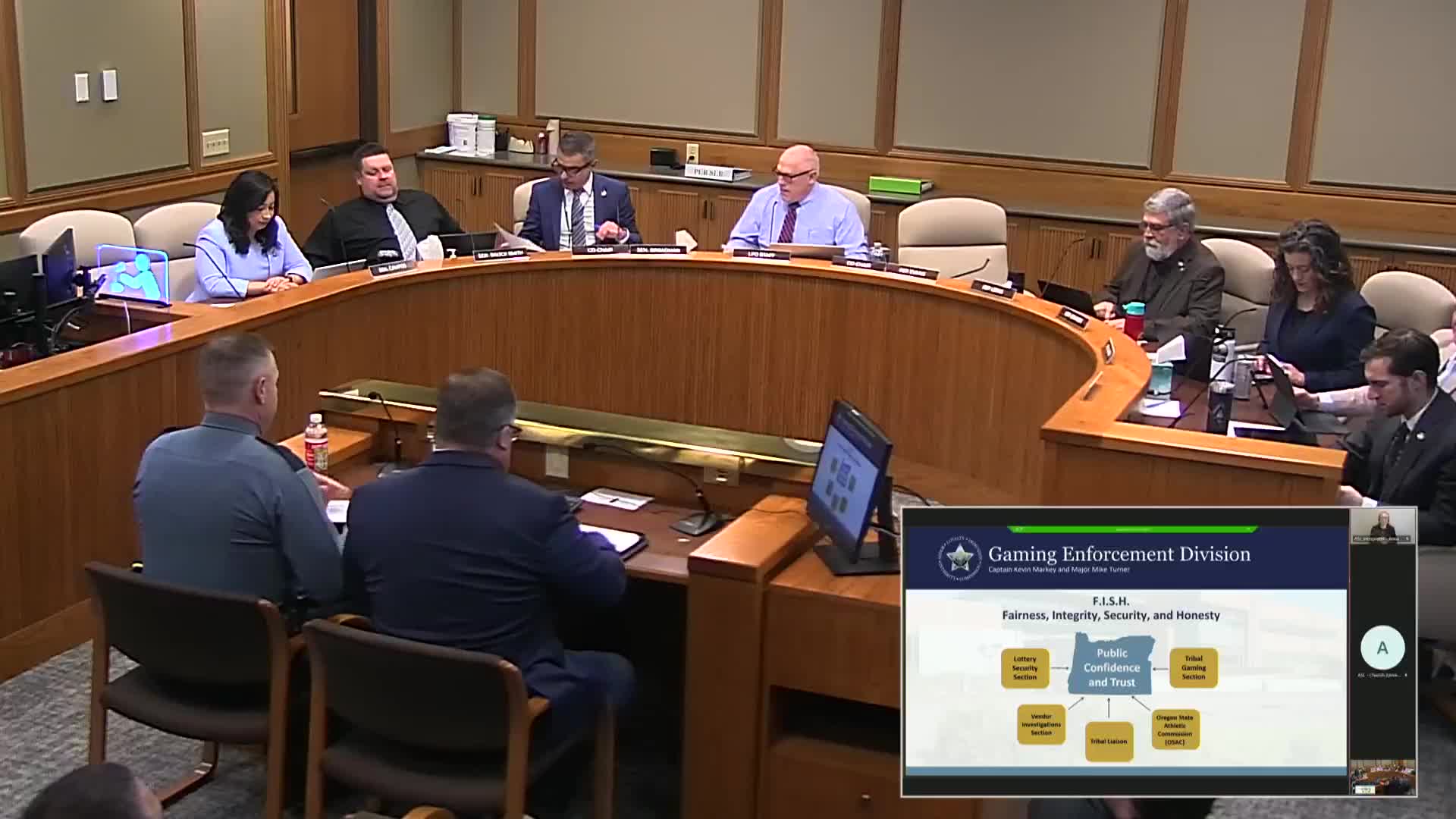
OSP Major Michael Turner opened the agency presentation and said the support services division oversees administrative functions including financial services, human resources, procurement and facilities. Captain Kevin Marquis, who leads the gaming enforcement division, told the committee the division “consists of the lottery security section, the tribal gaming section” and works to ensure “the fairness, integrity, security, and honesty of gaming within the state of Oregon.” Marquis described vendor background investigations, tribal compact compliance work, criminal investigations tied to gaming (forgery, counterfeit bills, money laundering and cheating) and backgrounding of vendor personnel before they do business with class 3 gaming operators.
Why it matters: OSP said those enforcement and background checks are funded through interagency contracts and vendor fees; the division’s workload and fee revenues have varied, prompting questions from legislators about fee levels and competitiveness with other states.
Support services overview: Major Turner described OSP’s human resources, recruiting and training, diversity/equity/inclusion unit, payroll and a health, wellness and resiliency (HWR) unit that provides peer support, contracted counseling and chaplaincy. Turner said the HWR unit offers a peer support team of roughly 60 employees, 10 contracted mental‑health professionals and 12 volunteer chaplains; the agency has offered cardiac screening to staff and uses aggregated results to inform agency wellness programming. “The jobs that we do on the street in the field could not be done without our support services and our professional staff,” Turner said.
Facilities and capital projects: OSP reviewed several construction and property projects tied to its 20‑year facilities plan. Phase 1 of the Central Point area command project was completed and funded by an approved bond authorization of approximately $60,400,000; that facility now houses dispatch and a crime lab and includes a training/EOC space. Turner corrected a slide during the presentation to note the Eugene crime lab project has an $83,000,000 XiQ bonds authorization (the slide had an error listing $3 million). The Springfield area command project received $21,600,000 in XiQ bonds for a new ~17,176‑square‑foot facility with demolition of the old building planned after completion. OSP also requested $3.5 million XiQ bonds for property purchases in Coos Bay and Ontario as part of future projects.
Procurement and finance data: presenters said financial services processed roughly 80,000 final transactions in 2024; procurement reported 669 managed agreements, 2,036 purchase orders and 31 solicitations in the calendar year. OSP noted it leases approximately 45 facilities statewide and manages 19 additional leases for storage and specialized space. Committee members asked about procurement flexibility to prioritize local suppliers for resilience and whether fee schedules for gaming vendor backgrounds were competitive relative to other states; OSP committed to follow up with comparative figures.
Staffing, vacancies and hiring: OSP leadership reiterated a goal to reduce vacancies to improve morale and reduce overtime, acknowledging the agency cannot run with zero vacancies but will pursue lower vacancy rates and targeted over‑hiring in hard‑to‑fill regions. The agency noted recent improved applicant interest for the South Coast.
Questions and follow-up: committee members asked about vendor fee benchmarking, gambling revenue interactions with tribal governments, hardening and security for new facilities, backup power and fuel resiliency, and the relationship between core public safety missions and ancillary duties such as medical examiner or coroner functions.
Next steps: the informational hearing concluded and the committee scheduled further public testimony and a work session on HB 5029 and related OSP items for the next day.