Get Full Government Meeting Transcripts, Videos, & Alerts Forever!
Get email alerts on the State Legislation topic
No spam. Unsubscribe anytime.
Utah Senate advances a package of bills on dental licensing, local fees, public safety and other issues
Summary
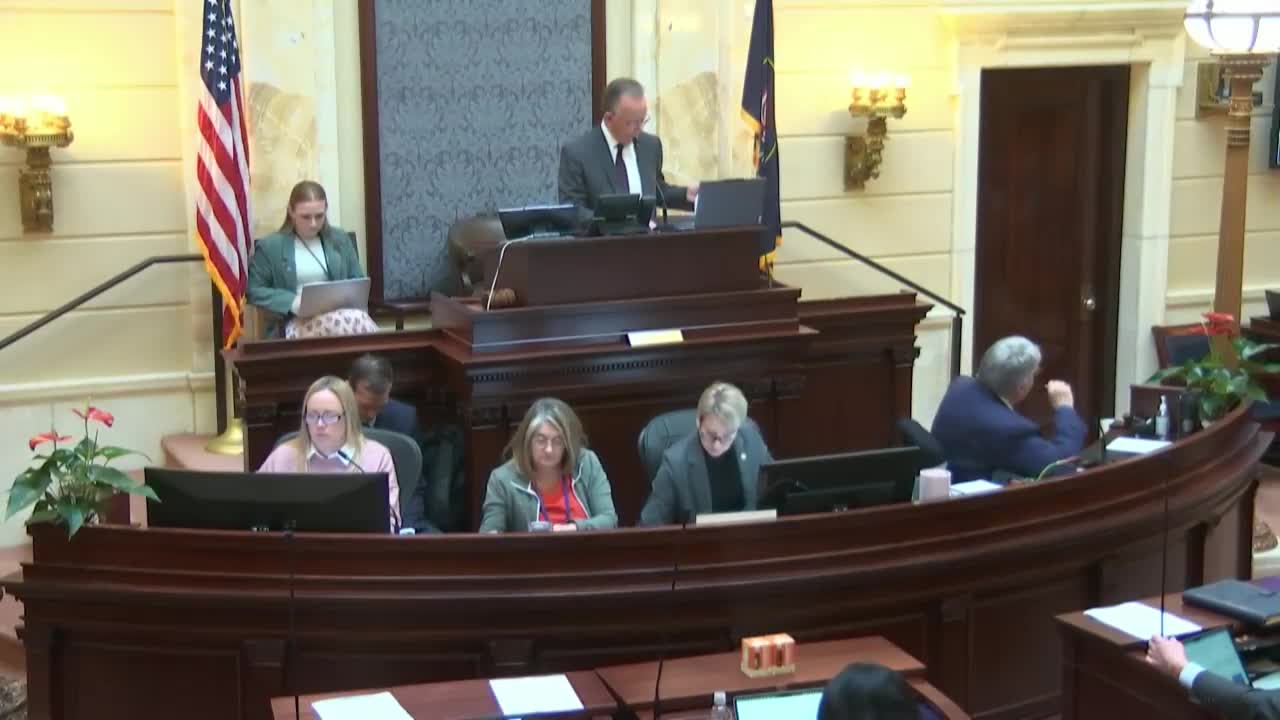
The Utah State Senate on the floor Wednesday passed a series of House bills spanning dental-practice regulation, local government fee limits, criminal-code changes and data-privacy updates. Several bills drew brief debate; votes were taken under suspension of the rules.
The Utah State Senate on Wednesday approved a set of House bills addressing dental-practice rules, local government fee limits, criminal-code changes and updates to state data-privacy and municipal authority.
The action came during a long floor session in which senators moved multiple bills from the concurrence and second-reading calendars and then voted on a series of measures under suspension of the rules. Sponsors described many measures as technical or stakeholder-driven updates; some drew substantive floor discussion before final votes.
Votes at a glance (items recorded on the Senate floor today):
- Third substitute House Bill 372, Dental Practice Amendments — Sponsor: Senator McCall. The Senate voted to pass the bill under suspension of the rules; final announcement on the floor reported “having received 25 yea votes, 2 nay votes, 2 being absent.” The sponsor said the bill “modernize[s] the Dental Malpractice Act,” adds teledentistry language, clarifies scopes of practice for hygienists and expands certain licensed functions.
- Second substitute House Bill 454, Local Government Fees Modifications — Sponsor: Senator Brammer. The bill passed on the floor (the president announced “14 yea votes, passes this body”). Sponsors said the substitute narrowed transportation-utility-fee exemptions and added transparency measures; the floor summary said it prohibits cities from using those fees for broadband or public safety except for limited exceptions and establishes a narrow exemption for property used to carry out religious worship or humanitarian aid.
- Third substitute House Bill 491, Behavioral Health Modifications — Sponsor: Senator Vickers. The floor announced the bill had received 25 yea votes and 0 nay votes with 4 absent. The sponsor said the substituted version corrected duplicate funding and narrowed the fiscal note; the remaining funding will be used to draw additional Medicaid dollars for the Utah State Hospital and the Huntsman Mental Health Institute.
- Fourth substitute House Bill 444, Data Privacy Amendments — Sponsor: Senator Cullimore. The floor announced the bill received 26 yea votes, 0 nay votes, 3 absent. The sponsor said the bill aligns code with last year’s government data-privacy law, moves privacy-notice requirements, and delays a full privacy-program maturity deadline to a requirement to initiate a program by July.
- Third substitute House Bill 256, Municipal and County Zoning Amendments (short-term rentals) — Sponsor: Senator Vickers. The president announced the bill had received “27 yay votes, 1 nay vote, 1 being absent.” The sponsor said the measure allows local governments, when investigating illegal short-term rentals, to use a listing on a short-term-rental website as corroborating evidence (not as sole proof), to request removal of listings that violate local rules, and to require collection of transient-room tax by operators.
- Second substitute House Bill 92, Individual Detention/Use-of-Force (citizen’s arrest clarification) — Sponsor: Senator Wilson. The Senate announced the bill passed with 24 yea votes, 0 nay votes, 5 absent. The sponsor said the bill replaces the label “citizen’s arrest” with “individual detention,” limits the circumstances where a private person may detain someone (must witness the crime and call law enforcement) and addresses use-of-force and transport restrictions.
- Third substitute House Bill 191, High School Credit Amendments — Sponsor: Senator Fillmore. The Senate announced the bill passed with 17 yea votes, 10 nay votes, 2 absent. Sponsors said the measure tasks the state board with standards for credit-recovery or competency packets and sets rules governing when local education agencies may accept such packets for credit recovery rather than as a replacement for a class grade.
- Third substitute House Bill 226 (recorded as House Bill 2 26 on the floor), Criminal Amendments — Sponsor: Senator McKay. Floor announcement: the bill passed with 21 yea votes, 8 nay votes. The sponsor described narrowing the list of qualifying offenses and increasing the maximum penalty for selected Class A misdemeanors from 364 to 365 days; the sponsor said the measure directs local law enforcement to notify federal authorities in certain convictions and argued the change will reduce state incarceration costs related to undocumented offenders.
- First substitute House Bill 379, Population Data Amendments — Sponsor: Senator McKell. The floor announced the bill passed with 23 yea votes, 0 nay votes and a large number listed as absent. Sponsors said the bill defaults certain state population references to Utah’s own population estimates rather than relying on federal counts that can lag.
- Second substitute House Bill 128, Dangerous Weapon at a School Amendments — Sponsor: Senator Musselman. The Senate reported the bill passed with 25 yea votes, 0 nay votes, 4 absent. Sponsors described the change as a recodification and clarification that possession of a dangerous weapon on school property is prohibited, including where a parent’s written permission had previously created an uncertainty.
Why it matters: the bills cover consumer protection and professional licensing (dental), local revenue and fee transparency (transportation utility fees), criminal penalties and immigration-related reporting, data privacy for governmental entities, and public-safety standards for schools and short-term rentals. Several passed measures direct new reporting or rulemaking by state agencies or create one-time appropriations noted by sponsors on the floor.
What’s next: Most passed bills were announced as returned to the House for further consideration or signature; the president said bills that passed would be signed and returned to the House for the speaker’s signature or placed on the concurrence calendar as appropriate.