Get Full Government Meeting Transcripts, Videos, & Alerts Forever!
Get email alerts on the Eelgrass Conservation topic
No spam. Unsubscribe anytime.
Lawmakers hear proposal to form eelgrass task force and study coastal seagrass status
Summary
House Bill 3580 would create a DLCD‑led task force and study to assess eelgrass (Zostera marina) extent, set conservation targets and recommend monitoring and policy changes; testimony emphasized ecological, fisheries and climate benefits and estimated staffing needs and a $400,000 biennial fiscal estimate for DLCD facilitation.
On March 5 the committee took testimony on House Bill 3580, a bipartisan bill to launch a DLCD‑led task force to study eelgrass (eelgrass/ Zostera marina) in Oregon estuaries, assess historical and current extent, recommend conservation targets, identify policy and monitoring gaps, and report back to the legislature in 2027.
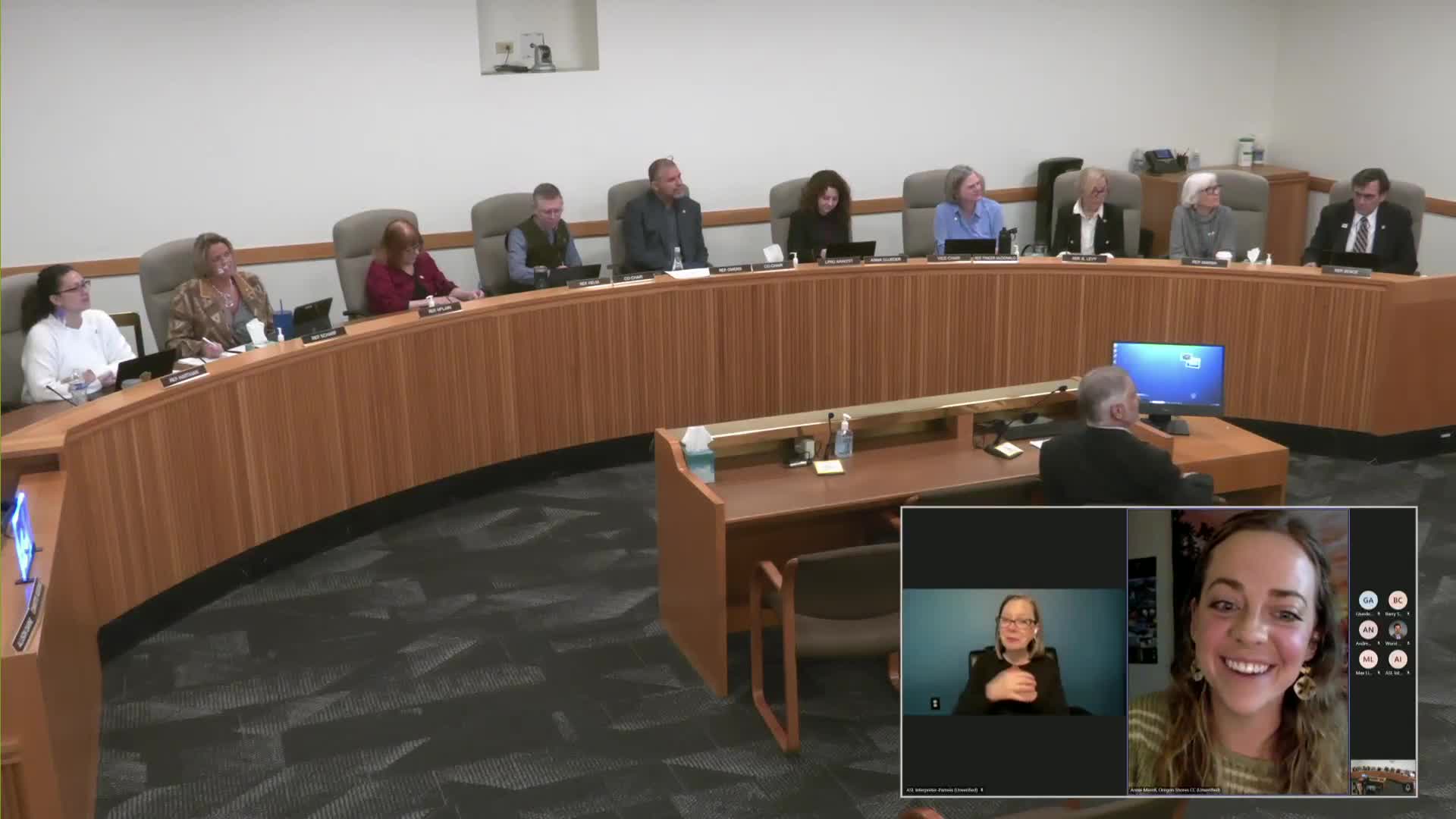
Annie Merrill, marine conservation manager for Oregon Shores Conservation Coalition and co‑chair of the Oregon Ocean Alliance, testified the bill is a first step to address widespread eelgrass declines and to coordinate mapping, monitoring and management across agencies. Merrill said eelgrass forms underwater meadows that provide nursery habitat for commercially and culturally important species (including rockfish, herring, Dungeness crab and salmon), stabilize sediment, filter water and sequester carbon; she noted a Coos Bay study showing a >90% decline in some meadows in a decade.
Merrill said the task force would include agency, technical and tribal representation and that federally recognized tribes are explicitly included and consulted in the bill language. She and other witnesses said the task force is intended to be science‑driven and inclusive of ports, fishermen, conservation groups and tribes.
Committee members asked about DLCD capacity and fiscal needs. Proponents said DLCD would likely need about one full‑time equivalent (a Planner 2) to support the two‑year task force process and estimated an approximate biennial cost of $400,000 to facilitate the task force, including staffing and support for the data assessment. Testimony noted that adding economic analysis would likely increase fiscal needs and require additional technical expertise.
Max (Blake) Pacheco, a Portland resident and bird watcher, and other public commenters emphasized the broader ecological and economic importance of eelgrass to fisheries, coastal tourism and carbon sequestration. The committee received numerous written endorsements, including tribal and fishing community sign‑ons, according to testimony.
No committee vote occurred during the hearing; staff closed public testimony after questions about staffing and potential economic analysis.