Senate committee hears bills to shield prescription drug sales from Oregon corporate activities tax
Loading...
Summary
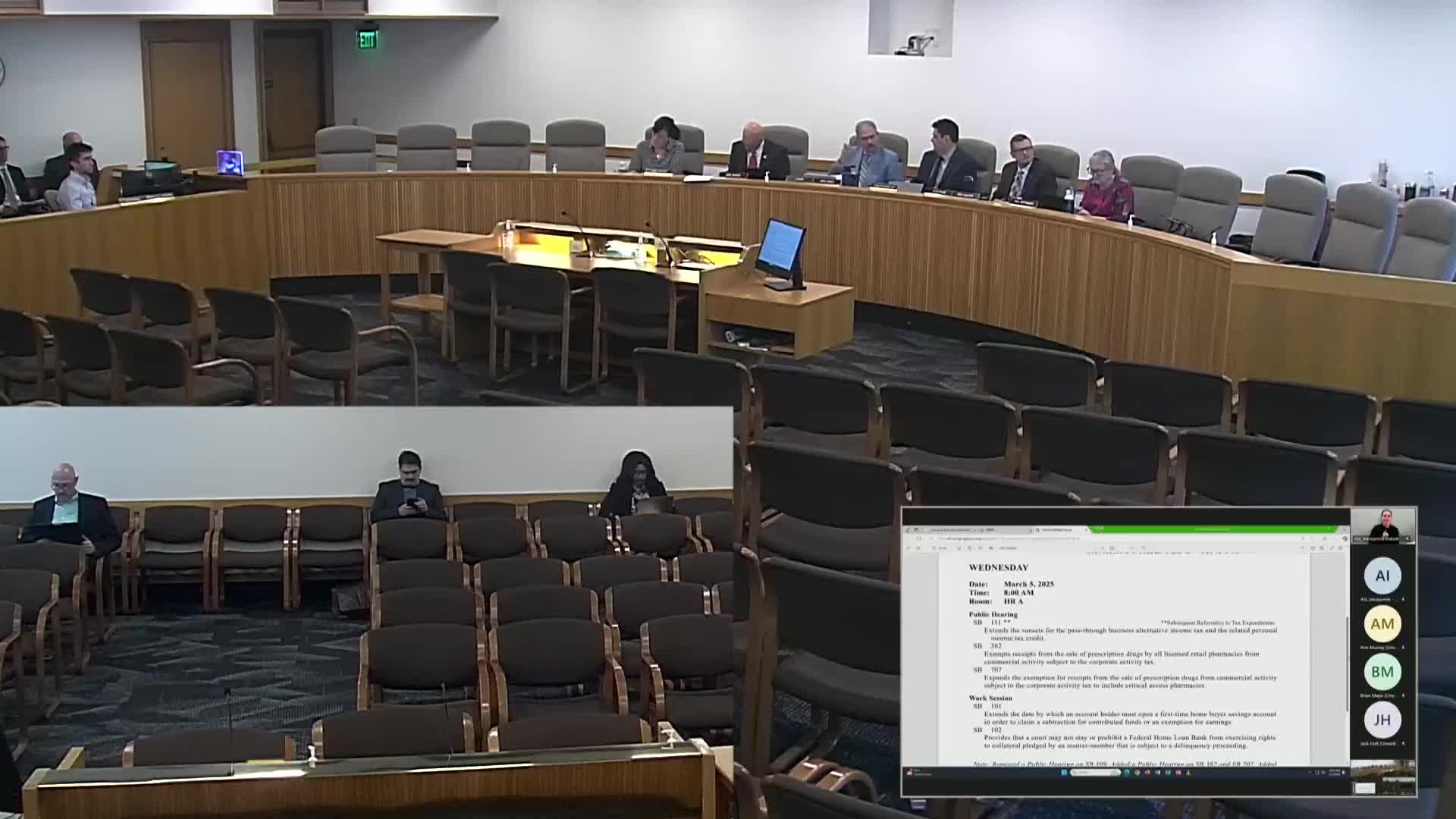
The Senate Committee on Finance and Revenue on March 5 heard testimony on two bills that would exempt or expand exemptions for prescription drug sales from Oregon’s corporate activities tax, as pharmacists warned closures are reducing patient access and education and labor groups warned of budget impacts.
The Senate Committee on Finance and Revenue on March 5 heard competing appeals over two bills that would change how Oregon’s corporate activities tax (CAT) treats prescription drug sales. Sponsors and pharmacy owners testified that expanding or extending exemptions is necessary to keep small and rural pharmacies open; education and labor groups warned any carve-outs would reduce general‑fund resources.
Sen. Suzanne Weber, who represents District 16, framed Senate Bill 382 as a straightforward exemption that would “completely exempt pharmacies’ sale of prescription drugs from the corporate activities tax,” arguing the change would reduce closures and long waits for medicines, especially in rural communities. Sen. Mark Meek, who introduced Senate Bill 707 to expand existing exclusions, said the CAT “is placing a disproportionate financial strain on many pharmacies leading to closures, service reductions, and barriers to care.”
The bills differ in scope: SB 382 would exclude retail pharmacy prescription drug sales from the CAT; SB 707 would expand the current exclusion that applies to pharmacies with nine or fewer locations to include additional critical‑access pharmacies as designated by the Oregon Health Authority (OHA). Committee witnesses described how the OHA determines critical‑access status by several criteria, including distance from other pharmacies, frontier‑county status, high‑poverty census tracts and tribal service designations.
Independent pharmacists and trade groups described near‑term consequences if relief is not extended. Anne Murray, owner of Murray Drug, said her three critical access pharmacies serve a more than 3,000‑square‑mile area and urged passage of SB 707. “Oregonians deserve local access to medication. This is a fundamental necessity for health care,” Murray said. Jack Holt, who operates seven rural pharmacies, told the committee that “passing Senate Bill 707 is crucial to protecting access to pharmacy services for all Oregonians.” Brian Mayo, executive director of the Oregon State Pharmacy Association, highlighted that pharmacies cannot set many of their prices because reimbursements are controlled by pharmacy benefit managers (PBMs), and that wholesalers often pass CAT costs through to pharmacies.
Opponents cautioned about the fiscal tradeoffs. Louis DeSitter of the Oregon Education Association opposed expanding the exemption statewide, saying the original, short‑term carve‑out was intended while PBM reform was developed and that broader, permanent exemptions would remove revenue used for education. Anthony Castaneda of SEIU 503 warned that reductions in general fund revenue require offsetting cuts or transfers and could reduce federal matching funds for programs such as Medicaid. Jody Weiser of Tax Fairness Oregon urged caution about setting a pattern of exemptions and recommended that the Legislative Revenue Office produce cost estimates and that any change be paid for.
Committee members asked technical questions about which sales would be exempt (witnesses and sponsors clarified the proposals target prescription drug sales, not retail items sold at pharmacies) and about how OHA designates critical access pharmacies. No work session or committee vote on either SB 382 or SB 707 was taken; legislative staff told the committee a fiscal analysis would be compiled if a work session is scheduled. Witnesses and members said they expect further informational exchanges on PBM reform and the interaction between CAT exemptions and broader budgetary priorities.
The committee closed the public hearing on SB 382 and SB 707 with no action taken; committee members said they plan follow‑up briefings and potential informational hearings to clarify OHA’s designation process, fiscal impacts and PBM reform status.