Get Full Government Meeting Transcripts, Videos, & Alerts Forever!
Get email alerts on the School Wellness Centers topic
No spam. Unsubscribe anytime.
County staff report progress on high‑school wellness centers; committee discusses access and middle‑school options
Summary
Staff reported on locations and planned funding for comprehensive high‑school wellness centers and ‘‘bridge to wellness’’ spaces. Six high schools already host full centers; committee members pressed agencies on access for uninsured students, Medicaid billing and options for middle‑school coverage.
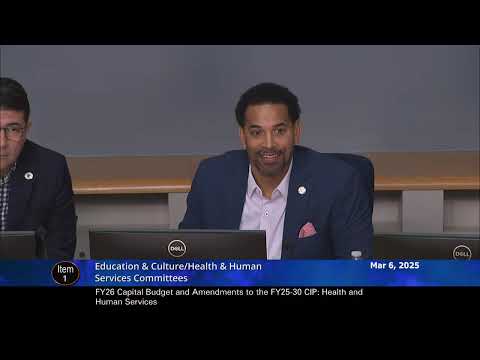
County staff updated the joint Health and Human Services and Education and Culture committees on the status of school‑based wellness centers and planned capital spending for new high‑school wellness facilities.
Council staff said the high‑school wellness centers program provides two facility types: comprehensive wellness centers offering somatic care, mental health, social services and family support; and bridge‑to‑wellness spaces focused on mental health and positive youth development (PYD). The FY25–30 CIP includes funding to expand full wellness centers and to program bridge spaces at schools undergoing major construction.
According to the packet overview, six high schools already have comprehensive wellness centers: Gaithersburg, Kennedy, Northwood, Seneca Valley, Watkins Mill and Wheaton. The approved FY25–30 CIP programs three additional comprehensive centers: Springbrook (standalone, FY26), Paint Branch (beginning FY28) and Woodward (programming beginning FY26 to serve Northwood students during reconstruction). The CIP also programs bridge‑to‑wellness (PYD) spaces for Blake (FY28), McGruder (FY29) and Crown (FY25). Staff noted that priorities for full centers are set according to need and racial equity considerations rather than the timing of school construction.
Mark Hodge, chief operating officer for the Department of Health and Human Services (HHS), described service models to improve access where students lack nearby somatic care or are uninsured. “Opening up the wellness centers and the school‑based health centers … to students from other schools who may need access to care is certainly an option we have,” Hodge said, and he added telehealth and rotating part‑time clinic presence as interim strategies.
Dr. Bridgers of HHS emphasized collaboration with MCPS and equity considerations in siting full centers and bridge programs. “This is an area that we really held close to look at how we can strengthen this area,” she said, noting HHS‑MCPS partnership on mental health and positive youth development programming.
MCPS Capital Budget Manager D.J. Conley said MCPS will continue feasibility work for stand‑alone projects such as Springbrook and that existing wellness centers will be incorporated into reconstruction projects where feasible. Conley told the committee MCPS and HHS will continue to coordinate program design and space planning.
Committee members raised operational questions: how the county will serve uninsured students, how Medicaid billing changes affect clinic operations, and whether bridge‑to‑wellness classrooms could preserve the option to add somatic services later. Members suggested short‑term strategies — rotating clinicians among middle schools, telehealth, and sharing school‑based health center capacity — while longer‑term CIP planning proceeds.
Staff said they will return with additional operational details and urged continued coordination between HHS and MCPS on program design, space reuse and billing strategies.
The report was informational; no formal action was recorded on wellness‑center siting during the session.