Get Full Government Meeting Transcripts, Videos, & Alerts Forever!
Get email alerts on the Attendance And Student Engagement topic
No spam. Unsubscribe anytime.
Montgomery County officials point to extracurriculars, school connectedness to curb chronic absenteeism
Summary
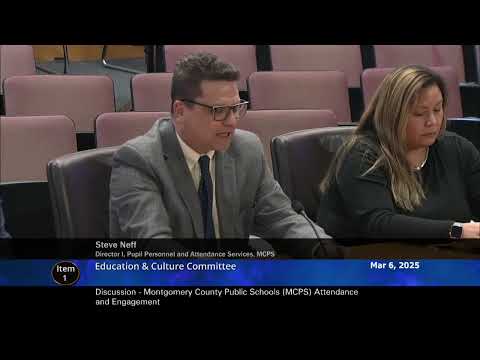
At a Montgomery County Council Education and Culture Committee work session, Montgomery County Public Schools (MCPS) officials presented an update on the district’s attendance action plan and data, saying school connectedness and extracurricular participation are central to reducing chronic absenteeism among students, particularly low‑income students, emergent multilingual learners and students receiving special education services.
At a Montgomery County Council Education and Culture Committee work session, Montgomery County Public Schools (MCPS) officials presented an update on the district’s attendance action plan and data, saying school connectedness and extracurricular participation are central to reducing chronic absenteeism among students, particularly low‑income students, emergent multilingual learners and students receiving special education services.
MCPS officials said the district has used a dashboard and school‑level outreach to drive a recent decline in chronic absenteeism but that progress is uneven: the district reported a roughly 3 percent improvement last year compared with the prior year, but pockets of concern remain, especially recent increases among kindergarten–fifth grade students and narrowing gains for emergent multilingual learners in January and February.
The issue matters because missed days correlate to lost instruction and long‑term achievement gaps, MCPS presenters told the committee. "Chronic absenteeism is 10% or more of the days enrolled being missed," said Steve Neff, Director of Pupil Personnel and Attendance Services, defining the district’s primary metric. Neff also noted the state label of truancy as 20% or more unexcused absences.
MCPS’s approach: connect, measure, intervene MCPS presented multiple, overlapping strategies intended to keep students in school. Damon Monteleone, Associate Superintendent in the Office of Well‑Being Student Services, said the system emphasizes nonpunitive approaches and school connectedness: "If a student is connected to their school community, they are going to come more often," Monteleone said, summarizing the district’s prevention focus. Presenters described three broad pillars: school climate and belonging (restorative practices, trusted adults, advisory time), classroom instruction that is meaningful and relevant, and extracurricular and leadership opportunities.
Extracurriculars and athletics Shella Cherry, Director of Student Leadership and Extracurriculars, described a newly collected roster dataset and a "certificate of student engagement" issued in secondary schools to quantify participation. Cherry explained the certificate tiers: bronze for participation in one activity, silver for two to three and gold for four or more. MCPS data presented by Cherry showed students with higher levels of participation miss fewer days; the correlation held across racial and service groups in the district’s aggregated secondary data.
Jeff Sullivan, Director of Systemwide Athletics, said athletics are treated as a schoolwide vehicle to build connection and accountability. "We want our student athletes to be leaders," Sullivan said, and described a 2019 Board of Education eligibility change that opened athletic participation to all ninth graders as an access measure. Sullivan and other presenters described partnerships with Montgomery County Recreation and community groups to expand low‑cost and intramural access where local private programs create uneven opportunity.
Data and recent shifts MCPS staff showed time‑series snapshots from the district dashboard. Presenters said data pulled on Feb. 28 (the 112th day of school in MCPS’s count) indicated modest year‑over‑year improvement in high school chronic absenteeism (about a two percentage‑point gain compared with the same point last year) but a recent deterioration in kindergarten–fifth grade attendance tied by staff to families’ recent safety and immigration concerns. Presenters also said emergent multilingual learner gains seen in mid‑December narrowed by late January and February, a change they described as worrying because it erased earlier improvements.
Interventions and operational questions MCPS described multi‑tiered outreach: automated attendance notifications and letters, teacher outreach as the first line of contact, then counselor/grade‑team consultation and referrals to school student well‑being teams for collaborative root‑cause work. Neff and others said the district now expects schools to use the dashboard in near real time to identify students or groups at risk and to design tier‑2 group interventions when individual capacity is limited.
Staff acknowledged uneven standardization. Committee members pushed for clearer timelines for teacher outreach and for tracking the effectiveness of interventions. MCPS staff said many schools already run quarterly student voice surveys and that every school has climate goals on its School Improvement Plan tied to state reporting metrics.
Special populations and policy questions Presenters and council members discussed newcomers and students who return from home and hospital teaching (HHT). Damon Monteleone and colleagues said MCPS is pursuing flexible course pathways for older newcomers and is pursuing state advocacy for additional flexibility. Councilmember David Meeks (name as recorded in the transcript) urged a policy change so students returning from HHT are not automatically penalized by athletic academic‑eligibility rules; staff said they would collect more information and raise the request with the Board of Education.
Suspensions, health and other drivers Committee members asked about suspensions and illness. Presenters reminded the committee that suspension days count toward chronic absenteeism and that MCPS has reduced overall suspension counts substantially from earlier years; nevertheless, disproportionality remains an area of work. Council members also pressed MCPS to analyze absences by cause, including consecutive illness days and by students’ home addresses or ZIP codes, to identify clusters that could reflect environmental or housing‑related health issues. MCPS staff said those analyses are possible and worth pursuing but are not yet routine.
Capacity and next steps MCPS officials said teams keep case logs and that schools triage cases because districtwide capacity does not permit intensive individual work for every chronically absent student. Staff said they will continue rolling out the attendance dashboard, refine the School Improvement Plan playbook so extracurricular metrics and attendance actions align with state report card measures, and provide follow‑up information about eligibility policy options for students returning from HHT.
No formal votes or board actions were taken during the session. Committee members asked the superintendent and MCPS staff to return with additional data and to refer the HHT/eligibility question to the Board of Education for potential policy change.