Get Full Government Meeting Transcripts, Videos, & Alerts Forever!
Get email alerts on the Crisis Stabilization Mcot topic
No spam. Unsubscribe anytime.
Committee backs nearly $2.9 million to expand crisis stabilization, mobile crisis outreach in Montgomery County
Summary
The Health and Human Services Committee recommended approval of a state grant supplemental appropriation of about $2.9 million to expand the county’s behavioral health crisis stabilization center, add mobile crisis outreach teams and fund 25 positions to meet licensing and Medicaid reimbursement requirements.
The Montgomery County Health and Human Services Committee recommended approval of a supplemental appropriation of roughly $2.9 million in state grant funds to expand behavioral health crisis stabilization services and mobile crisis outreach teams.
Council staff said the award would increase capacity at the county’s crisis stabilization facility, support licensure under the 2024 Code of Maryland Regulations (COMAR), and expand mobile crisis outreach teams (MCOTs) so the services can seek Maryland Medicaid reimbursement. The appropriation includes funding for 25 new positions and operations to prepare the program for licensure and billing.
County staff told the committee the existing Montgomery County Crisis Center has four residential crisis beds with a 72-hour maximum stay and can coordinate hospitalization as needed. The current crisis stabilization room, which opened in 2023, had admitted 409 individuals, with about 60% identifying as male, 38% as female and 1.5% as transgender. The county reported 1,994 completed MCOT or Mobile Outreach Team comprehensive assessments in fiscal year 2024. The proposed expansion would add a youth-focused space at the Pickard Drive center and create an alternative to incarceration for adults 18 and older charged with minor nonviolent offenses who are experiencing behavioral-health crises.
Council staff and DHHS said the grant-funded positions are term- or contract-funded and that the county is preparing services to be billable to Medicaid. Staff also warned that pending federal budget proposals could reduce Medicaid funding over time; the packet noted a U.S. House budgetary resolution that proposed large Medicaid cuts and that Maryland lawmakers were discussing potential fiscal impacts. County staff nevertheless said DHHS believes the services are sustainable through FY26 and that staff are pursuing other grants, foundation support and hospital partnerships to diversify funding.
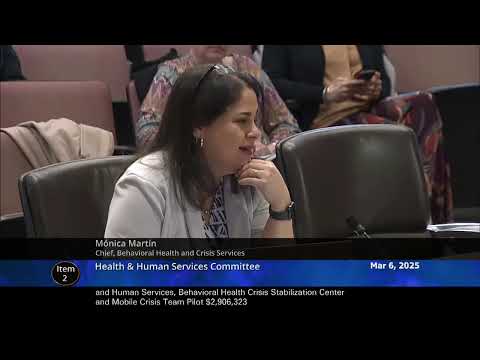
Monica Martin, chief of Behavioral Health and Crisis Services, said the county is prioritizing a youth and family-focused space and diversion from the criminal-justice system. "We're very excited to be looking forward to extending the service to youth specifically and to having a youth and family focused space that's centered on their needs," Martin said. She added that expanding licensable, billable services increases the prospects for sustainability but acknowledged the county is continuing contingency planning.
Councilmember Sales asked what would happen if funding were not available after FY26. Martin responded that because the stabilization unit is a licensable and billable service "the intent... was that they would be sustained through Medicaid fee collections and other fee collections as needed," though she cautioned that the county does not yet know what future Medicaid reimbursement levels will look like.
The committee’s action was a recommendation to support the supplemental appropriation; no formal roll-call vote appears in the transcript. Staff said they will include a forthcoming racial-equity impact assessment in future materials.
Ending: The committee recommended approval for the supplemental appropriation and urged continued contingency planning as the county pursues licensure and Medicaid reimbursement for the expanded crisis services.