Get Full Government Meeting Transcripts, Videos, & Alerts Forever!
Get email alerts on the Infrastructure Funding Workgroup topic
No spam. Unsubscribe anytime.
Council committee narrows scope and membership for proposed infrastructure funding work group
Summary
A Montgomery County Council committee agreed to narrow a draft resolution creating an infrastructure funding work group, limiting its scope to schools, transportation and parks and adjusting membership and reporting requirements before the measure goes to the full council.
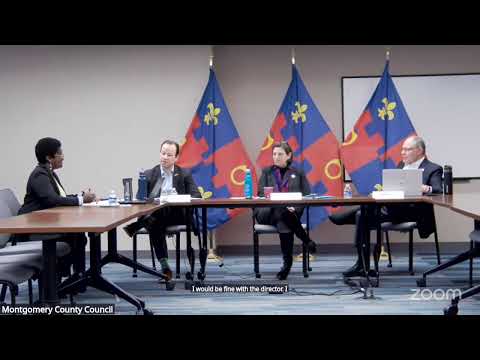
The Montgomery County Council’s GO Committee reviewed a draft resolution to establish an Infrastructure Funding Work Group and recommended narrowing the group’s scope, changing membership, and clarifying reporting and equity requirements before the resolution goes to the full council.
Committee staff presented a redraft that kept two principal objectives: (1) the work group should determine and assess the county’s infrastructure needs and (2) research funding mechanisms. Staff read proposed final language saying the work group will consider “net new infrastructure and upgrading existing infrastructure to levels that meet capacity needs and county policy standards,” and that funding mechanisms should be “equitable, predictable and sustainable,” language the committee signaled it could accept.
The decision to tighten scope came after committee members and public testimony urged limits to keep the group productive. Committee members agreed the work group should concentrate on school, transportation and parks infrastructure tied to growth and development, rather than an open-ended list that included utilities, telecommunications, or all maintenance needs. Members cautioned that an overly broad mandate would make it difficult for the group to produce actionable recommendations within the timeline.
On repairs and maintenance, the committee removed the single word “repairs” from the draft and substituted wording focused on meeting current capacity needs and county policy standards; members said that phrasing allowed the group to address existing shortfalls without implying the work group must solve every maintenance need across the county’s capital program.
The committee also refined the draft’s description of acceptable funding work. The resolution retains explicit direction that the work group must consider new funding mechanisms in addition to reforms to the current impact-tax system, and that any recommended mechanisms should not undermine other county priorities such as housing, climate resiliency and economic development.
Members discussed composition and outreach at length. The introduced draft listed about 14 government representatives from county departments, two MCPS seats and a State Highway Administration (SHA) seat. Committee members recommended trimming agency representation to a more manageable core, removing SHA as a voting member, and adding two external stakeholders: one for‑profit housing developer and one nonprofit housing developer. The committee also recommended reducing multiple seats from agencies (for example, trimming MCPS to a single representative) while preserving subject-matter representation through council analysts and invited testimony.
To preserve outside input without expanding membership, the committee directed that the work group’s outreach plan explicitly include municipalities, SHA, DPS, DHCA and other stakeholders; it also recommended that all feedback received be attached to the work group’s interim and final reports so the full council can review public and stakeholder input.
The draft resolution was revised on requirements related to racial equity and social justice. Committee staff proposed—and members agreed—to require the work group to address a set of equity questions in its interim and final reports and to review the Racial Equity and Social Justice policy guidance referenced in the staff packet as part of its analysis and recommendations.
On leadership and support, committee members favored having council central staff chair or facilitate the work group (with the executive director selecting three council central staff members, including a chair). The committee discussed but did not require an outside facilitator or a separately procured data analyst; staff noted such contracting would add time and cost and that the work group could request outside analysis later if necessary.
Timing for reporting remains the introduced schedule: a progress update roughly mid-process (between December and March) and a final report by June 30, 2026, to allow the council to consider recommendations ahead of the next growth and infrastructure policy cycle. Committee members acknowledged the timetable is aggressive but left the June 30 date in place while noting the group may deliver earlier if ready.
The committee will ask staff to incorporate the agreed revisions into the resolution and bring the amended draft to the full council. No formal final vote on the resolution was recorded during the committee meeting; the changes are recommendations to the full council for consideration.
A copy of the revised draft and a list of stakeholder input will be appended to the work group’s reports as the committee requested.