Get Full Government Meeting Transcripts, Videos, & Alerts Forever!
Get email alerts on the Economic Development topic
No spam. Unsubscribe anytime.
Montgomery County committee reviews incubator network, seeks third‑party operator and more lab space
Summary
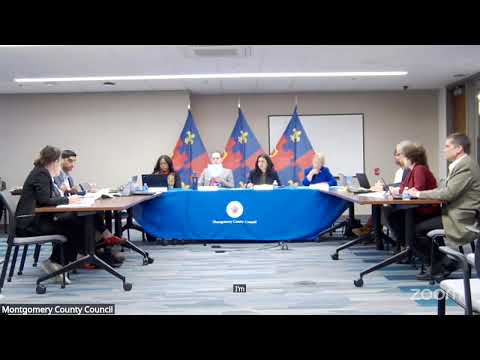
Councilmember Natalie Fanny Gonzales, chair of the Montgomery County Council’s Economic Development Committee, opened a March 6 work session focused on the county’s three publicly run innovation centers and options to strengthen the local incubator network.
Councilmember Natalie Fanny Gonzales, chair of the Montgomery County Council’s Economic Development Committee, opened a March 6 work session focused on the county’s three publicly run innovation centers and options to strengthen the local incubator network.
The session, which included staff from the County Executive’s office, the Montgomery County Business Center, the Office of Legislative Oversight (OLO) and outside consultant Sarah Miller of Marguerite Strategies, revisited recommendations from a year of tours and research and previewed budget requests for FY25 and FY26. Committee members and staff discussed converting more space to shared wet labs, an emerging AI innovation center, formalizing international partnerships and whether to hire a specialized third‑party operator to manage the incubator network.
Why it matters: Montgomery County markets itself as a major life‑sciences and tech hub in the DMV region. Committee members said bolstering the incubator network could help translate federal and university research into local businesses and jobs, provide re‑employment pathways for displaced federal workers and attract international firms.
Staff and consultant overview Ken Hartman, assistant administrative officer for the County Executive’s office, described the incubator system as an “integrated system” of public, private and academic actors that supports entrepreneurs from idea through commercialization. Gene Smith, manager of the Montgomery County Business Center, outlined the county‑operated facilities in Germantown, Rockville and Silver Spring and said roughly $1 million per year supports upkeep of those three facilities under the county’s contracts.
Sarah Miller of Marguerite Strategies and OLO staff reviewed best practices for incubators. Miller summarized four core incubator components: infrastructure (lab, office and flex space), business services (legal/accounting/HR support), financing connections (investors or funds) and people/connectivity (mentoring and networking).
Current capacity and recent activity Staff described recent, incremental expansions and pilots: the county negotiated a sublease for an AI innovation center at 6116 (near the University of Maryland Institute for Health Computing) and reported that three closed offices there were already claimed. Gene Smith said Silver Spring’s occupancy had risen from below 50% toward 75–80% and staff hoped to reach about 90% in 2025; Rockville was reported as roughly fully occupied with a wait list; Germantown still had some lab and office availability.
On capital projects, council staff said the council previously approved $2.4 million in operating support for the four incubator centers and $3.0 million for an incubator capital improvements program (CIP). Committee discussion also noted a prior council approval of $1.4 million to convert 10 offices into four wet labs; staff said that further work would be required to create “shared bench” wet lab benches, which are much more expensive.
Programmatic gaps and proposals Staff and the consultant emphasized repeated requests from local entrepreneurs for more technical assistance, one‑on‑one coaching, marketing support and help connecting with venture or philanthropic capital. Judy Castello, a project manager with the Business Center, noted that day‑to‑day tenant (licensee) management limits staff time for intensive 1:1 advising and that a dedicated third‑party operator could provide more nimble contracting, sales/outreach and specialized program delivery.
“The incubators provide critical supports to our early stage startups and represent an investment in the growth of our local economy,” Ken Hartman said.
Officials described a range of non‑facility supports to pursue: partnering with regional academic programs for free or low‑cost training, developing an international “soft landing” pathway to help overseas firms locate locally (staff said a Daejeon trade office recently opened space in the Rockville Innovation Center), and exploring investor‑linked fund models used in other cities to increase local investment in underrepresented founders.
Metrics, accountability and data limits Committee members pressed staff on how the county measures success. Staff outlined common metrics — jobs supported, capital raised by graduates, patents and commercialization — but also said those outcomes reflect market forces outside the county’s direct control. Staff acknowledged gaps in long‑term follow‑up on graduates and recommended better tracking and reporting, possibly as a deliverable for any future third‑party operator.
“Success is typically viewed as job growth and commercialization of products,” Gene Smith said, noting biotech firms’ long timelines and capital intensity.
What committee members asked for and next steps Members sought more detail in the upcoming budget packet about the price and scope of a potential contract for a third‑party operator; staff indicated such a request will appear in the County Executive’s FY26 budget materials. Council members also requested ownership and demographic data on incubator members, more precise reporting on outcomes for past graduates, and clearer performance targets for any contracted operator.
No formal vote or motion occurred during the work session. Staff noted the Office of Legislative Oversight report and consultant recommendations would inform budget deliberations, and committee members flagged upcoming budget hearings and a related session on grant awards scheduled for the committee’s next meetings.
Taper: Staff said they will return more detailed budget figures and recommended contract language for committee review in advance of the FY26 budget cycle; the committee also indicated it will examine founder‑grant outcomes and data at an upcoming session.