Get Full Government Meeting Transcripts, Videos, & Alerts Forever!
Get email alerts on the Corrections Mat Opioid Response topic
No spam. Unsubscribe anytime.
Montgomery County committee backs $1.3 million state grant to expand jail medication-assisted treatment
Summary
The County Health and Human Services Committee recommended approval of a $1,299,883 supplemental appropriation for the State Opioid Response IV grant to expand medication-assisted treatment (MAT) in correctional facilities, adding staff and operations to meet state-mandated standards amid federal funding uncertainty.
The Montgomery County Health and Human Services Committee recommended approval of a $1,299,883 supplemental appropriation for the State Opioid Response IV (SOAR 4) grant to expand medication-assisted treatment services for people in the county correctional facility.
The appropriation would fund new positions and service delivery to meet Maryland’s 2019 legislative requirement that local correctional facilities conduct mental health and substance-use assessments and provide medication-assisted treatment as indicated. Council staff said the grant will pay for a new therapist, four new community health nurses and one community services aide, and will support screenings, examinations, behavioral-health treatment and reentry plans for offenders diagnosed with opioid-use disorder.
Council staff told the committee that the jail-based MAT program doubled the number of clients served in the most recent full grant year (October 2023–September 2024), to 37 clients. About three-quarters of that caseload were identified as male and roughly half identified as White and 47% as African American. The staff presentation noted the award is a state pass-through of federal funds and flagged the risk that federal funding changes could make future years less certain. Council staff recommended approval and said a public hearing on the supplemental is scheduled for March 11; the Office of Racial Equity and Social Justice impact assessment was not yet available.
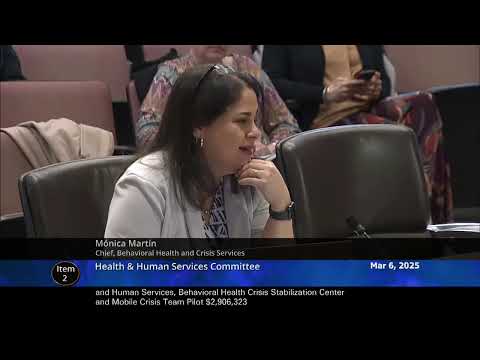
Monica Martin, chief of Behavioral Health and Crisis Services, described the services as required by state law and said staffing in prior grant cycles relied on contractors, creating retention and recruitment problems. "These are mandated services," Martin said. She added that the county had received notice of funding for the first quarter of FY26 but that federal support could be "piecemeal," and that the county would explore additional grants or opioid-abatement funds if the federal pass-through were reduced. Chair Albornoz also warned of the unstable federal funding climate and said the county must "think through creatively what happens at the end of the funding cycle."
The committee’s action was a recommendation to support the supplemental appropriation; no formal roll-call vote was recorded in the transcript. Council staff noted the county previously approved opioid-abatement funding on Feb. 7, 2024, and that contingency planning would continue if federal funding became unavailable.
The committee discussion distinguished between the recommendation before the committee and any final Council action; the transcript records committee support for the staff recommendation but not a final Council appropriation.
Ending: The committee recommended approval to forward the supplemental appropriation to the full Council with a public hearing scheduled; staff said they would include the racial-equity impact assessment and any additional funding contingencies in future packets.