Get Full Government Meeting Transcripts, Videos, & Alerts Forever!
Get email alerts on the Land Use Data Centers topic
No spam. Unsubscribe anytime.
Planning commission rejects technology overlay district for Celebrate Virginia South after heated public hearing
Summary
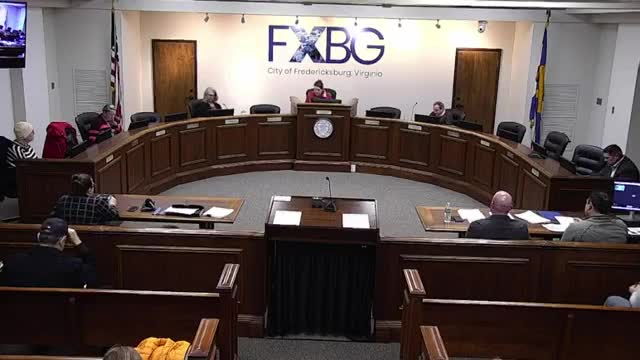
After hours of testimony and staff presentations on fiscal, environmental and infrastructure impacts, the Fredericksburg Planning Commission voted 4-3 on Feb. 12 to recommend that City Council not adopt a proposed technology overlay district that would have allowed by-right data center campuses in Celebrate Virginia South.
The Fredericksburg Planning Commission voted 4-3 on Feb. 12 to recommend that City Council not adopt a proposed technology overlay district (TOD) that would have allowed by-right data center development in the Celebrate Virginia South area.
The commission’s decision followed a multi-hour public hearing in which city staff, consultants, landowners, developers and more than two dozen members of the public debated whether the site should remain planned for mixed-use development or be rezoned to permit large data center campuses by right. Staff presented fiscal, environmental and infrastructure analyses commissioned by the city—summaries of a Magnum Economics fiscal analysis, a JLARC (Joint Legislative Audit and Review Commission) review, and an environmental memo by WSSI—and outlined draft Unified Development Ordinance text intended to regulate visual impacts, noise, setbacks, water cooling and other standards for a TOD.
Economic development staff emphasized the potential tax revenue from data centers but acknowledged trade-offs. “A single 250,000-square-foot data center building represents, on average, about $5,000,000 in annual tax revenue,” Economic Development & Tourism Director Josh Summits told the commission as staff summarized the Magnum Economics findings. Summits also said staff modeled an alternate mixed‑use scenario that would produce roughly $3,100,000 in annual fiscal benefit and about 1,900 new residential units under the current small‑area plan.
Staff and consultants presented environmental and utility findings from the JLARC and WSSI material. The JLARC summary cited by staff reported that diesel backup generators are a source of localized emissions but that, in some regions, generator emissions account for a small share of regional totals. The WSSI memo recommended site‑specific noise studies and noted that data center potable water use is a small share of statewide withdrawals; staff said a 12‑building campus scenario could use several million gallons of potable water annually if potable sources were used rather than reuse systems.
Public testimony opposed the TOD by wide margins at the hearing. Brent Hunsinger of Friends of the Rappahannock said the group “oppose[s] this TOD and prefer[s] a special use permit process,” and called for binding transparency on water use, strong protections for riverfront views and limits on groundwater or direct river withdrawals. Other speakers raised concerns about noise from generators, potential lost tree canopy, long‑term energy demand and the cumulative effects of many data centers in the region.
Landowners and applicants argued the TOD would enable a coordinated, campus‑style development and greater infrastructure efficiency. Karen Cohen, representing a property owner inside the proposed overlay, told the commission her client “is all in” on creating a campus environment and said a single larger campus reduces the need for multiple substations and related overhead transmission. Charlie Payne, representing an applicant and data center proponents, highlighted low trip generation for data centers compared with retail and said larger campuses allow more efficient infrastructure and greater fiscal yield.
Commissioners pressed staff and witnesses on several recurring issues: the length and content of a city water service agreement and whether bridging potable water would be permitted while reuse systems are built; whether generator testing and operation should be exempt from noise limits; and whether the TOD should require a minimum campus size (staff proposed options ranging from none to 150 acres). Commissioners also discussed a possible river crossing and trail connectivity and asked staff to ensure the overlay would not preclude a preferred river crossing alignment being studied by the regional planning body.
After extended discussion the commission considered motions. A first motion to recommend approval failed. Later, after more debate, a motion to recommend that City Council not adopt the TOD package passed 4-3. The commission did not vote on any ordinance language; the defeated proposal would have made data centers a by‑right use under the new TOD regulations and applied that overlay to roughly 253 acres in Celebrate Virginia South.
What the commission voted on: the Planning Commission’s recommendation to City Council is advisory. By voting to recommend denial of the TOD, the commission left intact the city’s existing zoning framework and the option for developers to seek data centers by special use permit in districts where that route is already allowed by the UDO. Planning staff will transmit the commission’s recommendation and the hearing record to City Council for its March meeting cycle.
The hearing included a long list of technical questions members asked staff to follow up on if the item returns for further review: more precise language on water reuse and whether potable groundwater withdrawals or direct river withdrawals would be allowed; a requirement that any on‑site water‑treatment or reuse facility be permitted and coordinated with the city’s Public Works; specification that generators be subject to the same site noise standards as other equipment (not exempted for testing); clarity on noise‑study timing and monitoring (pre‑occupancy plus ongoing compliance checks); and stronger, uniform setbacks from residential uses. Commissioners asked staff to include the preferred river‑crossing alignment the city has discussed as a planning objective to help protect that option from losing right‑of‑way in future site plans.
The public hearing and staff materials also produced a string of technical figures and recommendations that the commission and public emphasized as follow‑up needs: more detail from Dominion Energy and the utility transmission study, explicit water‑use and water‑service terms to be decided in a public City Council approval process, and a clearer fiscal schedule linking the timing of any tax revenue to the timing and costs of required off‑site infrastructure improvements.
The commission’s recommendation returns the central policy question—the tradeoff between large fiscal revenue from possible data center campuses and community and environmental concerns—to City Council, where elected members will decide whether to pursue the overlay, require a special use permit path, or preserve the Comprehensive Plan’s mixed‑use vision for Celebrate Virginia South.